
Sonotrodes are acoustic horns that transmit ultrasonic energy into molten metal for degassing and grain refinement. Discover why ceramic sonotrodes outperform metal probes at extreme temperatures, and how Sialon Ceramics’ in-house engineering drives the NIMA system’s global advantage.
August 8, 2026 · 9 min read
TL;DR
A sonotrode is an acoustic horn that transmits ultrasonic vibrations into molten metal, enabling degassing, grain refinement, and microstructure improvement through cavitation-driven bubble collapse. Traditional titanium and steel sonotrodes fail catastrophically in molten metal at 1,200–1,800°C due to corrosion, thermal shock, and erosion. Sialon ceramic sonotrodes survive these conditions because they’re chemically inert, maintain structural rigidity at extreme temperatures, naturally repel molten metal (enabling clean acoustic transmission), and resist cavitation erosion 10–100× better than metals. Sialon Ceramics develops these ceramic sonotrodes in partnership with Aktive Arc Ultrasonics, specialists in high-power ultrasonic system engineering—a 20-year materials engineering advantage that powers their NIMA ultrasonic generator system and makes them the global leader in large-volume molten metal treatment. Browse the full range of Sialon ceramic products for molten metal at sialon.com/shop.
What Are Ceramic Sonotrodes and How Do They Work?
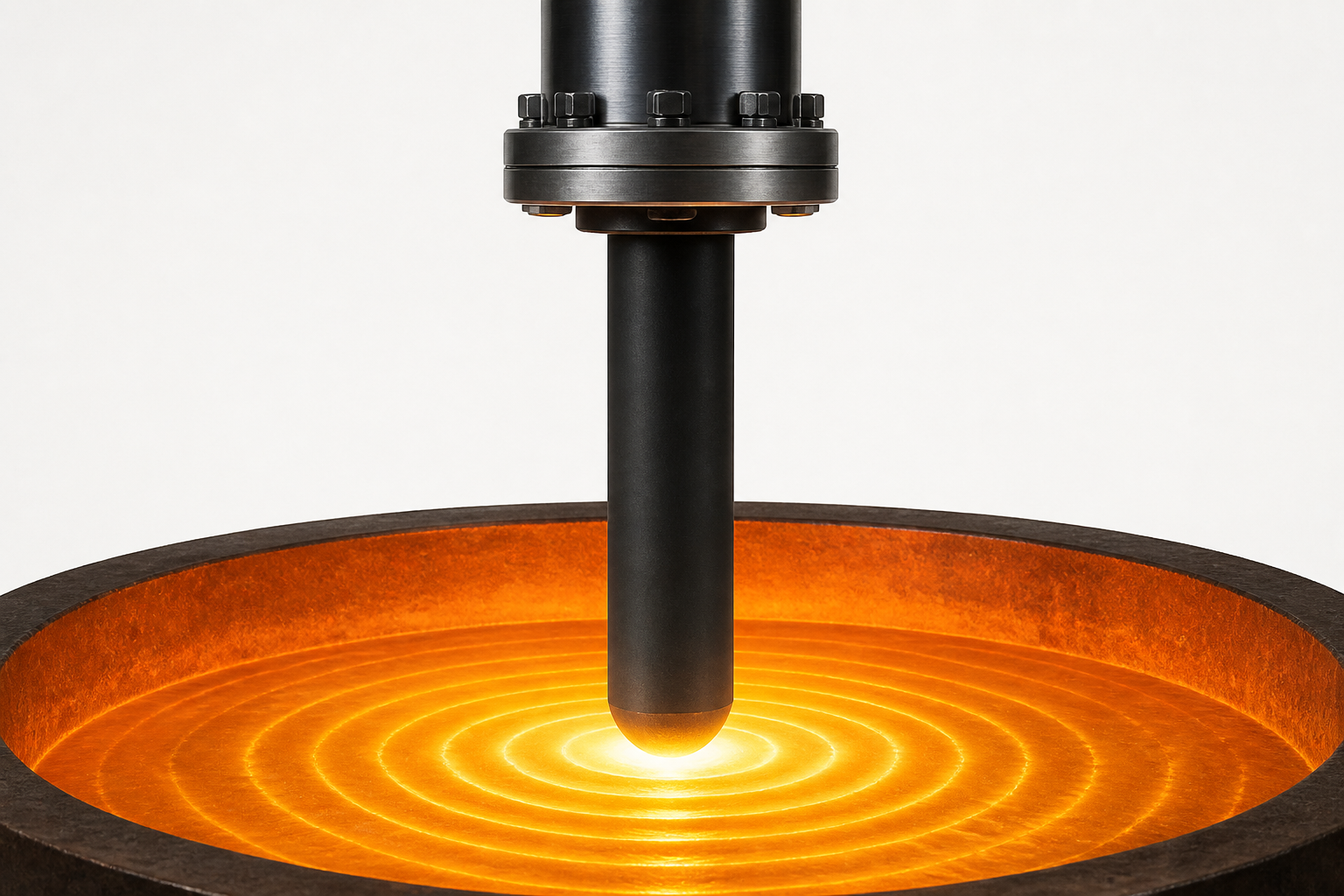
A sonotrode (also called an acoustic horn or probe) is the business end of an ultrasonic transducer system-the part that actually touches and energizes the molten metal. The physics is elegant: an ultrasonic transducer converts electrical power into mechanical vibrations, typically at frequencies between 20–40 kHz. These vibrations travel down the sonotrode horn, which is engineered to resonate at that frequency and amplify the displacement. The horn’s tapered geometry (wider base, narrow tip) concentrates vibrational energy, much like an acoustic megaphone in reverse.
When the sonotrode tip contacts molten metal, the oscillating pressure creates cavitation bubbles-localized regions of near-vacuum that form and collapse billions of times per second. Each bubble collapse generates a shock wave with temperatures exceeding 1,000K and pressures surpassing 400 MPa. This cavitation does the real work: it nucleates grain formation during solidification, coalesces gas bubbles together so they rise out of the melt, and breaks up dendritic structures that weaken castings.
The sonotrode must maintain resonance frequency (acoustic efficiency depends on it) while transferring this energy into the melt with minimal loss. That’s where material engineering becomes critical-and where most sonotrodes fail.
The extreme environment: why molten metal is so hostile
Temperature Cycling in Molten Metal
Aluminum melts at 660°C, steel at 1,600°C, and specialty alloys reach 1,800°C. The sonotrode tip experiences this extreme temperature, while the body remains cooler—creating thermal gradients of 800°C across just centimeters. Each time the system cycles on and off, the material expands and contracts differentially. The coefficient of thermal expansion mismatch causes compressive and tensile stresses that accumulate into micro-cracks and accelerated creep. Accurate temperature monitoring in the melt is critical — Sialon’s thermocouple protection tubes are designed to survive the same extreme environment and keep readings reliable.
Corrosion and Dissolution
Molten metals are chemically aggressive. Aluminum dissolves titanium above 900°C. Iron contamination leaches into the melt from steel horns, degrading alloy properties in critical applications. Both metals form complex oxides at the contact surface that spall away under thermal cycling, exposing fresh material to attack. The sonotrode essentially corrodes from the inside out.
Acoustic Fatigue and Cavitation Erosion
The sonotrode vibrates at cyclic stress amplitudes of 50–150 MPa at 20–40 kHz. Over hours of operation, this repeated cycling initiates fatigue cracks. Meanwhile, cavitation erosion—the mechanical wearing caused by bubble collapse—removes 0.01–0.1 mm/year from metallic surfaces. Fretting wear at the contact interface adds to the damage.
Non-Wetting and Acoustic Loss
Most molten metals don’t “wet” metallic sonotrodes—they form an air gap at the contact surface. This air pocket reduces acoustic transmission efficiency by as much as 60×, turning 62% acoustic transfer efficiency into just 1%. The contact area becomes a hotspot of localized oxidation and preferential erosion.
These stresses don’t occur in sequence—they happen simultaneously and reinforce each other. A crack initiated by thermal stress becomes a corrosion pathway. Erosion from cavitation exposes fresh metal to chemical attack. Temperature cycling reopens micro-cracks. Within 20–50 hours, a titanium sonotrode in molten aluminum is typically consumed.
Why Ceramic Sonotrodes Outperform Conventional Metal Sonotrodes
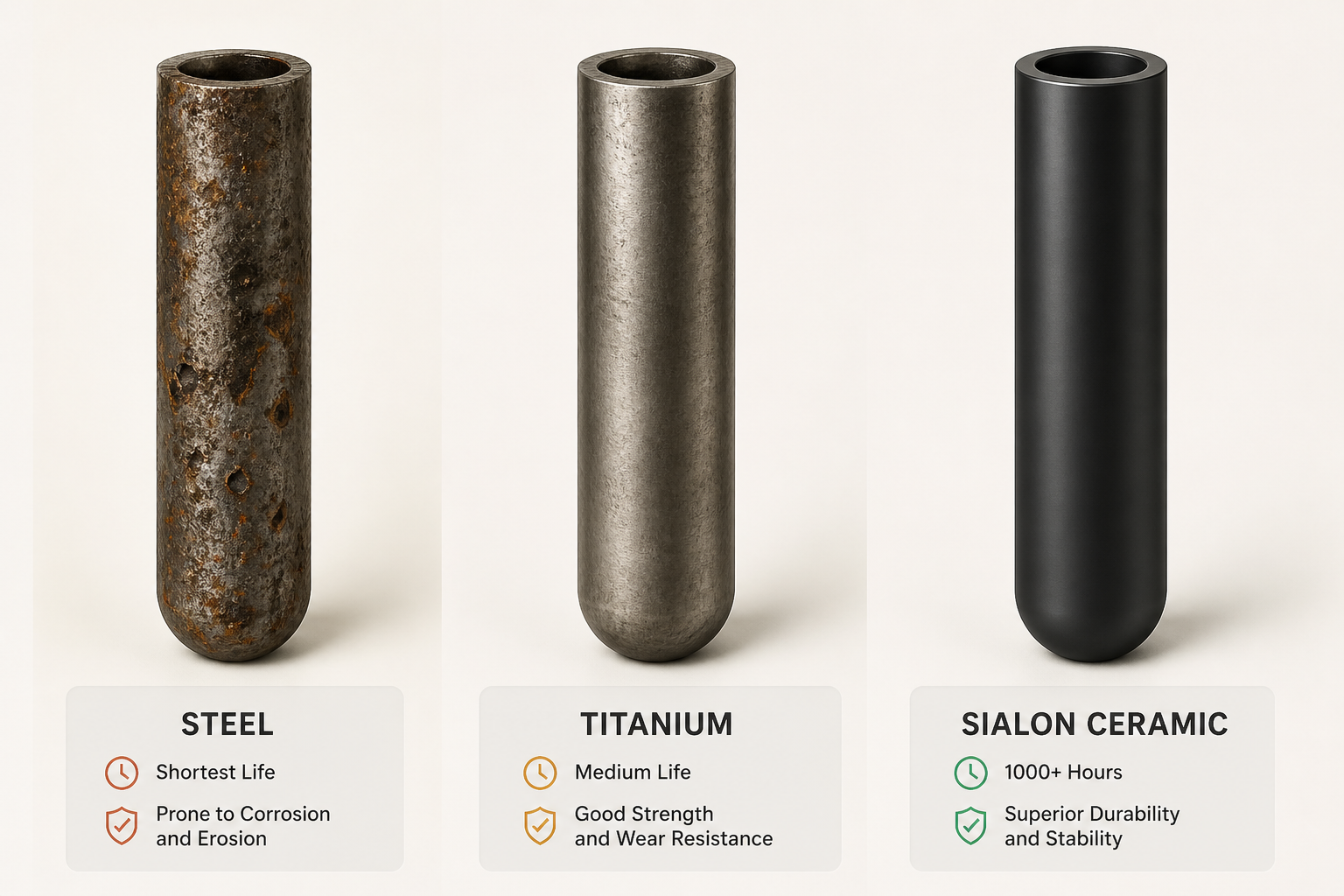
Titanium and steel are strong materials by conventional standards. Titanium has a Young’s modulus of ~103 GPa and steel ~200 GPa-both theoretically good for maintaining resonance frequency and acoustic efficiency. But these properties only tell half the story.
| Failure Mechanism | Titanium | Steel | Ceramic |
|---|---|---|---|
| Corrosion rate | Dissolves above 900°C | 2-5 mm/year | Inert (0 mm/year) |
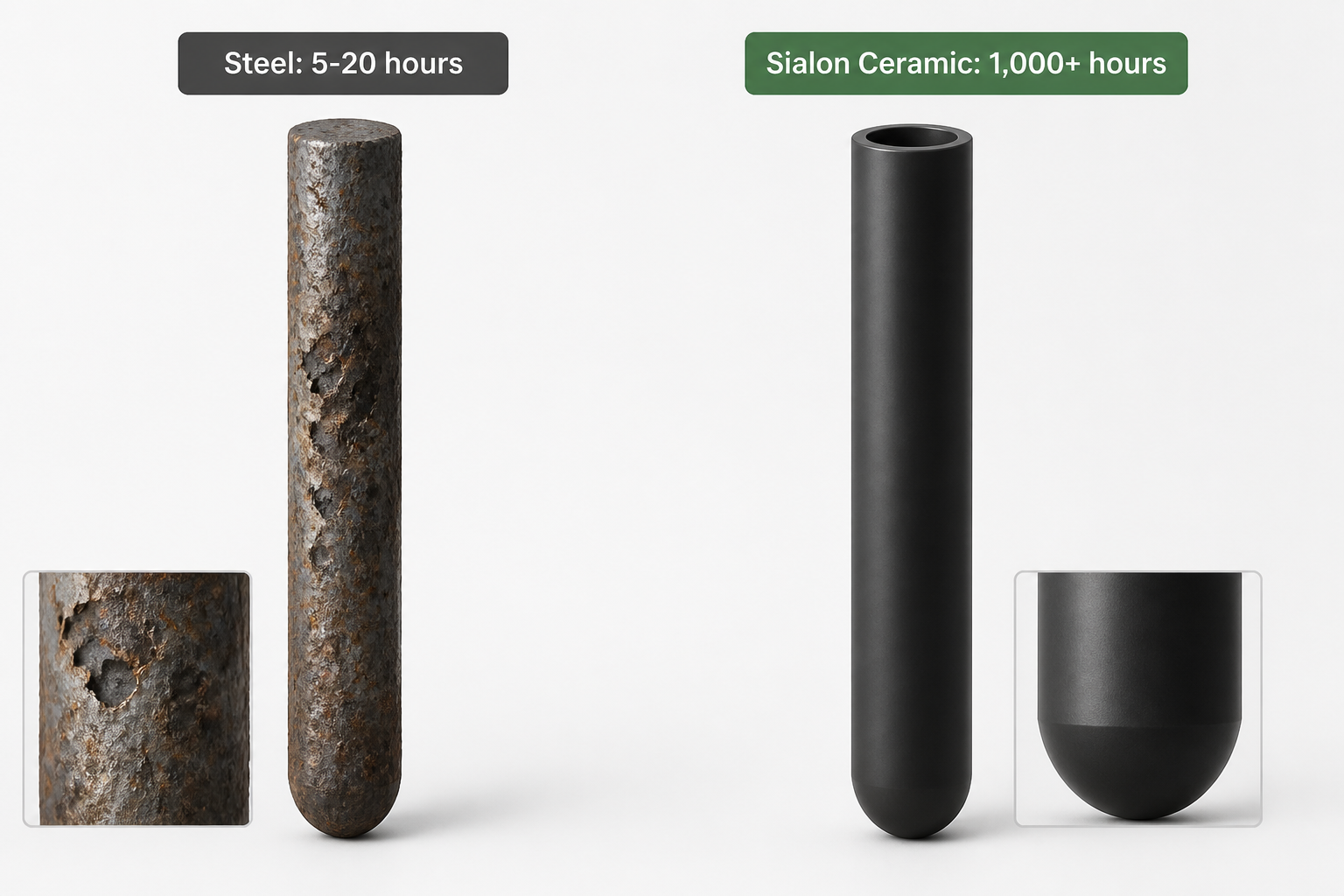
| Service life | 20-50 hours | 5-20 hours | 1,000+ hours |
| Contamination risk | Ti intermetallics | Fe contamination | None |
| Frequency drift | Yes (modulus drops) | Yes | No |
| Cost per hour | ~$10-25/hr | ~$25-100/hr | ~$0.05-0.10/hr |
Why Metal Sonotrodes Fail in Molten Metal
Titanium forms a protective TiO₂ oxide layer that initially delays corrosion. However, this oxide is thermally unstable and can spall under repeated heating and cooling, exposing bare titanium to the melt. Above 900°C, titanium begins dissolving directly into molten aluminum and steel, forming titanium-rich intermetallic compounds that can contaminate the alloy. In regulated automotive and aerospace applications, this type of contamination can be unacceptable.
Steel Sonotrode Corrosion and Contamination
Steel faces an even greater challenge. Iron contamination can be particularly damaging in aluminum alloys because it can increase hardness while reducing ductility and contributing to casting defects. Steel sonotrodes can corrode at 2–5 mm per year in molten aluminum, resulting in a service life of just 5–20 hours. The economics are significant: a steel horn might cost $500 to replace, but if it lasts only 10 hours, the replacement cost alone is $50 per operating hour.
For a continuous casting line operating 24/7, these recurring replacement costs can become a significant factor in overall system profitability. The same corrosion concerns apply to other components that come into contact with the melt — which is why Sialon’s aluminium immersion heaters and Sialon heater tubes use inert ceramic chemistry.
Acoustic Fatigue in Metal Sonotrodes
Both titanium and steel also suffer from acoustic fatigue at elevated temperatures. Their elastic modulus decreases above 600°C, which can cause the resonance frequency to drift. When the horn no longer oscillates at its designed frequency, acoustic power transfer can decline.
What appears to be a strong material under conventional conditions can therefore become a significant limitation when exposed to the combined thermal, chemical, and acoustic stresses of molten metal processing.
Why Sialon Ceramic Sonotrodes Perform Better
Why Ceramic Sonotrodes Perform Better
Ceramic sonotrodes—particularly advanced Sialon ceramics—survive these conditions because they operate on fundamentally different principles.
Chemical Inertness of Ceramic Sonotrodes
Ceramics don’t dissolve or form reactive compounds with molten metals. Aluminum oxide (Al₂O₃) is thermodynamically stable in molten aluminum—there’s simply no driving force for a chemical reaction. Molten steel has no appetite to corrode a ceramic probe. This single property eliminates the largest failure mechanism for metallic horns. After 1,000+ operating hours, a ceramic sonotrode shows surface wear but no contamination and no material loss to the melt.
Natural Non-Wetting
Molten metals naturally repel ceramic surfaces. This is a property, not a liability. The non-wetting contact actually maintains acoustic transmission efficiency because it prevents the formation of a thermally unstable, oxidizing air gap. The contact stays clean and efficient. This means acoustic power transfer remains at 60%+ rather than degrading to 1%.
Thermal Stability of Sialon Ceramics
Ceramics maintain—and often increase—their Young’s modulus at high temperature. A Sialon ceramic might have a modulus of 280–320 GPa at room temperature and hold or improve that at 1,000°C. The resonance frequency stays locked. The acoustic efficiency doesn’t drift.
Thermal Shock Resistance
Advanced ceramic compositions, particularly Sialon with specific grain structures and additives, are engineered to tolerate rapid temperature cycling. Where a metallic horn accumulates micro-cracks, a carefully designed ceramic can cycle thousands of times with minimal crack propagation.
The brittleness that concerns people about ceramics in general becomes an advantage here—the material doesn’t plastically deform and accumulate residual stress; cracks either grow to critical size and fracture cleanly, or they stabilize and stop.
Cavitation Erosion Resistance
Ceramic hardness, with Vickers hardness of 1,200–1,600 for advanced Sialons, resists the mechanical pounding of cavitation erosion. Field data shows erosion rates of 0.001–0.01 mm/year from ceramic sonotrodes—10–100× lower than metallic counterparts.
The Trade-Off: Ceramic Brittleness
The trade-off is brittleness: ceramics don’t tolerate impact loading or sudden thermal quenching the way metals do. But inside a molten metal degassing system—where the sonotrode is suspended, temperature-controlled, and never suddenly submerged in cold water—this brittleness is a non-issue.
The Engineering Behind Advanced Ceramic Sonotrodes
It would be easy to assume that “just use a ceramic” solves the problem. In practice, ceramic sonotrode development is a specialized engineering discipline. Not all ceramics are Engineering Ceramic Sonotrodes for Precision
It would be easy to assume that “just use a ceramic” solves the problem. In practice, ceramic sonotrode development is a specialized engineering discipline. Not all ceramics are equal.
A ceramic sonotrode must be precision-engineered: the horn geometry must be calculated so that the ceramic’s modulus produces resonance at exactly 20–40 kHz. Too soft and it won’t resonate efficiently. Too hard and it becomes brittle to an unacceptable degree. The grain structure and additives must be tuned to maximize thermal shock resistance without sacrificing acoustic impedance. Machining tolerances must be held to ±0.1 mm to maintain resonance and acoustic efficiency. Post-machining thermal treatment must relieve residual stresses without degrading the microstructure.
From Ceramic Material to Ultrasonic Sonotrode
Standard ceramic suppliers don’t make ultrasonic sonotrodes—they make bearings, tiles, and industrial liners. Getting from bulk ceramic material to a precision-engineered acoustic horn requires custom composition, custom processing, and custom finishing. It’s the kind of work that requires 20 years of materials science experience.
Sialon Ceramics has invested precisely that. They develop their ceramic sonotrodes in-house, controlling every step from material formulation through final precision finishing.
Advantages of In-House Ceramic Sonotrode Development
This in-house approach allows Sialon Ceramics to:
- Tailor the ceramic composition for specific molten metal environments, including aluminum, steel, and glass.
- Optimize the horn geometry for the frequency and power output of their NIMA generators.
- Achieve the acoustic impedance needed to maintain transmission efficiency without sacrificing thermal shock resistance.
- Deliver precision and consistency that OEM ceramic suppliers may not offer.
The same depth of in-house ceramic engineering extends across Sialon’s product range — from degassing rotor shafts and riser tubes for low-pressure die casting to Westofen dosing tubes for automated casting lines. Every product is designed for the same demanding environment as the sonotrode.
How Ceramic Sonotrodes Support the NIMA Advantage
This in-house capability is what makes the NIMA system globally competitive. Competitors using off-the-shelf ceramic or metal horns face fundamental performance ceilings. Sialon’s approach—a complete system where the generator, sonotrode, and ceramic material are engineered as a unified whole—delivers performance that standalone sonotrodes simply can’t match.
How in-house sonotrode development powers the NIMA advantage
The NIMA (Next-generation Industrial) ultrasonic generator is built around Sialon Ceramics’ proprietary “no standing waves” architecture, developed in collaboration with Aktive Arc Ultrasonics as the system integration partner. This refers to the software control system that prevents acoustic resonance patterns from building up in the molten metal-patterns that would reduce effectiveness and create hotspots.
But the NIMA system’s real power comes from coupling this generator design with ceramic sonotrodes engineered specifically for NIMA’s frequency and power characteristics. The sonotrode isn’t bolted on afterward; it’s integrated into the system design. The result:
- Large-volume melt treatment: NIMA systems can treat volumes that competitors’ systems simply can’t handle efficiently. Competitors hit an effectiveness ceiling with standing waves; NIMA’s architecture and matching ceramic sonotrodes overcome it.
- Proven industrial deployment: NIMA systems have been deployed on vertical Wagstaff DC casters and continuous casting lines from Bruno Presezzi-the kind of mission-critical equipment where downtime costs thousands per hour. The proven reliability of Sialon’s ceramic sonotrodes enables these deployments.
- Energy efficiency benefits: In glass refining, NIMA’s combination of ultrasonic architecture and acoustic transmission efficiency reduces processing temperature by up to 170°C, saving 20% of energy costs in an energy-intensive process.
This is why the system works where others don’t: it’s the result of two decades of materials engineering focused on one problem.
The global context: why Sialon Ceramics is unique
Large-scale molten metal and glass treatment is a global industry-aluminum foundries, steel mills, and glass manufacturers on every continent. Yet the capability to develop, manufacture, and deploy ultrasonic systems with custom-engineered ceramic sonotrodes is concentrated in only a handful of companies globally. Sialon Ceramics holds a unique position:
- They develop ceramic sonotrodes in-house, not sourcing them from standard suppliers
- They’ve integrated this capability into a complete ultrasonic system (NIMA) optimized for large-volume melt treatment
- They’ve deployed these systems at scale in mission-critical continuous-casting operations
- They hold 20 years of proprietary materials science in ultrasonic sonotrode design
This combination is rare. Most ultrasonic equipment manufacturers license or source their sonotrodes externally. Sialon’s vertical integration-from materials science through system architecture to on-site support-is a structural competitive advantage.
For procurement managers evaluating ultrasonic melt treatment systems, this matters. When you buy a NIMA system, you’re not buying off-the-shelf components bolted into a generator. You’re buying the result of two decades of focused engineering on a single problem: how to treat large volumes of molten metal reliably and efficiently. The ceramic sonotrode is the visible proof of that investment. If you’re also sourcing other ceramic components for your foundry — ladles, thermocouple tubes, crucibles, or heater tubes — Sialon’s full shop covers every contact point in the melt.
Conclusion
A sonotrode is a precision instrument that enables degassing, grain refinement, and metallurgical transformation through ultrasonic cavitation. Conventional metal sonotrodes fail in molten metal at 1,200–1,800°C because corrosion, thermal cycling, and erosion overwhelm their material properties within hours.
Sialon ceramic sonotrodes overcome this by virtue of their chemistry: they’re inert, they maintain structural properties at extreme temperature, they naturally work with molten metal rather than against it, and they endure cavitation erosion far better than metals can. But ceramic sonotrodes only reach their full potential when they’re engineered for a specific system-matched to the generator’s frequency and power characteristics, designed for the specific molten metals being treated, and manufactured with the precision that acoustic efficiency demands.
That’s the engineering work Sialon Ceramics has invested 20 years into. It’s the reason NIMA systems can treat large volumes where competitors hit ceilings, and why their customer list includes the world’s most demanding continuous-casting operations.
If you’re evaluating ultrasonic melt treatment for aluminum, steel, or glass, the sonotrode material isn’t just a component choice-it’s the most consequential decision in the system’s long-term performance and cost. Choosing ceramic isn’t just about surviving the heat. It’s about choosing a material designed from the ground up for your application, engineered by a team that’s spent two decades perfecting the craft.
Try Sialon Ceramics for ultrasonic degassing and grain refinement
Sialon Ceramics specializes in NIMA ultrasonic generators paired with proprietary ceramic sonotrodes engineered for large-volume molten metal and glass treatment. Unlike systems with off-the-shelf sonotrodes, Sialon’s in-house materials engineering ensures acoustic efficiency, thermal stability, and decades-long service life-even in continuous-casting environments reaching 1,800°C. For foundries and glass manufacturers looking for proven performance at industrial scale, NIMA systems deliver the engineering advantage that two decades of sonotrode development makes possible.
Explore the full range of Sialon ceramic products for your foundry:
- Degassing rotor shafts — for rotary degassing alongside or preceding ultrasonic treatment
- Aluminium immersion heaters & heater tubes — melt maintenance with ceramic-grade durability
- Thermocouple protection tubes — accurate temperature readings in aggressive melts
- Riser tubes & Westofen dosing tubes — low-pressure and automated casting lines
- XICRU SiC foundry crucibles & induction furnace crucibles — holding and melting with zero contamination
- Sialon ladles — transfer and handling in molten metal environments
Frequently Asked Questions
What is a sonotrode and what does it do?
A sonotrode (or acoustic horn) is the probe that transmits ultrasonic vibrations into molten metal. It works by converting electrical power from a transducer into mechanical vibrations at 20–40 kHz, which create cavitation bubbles in the melt. The collapse of these bubbles generates shock waves that enable degassing (hydrogen removal), grain refinement, and microstructure improvement in aluminum, steel, and glass at industrial scale.
Why do titanium and steel sonotrodes fail in molten metal?
Titanium dissolves into molten aluminum and steel above 900°C, contaminating the alloy and degrading properties. Steel corrodes at 2–5 mm/year, giving it a service life of just 5–20 hours. Both metals suffer thermal cycling cracks, acoustic fatigue, and cavitation erosion (0.01–0.1 mm/year). The combination of corrosion, thermal shock, and erosion leaves a metal sonotrode with a lifespan measured in hours, not thousands of operating hours.
What makes ceramic sonotrodes superior at extreme temperatures?
Ceramics like Sialon are chemically inert (they don’t dissolve or form reactive compounds with molten metals), thermally stable (they maintain structural rigidity up to 1,800°C), and naturally non-wetting (molten metals repel ceramic surfaces, enabling efficient acoustic transmission). They also resist cavitation erosion 10–100× better than metals due to their hardness. These properties allow ceramic sonotrodes to survive 1,000+ operating hours versus 20–50 hours for metal equivalents.
Why does Sialon Ceramics develop sonotrodes in-house rather than sourcing them?
Ceramic sonotrodes must be precision-engineered for specific generator frequencies, power levels, and molten metal applications. The horn geometry, grain structure, thermal treatment, and finishing tolerances (±0.1 mm) must all be optimized for acoustic resonance and efficiency. Sialon’s 20-year investment in materials science allows them to tailor ceramics for their NIMA system’s architecture and performance requirements-something off-the-shelf ceramic suppliers simply cannot offer.
How does the NIMA system’s sonotrode engineering create a competitive advantage?
Sialon’s NIMA system couples proprietary ‘no standing waves’ generator architecture with custom-engineered ceramic sonotrodes designed to work together as a unified whole. This integration enables large-volume melt treatment that competitors cannot match efficiently, proven reliability in continuous-casting operations, and energy savings of 20% in glass refining. The competitive advantage comes from two decades of focused engineering-the sonotrode is proof of that investment.