
Discover how Sialon Ceramics’ NIMA generators overcome standing wave problems in conventional ultrasonic systems, enabling uniform treatment of large-volume molten metal melts at industrial scale.
August 8, 2026 · 21 min read
TL;DR
Conventional ultrasonic generators operating at 20–40 kHz rely on fixed frequencies that create standing wave patterns in large molten metal volumes, leaving dead zones where cavitation fails. Sialon Ceramics’ NIMA generators, developed in partnership with Aktive Arc Ultrasonics, specialists in high-power ultrasonic system engineering, solve this through two decades of proprietary software development: a multi-frequency, adaptive “no-standing-waves” architecture that eliminates dead zones and maintains uniform cavitation across the entire melt. Paired with Sialon’s engineered ceramic sonotrodes-which resist thermal shock, prevent metal wetting, and maintain structural integrity at 1,800°C-the NIMA system is the only platform proven to treat large melt volumes (400 kg+) of aluminium, magnesium, glass, and ferrous alloys at industrial scale. The result: 20% faster hydrogen removal, 6-fold oxide inclusion reduction, 81% lower dross, and measurably stronger, more ductile final components.
Introduction: the standing wave problem
When a metallurgist first encounters ultrasonic degassing or grain refinement, the appeal is immediate: cavitation bubbles strip dissolved gases from molten metal far faster than traditional methods-in 3 minutes instead of 10. But the reality of scaling that technology to production foundries has, for decades, been constrained by a physics problem that most equipment suppliers quietly ignore: standing waves.
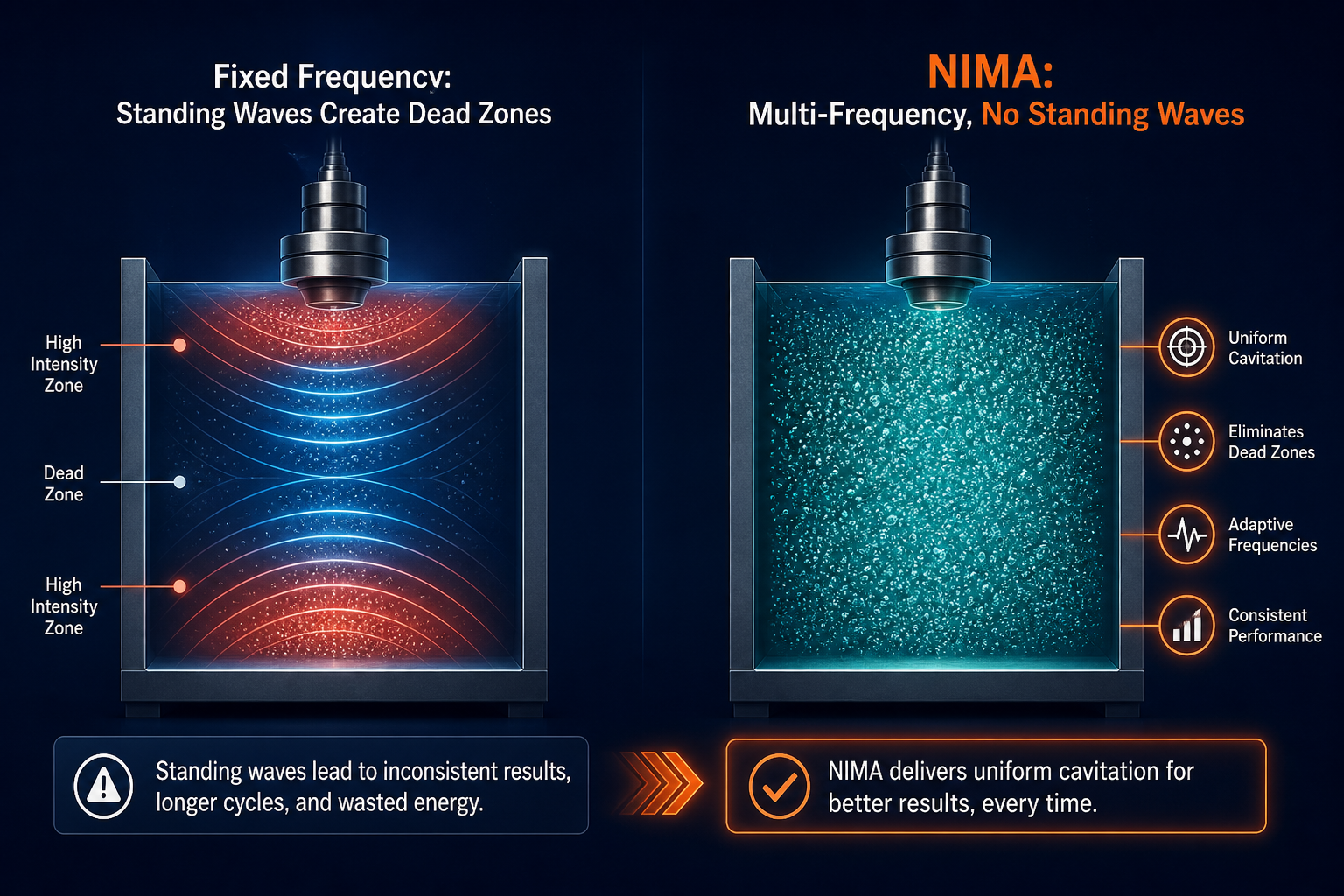
Any acoustic wave in a confined space-a casting ladle, a degassing vessel, a molten metal bath-bounces off the boundaries and interferes with the incident wave. When frequency and vessel geometry align, standing wave nodes form: regions of near-zero acoustic intensity where cavitation simply doesn’t initiate, no matter how much power you apply. For fixed-frequency systems operating at conventional industrial frequencies (typically 20–40 kHz), a 200 kg or 400 kg melt becomes a patchwork of active zones and dead zones. The dead zones don’t degas, don’t refine grain, don’t distribute alloy elements. Operators compensate by running longer cycles, accepting incomplete treatment, or accepting that the technique won’t scale cleanly to their melt sizes.
The NIMA generators from Sialon Ceramics, engineered with Aktive Arc Ultrasonics’ expertise in ultrasonic system design, eliminate this constraint through proprietary multi-frequency architecture developed over 20 years. No standing waves means no dead zones-the entire melt volume, from edge to edge, undergoes uniform cavitation. Coupled with Sialon’s engineered ceramic sonotrodes, which can withstand the extreme temperatures and pressures of industrial molten metal treatment, the result is the only system proven to treat large-scale melts (up to 400 kg and beyond) at production-grade speeds without compromise. This matters not just for throughput, but for quality: uniform cavitation means uniform degassing, refined grain, and predictable mechanical properties downstream.
Let’s walk through how conventional systems work, why they falter at scale, and how NIMA’s architecture closes that gap.
How NIMA Ultrasonic Generators Work: The Fundamentals
An ultrasonic generator is, at its core, a transducer: it converts electrical energy into high-frequency mechanical vibration. In molten metal applications, that vibration is transmitted to a sonotrode-a ceramic or metallic horn-that couples directly to the melt. The sonotrode oscillates at ultrasonic frequencies (typically 17–40 kHz in metalcasting, chosen because cavitation initiation is reliable in this band and cavitation bubble size is optimal for gas diffusion and inclusion flotation).
Cavitation: the engine of degassing and grain refinement
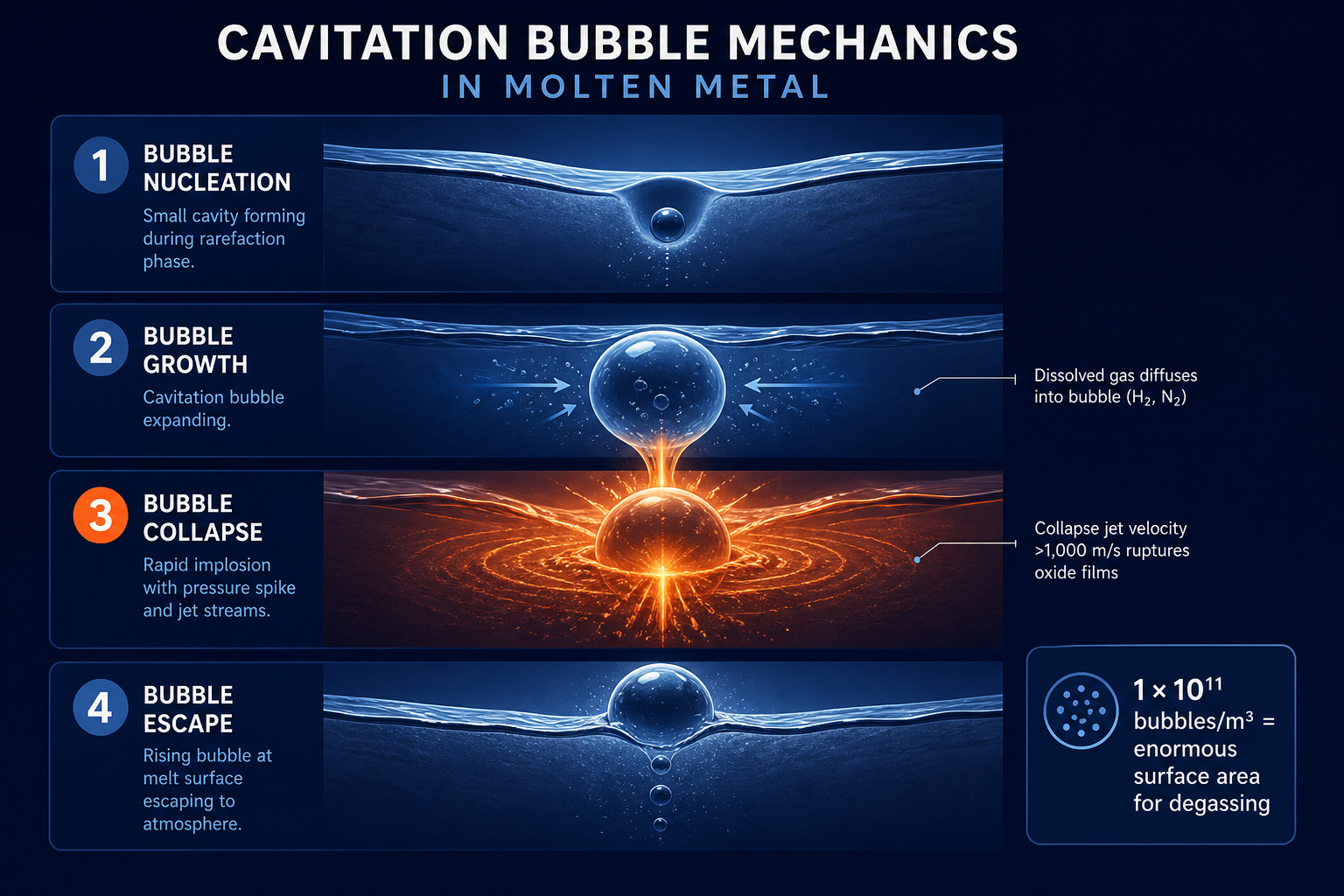
As the sonotrode vibrates, it creates alternating compression and rarefaction (expansion) cycles in the melt. During rarefaction, acoustic pressure can drop below the vapor pressure of the molten metal, creating tiny cavities-bubbles of vapor and dissolved gas. These bubbles are the mechanical workhorses:
- For degassing: The bubble interior provides an enormous surface area for hydrogen and other dissolved gases to diffuse out of the liquid. Cavitation bubble density can reach 1 × 10¹¹ bubbles/m³, offering surface area equivalent to millions of liters of exposed interface. Dissolved hydrogen finds the path of least energy and migrates into these bubbles, which then rise and escape at the melt surface.
- For grain refinement: Collapsing bubbles release tremendous energy-localized heating, shock waves, and high-velocity jets-that disrupt dendrite formation and trigger heterogeneous nucleation. The result is a finer, more equiaxed (uniform in all directions) grain structure, which reduces hot tearing, shrinkage porosity, and segregation during casting.
- For alloying: The acoustic streaming generated by the oscillating sonotrode creates bulk fluid circulation. This mixing ensures that alloying elements (silicon, copper, magnesium, etc.) distribute uniformly through the melt rather than settling or forming segregation layers.
The Bjerknes force-the acoustic radiation force that acts on bubbles-keeps small bubbles from coalescing into larger, ineffective ones. With optimal frequency and amplitude, the cavitation process becomes self-sustaining and efficient.
Sonotrode design: the interface between energy and metal
The sonotrode is everything. It’s the coupling point where electrical vibration meets molten metal, often at temperatures exceeding 700°C. The material must:
- Resist thermal shock (temperature swings during immersion and removal)
- Not wet the molten metal (metal shouldn’t adhere to the surface, which would damage the sonotrode on removal)
- Maintain high Young’s modulus (so vibrations couple efficiently rather than dissipating as heat)
- Withstand erosion from cavitation collapse jets (which can exceed 1,000 m/s at bubble collapse)
Graphite was historically the standard, but it’s brittle and prone to oxidation at high temperature. Sialon Ceramics developed proprietary ceramic formulations specifically to overcome these constraints-more on that in the next section.
Why conventional high-frequency generators struggle with large melt volumes
Here’s where fixed-frequency systems hit the wall.
Standing waves and dead zones
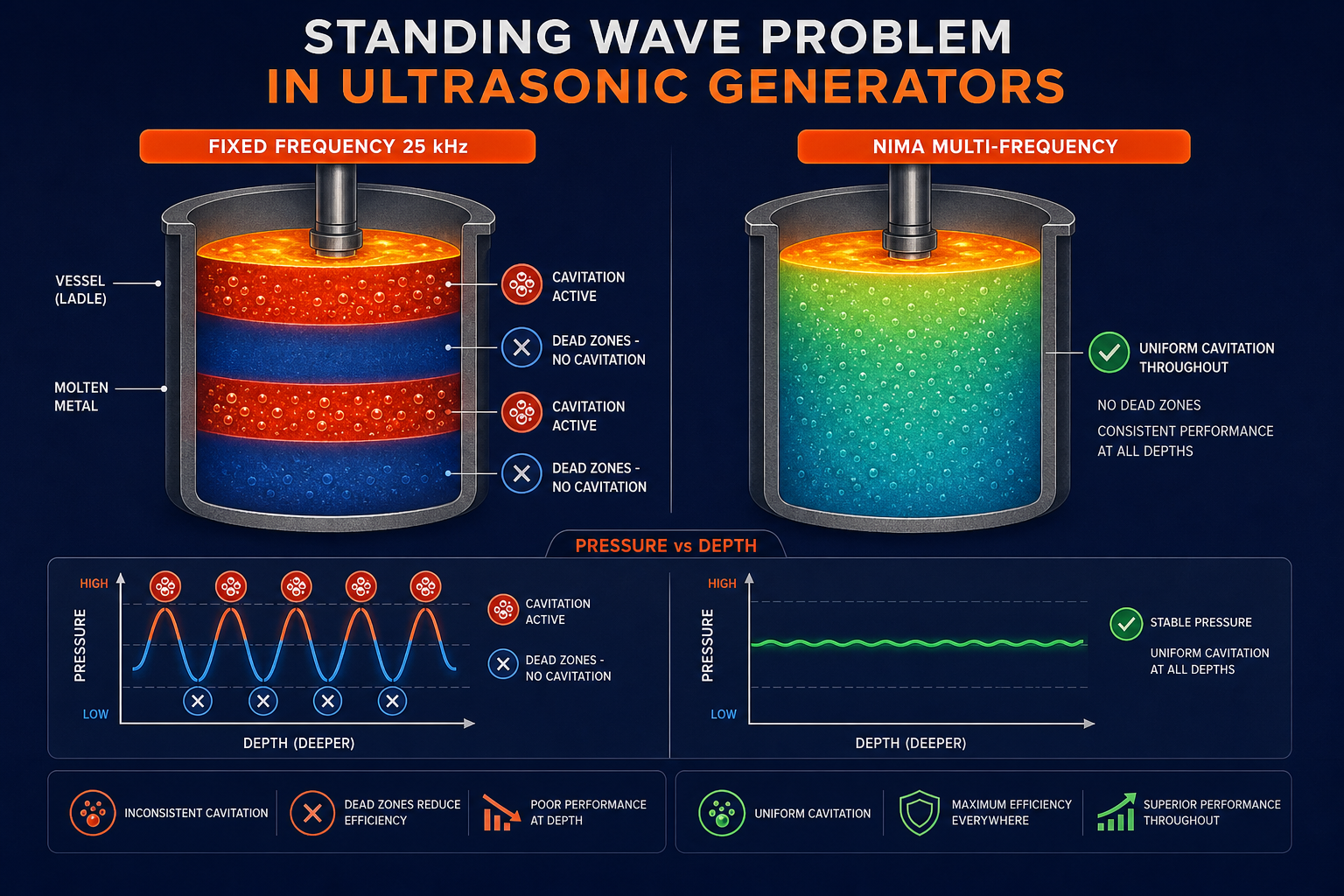
A 25 kHz ultrasonic wave propagating through molten aluminium has a wavelength of approximately 200 mm (derived from speed of sound ~5,000 m/s ÷ 25 kHz). In a vessel containing 400 kg of melt, that wavelength becomes a resonance criterion: if the vessel dimension along the acoustic axis is a multiple of half-wavelengths, standing waves form. Compression antinodes (pressure peaks) and nodes (pressure minima) create a checkerboard pattern of high and low acoustic intensity.
The problem: nodes are dead zones. Cavitation requires acoustic pressure amplitude above the cavitation threshold (~0.1 MPa for molten aluminium at typical temperatures). At nodes, pressure amplitude approaches zero. No matter how much total power the generator supplies, the dead zones remain inactive.
At 400 kg scale-a melt roughly 1.2 m³ in volume-a single frequency almost always creates dead zones covering 20–40% of the vessel volume. Operators observe:
- Incomplete degassing: Hydrogen remains in the melt because some regions never underwent cavitation. Late-stage porosity appears in castings from the “quiet zones.”
- Unrefined grain in segregated zones: Grain refinement effect is localized to the active regions; other zones revert to coarse, columnar growth, weakening mechanical properties.
- Alloy segregation persists: Dead zones prevent acoustic streaming in certain regions, allowing heavy alloying elements to stratify.
Limited penetration depth
Even in active cavitation zones, high frequencies (40 kHz and above) are absorbed rapidly by the molten metal. Attenuation increases with frequency squared, so power dissipates into heat rather than driving cavitation deep into the melt. A 40 kHz system may create vigorous cavitation in the outer 100–150 mm of melt but leave the core only gently treated. Large ingots or thick sections end up with gradients in mechanical properties: outer layers well-refined, cores coarse.
Sonotrode erosion and maintenance
High-frequency systems (40 kHz and above) with high amplitude drive cavitation collapse jets to extreme velocities. While this creates the most intense local cavitation, the sonotrode pays the price. Erosion rates climb, especially with graphite sonotrodes, which oxidize and spall at temperature. Equipment downtime for sonotrode replacement cuts into production windows. The total cost of ownership-capital + maintenance-rises steeply.
The rotary degassing fallback
Faced with these constraints, many foundries revert to rotary degassing: a graphite or ceramic rotor spinning at the bottom of the ladle, with nitrogen or argon bubbled in. Rotary systems sidestep standing waves (they work by bubble agitation, not acoustic frequency) but sacrifice speed and environmental impact. They require inert gas-a recurring consumable cost and environmental concern. Treatment cycles run 10+ minutes for the same hydrogen removal that ultrasonic achieves in 3 minutes.
The standing wave problem is why ultrasonic generators have been labelled “laboratory tools” or “marginal for production”-not because the physics is wrong, but because single-frequency fixed designs don’t scale cleanly to large industrial melts.
How NIMA Ultrasonic Generators Eliminate Standing Waves
Sialon Ceramics, in partnership with Aktive Arc Ultrasonics for system integration, solved the standing wave problem through two decades of proprietary software development. Their innovation: instead of a single fixed frequency, NIMA generators sweep through or combine multiple frequencies in real-time, adaptively avoiding standing wave resonances.
The multi-frequency approach
The NIMA generator operates at a base frequency (25 kHz in most industrial configurations) but continuously modulates or sweeps the actual frequency by ±10–15%, varying the frequency hundreds of times per second. This modulation, controlled by proprietary algorithms, ensures that the acoustic field never settles into a standing wave pattern. As one frequency approaches a resonance condition, the generator shifts away. The result: the entire melt volume experiences consistent acoustic intensity. Dead zones are eliminated.
At this operating point-25 kHz base with adaptive modulation-the generator maintains:
- Optimal cavitation initiation (cavitation threshold is lowest in the 20–25 kHz band)
- Efficient penetration depth (lower frequencies penetrate deeper than 40 kHz alternatives)
- Manageable erosion (lower frequency = lower collapse jet velocity = longer sonotrode lifespan)
- No spatial dead zones (frequency sweep eliminates resonances)
Proprietary software: the 20-year edge
The algorithms that control this frequency modulation are Sialon Ceramics’ core intellectual property. They account for:
- Vessel geometry (the software detects or adapts to different ladle sizes and shapes)
- Melt temperature (acoustic properties of molten metal change with temperature; the software compensates)
- Alloy composition (hydrogen diffusion rates, cavitation threshold, and acoustic attenuation vary with alloy)
- Sonotrode immersion depth (acoustic field changes as the sonotrode is immersed deeper or pulled back)
An adaptive control loop monitors acoustic power feedback in real-time and fine-tunes frequency, amplitude, and duty cycle to maintain optimal cavitation conditions across the entire melt volume. This level of control is not trivial-it requires decades of field data, metallurgical insight, and iterative refinement. Sialon has invested exactly that.
1,800°C Capability: Temperature as a Design Constraint
Industrial molten metal temperatures vary:
- Aluminium alloys: 700–750°C
- Magnesium alloys: 650–700°C
- Ferrous alloys (steel, iron): 1,550–1,650°C
- Specialty glass: 1,400–1,800°C
A sonotrode must function reliably across this entire range. At 1,800°C, most materials lose structural integrity. Graphite oxidizes catastrophically. Traditional ceramics thermal-shock. Sialon’s engineered ceramics-proprietary formulations developed specifically for this application-maintain Young’s modulus, thermal conductivity, and erosion resistance up to 1,800°C, even in rapid thermal cycling.
This is why the company name itself signals the material advantage: Sialon (silicon-aluminium-oxynitride) ceramics are one of the few material families that perform reliably in this thermal regime. The combination of NIMA’s adaptive frequency control plus Sialon’s high-temperature ceramics creates a system with no thermal limitations. You can treat a specialty glass melt at full temperature without worrying about sonotrode failure or frequency instability.
NIMA Ultrasonic Generators and Sialon Ceramic Sonotrodes
The NIMA generator + Sialon ceramic sonotrode pairing is the only system proven at industrial scale (400 kg+) to treat large-volume melts uniformly and repeatably.
Why this combination is unique
- Hardware and software together: The generator’s frequency control is tuned specifically to work with Sialon’s ceramic properties. A Sialon sonotrode has precisely characterized acoustic impedance, thermal expansion, and damping. The NIMA algorithms compensate for these material properties to maximize cavitation efficiency. Pairing NIMA electronics with a third-party sonotrode (or vice versa) degrades performance because the software tuning is lost.
- Thermal stability at extreme temperature: Sialon maintains mechanical properties where other ceramics or graphite fail. This enables treatment of glass and ferrous melts-applications that would destroy alternative sonotrodes.
- Erosion resistance proven in field trials: Sialon’s proprietary ceramic formulation resists cavitation erosion far longer than graphite. Industrial deployments report 3–5x longer service life, which translates to lower maintenance costs and more consistent treatment quality over time.
- Scale demonstrated: The 400 kg trial on an Al-9Si-3Cu-1.3Fe alloy-documented in peer-reviewed research published in 2026-proved uniform cavitation and treatment across the full melt volume. Competitors claim capability; Sialon has published data.
System architecture: 1–5 kW, air or water cooled
The NIMA generator is compact:
- Electrical input: 1–5 kW, configurable for different treatment volumes and cycle times
- Cooling: Air-cooled or water-cooled piezoelectric transducers, depending on duty cycle and facility infrastructure
- Frequency: 25 kHz base with proprietary modulation
- Amplitude control: Independently tunable, allowing operators to dial in the cavitation intensity needed for their specific alloy and treatment goal
The modularity means a foundry can start with a 1 kW system for process trials on smaller melts (50–100 kg), then scale to 5 kW (or multiple systems in parallel) for production volumes, without replacing software or retraining operators. The NIMA architecture scales cleanly.
NIMA Ultrasonic Generators: Performance Data: the proof
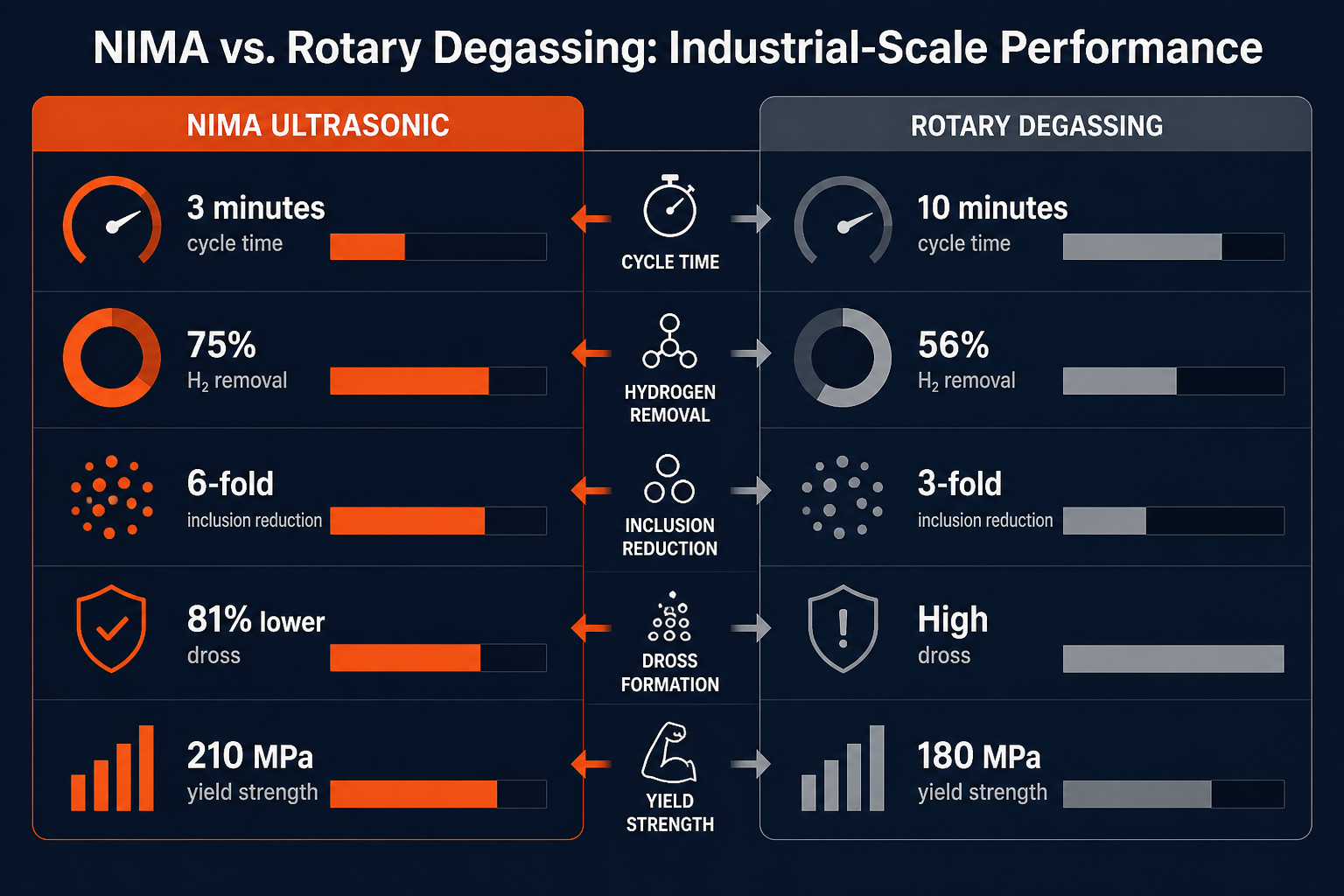
The industrial-scale comparison provides hard numbers. In a 2022 peer-reviewed study published by CastMan, researchers tested a NIMA system against conventional rotary degassing (rotating impeller with nitrogen injection) on a 400 kg Al-9Si-3Cu-1.3Fe alloy melt used for high-pressure die-cast automotive components.
Degassing efficiency
NIMA Ultrasonic: 75% hydrogen removal in 3 minutes (density index: 10.3% → 2.6%)
Rotary + Nitrogen: 56% hydrogen removal in 10 minutes (density index: 10.5% → 4.6%)
Advantage: 20% faster hydrogen removal, completed in one-third the cycle time. This efficiency gain is attributed to the 1 × 10¹¹ m⁻³ cavitation bubble density and uniform acoustic treatment across the entire melt volume.
Oxide inclusion reduction
NIMA Ultrasonic: 6-fold reduction vs. untreated melt; 2-fold reduction vs. rotary-treated melt
Rotary + Nitrogen: 3-fold reduction vs. untreated melt
Mechanism: Collapsing cavitation bubbles generate jet streams (>1,000 m/s) that rupture protective oxide films on inclusion surfaces, promoting attachment to rising bubbles. The 6-fold advantage comes from sustained cavitation throughout the entire melt volume-no dead zones means every inclusion gets exposed to jets.
Dross formation (hydrogen recontamination indicator)
NIMA Ultrasonic: 245 grams dross per cycle
Rotary + Nitrogen: 1,300 grams dross per cycle
Reduction: 81% lower dross. Why this matters: dross-a mixture of metal oxides and absorbed hydrogen-acts as a hydrogen reservoir. It adsorbs hydrogen through molecular bonding at elevated temperature. Lower dross = less opportunity for re-contamination after degassing, maintaining the degassed state longer.
Mechanical property gains
Cast components from NIMA-treated melts showed measurable improvements:
| Property | NIMA Ultrasonic | Rotary + Nitrogen | Improvement |
|---|---|---|---|
| Yield Strength (YS) | 210 MPa | 180 MPa | +17% |
| Ultimate Tensile Strength (UTS) | 303 MPa | 288 MPa | +5% |
| Elongation | 6% | 3% | +100% |
These gains reflect both cleaner melt (fewer inclusions, lower porosity) and refined grain structure (equiaxed rather than columnar grains), both benefits of uniform ultrasonic cavitation.
Microstructure: visible refinement
Optical and scanning electron microscopy of cast components showed significantly reduced intermetallic particle size and finer, more uniform grain distribution in NIMA-treated samples. The refined microstructure translates directly to toughness and fatigue resistance-critical for automotive and aerospace components.
Industrial applications: beyond aluminium
While aluminium is the flagship application, NIMA’s temperature range (up to 1,800°C) and no-standing-waves architecture enable treatment of a wider range of metals and glass:
Magnesium alloys
Magnesium is more reactive than aluminium and more susceptible to hydrogen absorption. Degassing cycles must be faster (to minimize oxidation exposure) and complete (to prevent late-stage porosity). NIMA’s 3-minute cycles and uniform treatment are ideal. Grain refinement improves creep resistance-important for high-temperature magnesium applications in aerospace.
Glass melts
Industrial glass (soda-lime, borosilicate, specialty glasses) suffers from bubble inclusions that scatter light, weaken the finished product, and cause optical defects. Ultrasonic cavitation disperses trapped gases, improving transparency and structural integrity. At 1,400–1,800°C, only the Sialon sonotrode survives repeated thermal cycling.
Ferrous alloys (steel, cast iron)
Steel foundries historically relied on rotary degassing or vacuum treatment because ultrasonic technology was thought unsuitable for extreme temperatures. NIMA’s 1,800°C capability changes that equation. Degassing cycles can be compressed, grain refinement can be applied to near-net-shape castings (reducing machining), and alloy distribution improves homogeneity.
Zinc, brass, bronze, copper
These non-ferrous melts benefit from the same physics: cavitation-driven degassing, grain refinement, and alloying. NIMA’s modular power output (1–5 kW) scales these applications without overengineering.
Why Conventional Ultrasonic Generators Fall Short
To close the loop: why does the industry still sell fixed-frequency 40 kHz systems when the physics clearly favors NIMA’s approach?
- Lower R&D cost: A fixed-frequency generator is simpler to engineer-pick a frequency, build the transducer, sell it. NIMA’s adaptive algorithms required two decades of development and field trials.
- Marketing inertia: The narrative “higher frequency = better cavitation” has persisted for decades, even though data shows it’s frequency variability and full-volume treatment that matter most.
- Supplier lock-in: Competitors tie their systems to proprietary sonotrode designs or third-party equipment, making it hard for customers to compare on level ground.
- Standing wave problem not universally acknowledged: Many equipment suppliers don’t publicly discuss standing waves, leaving customers unaware of the efficiency loss in large-melt applications.
A 40 kHz system on a 100 kg melt in a small ladle may outperform lower-frequency alternatives-hence the lingering reputation. But at 400 kg scale, in a production foundry, fixed-frequency systems lose decisively to adaptive, multi-frequency designs.
Competitive differentiation: why NIMA stands alone
The combination of factors-adaptive multi-frequency software, 1,800°C ceramic capability, proven 400 kg+ scale, 20 years of field data-makes NIMA the only system qualified for industrial-scale treatment of large-volume melts across the full temperature and alloy range.
Competitors exist:
- High-frequency (40–60 kHz) systems from equipment OEMs struggle with standing waves and penetration depth at large scales.
- Rotary degassing systems sidestep acoustic physics entirely but sacrifice speed, require inert gas, and don’t achieve grain refinement.
- Vacuum degassing removes gases but is slow, expensive on large volumes, and provides no grain refinement benefit.
NIMA combines speed (3-minute cycles), environmental benefit (no inert gas), quality advantage (grain refinement + inclusion removal), and proof of scale (400 kg+ documented). The closest competitor-Hielscher’s high-frequency ultrasonic systems-excel at laboratory and small-scale work but have not published comparative data at NIMA’s scale or temperature range.
Implementation: foundry to process
For process engineers and procurement managers evaluating NIMA systems:
- Cycle time reduction: Expect 65% shorter degassing cycles (10 minutes → 3 minutes), translating to increased production throughput and lower energy per unit treated.
- Quality gains: Measurable improvements in tensile strength, elongation, and fatigue life because melt quality is reproducibly higher and grain structure is uniformly refined.
- Dross and environmental cost: 81% reduction in dross generation and zero inert gas consumption-cost savings cascade through waste disposal and gas budgets.
- Scalability: Whether your process is 50 kg pilot trials or 400 kg production runs, NIMA’s modular power architecture (1–5 kW) accommodates the range without system redesign.
- Maintenance: Sialon sonotrodes outlast graphite or other ceramics by 3–5x, reducing downtime and replacement costs over equipment lifetime.
Try Sialon Ceramics
If your foundry is currently running rotary degassing, vacuum treatment, or fixed-frequency ultrasonic on large volumes, a side-by-side trial with NIMA can quantify the gains. The typical trial protocol: treat two identical melt batches (one with your current method, one with NIMA), measure hydrogen content via ALSCAN or equivalent, collect mechanical property data, and compare cycle times. Most foundries see the efficiency and quality gains in the first week.
Sialon Ceramics offers free webinars on ultrasonic degassing and grain refinement in molten metals and glass, with Q&A tailored to your specific alloy and application. For large-volume trials or production implementation, their team can spec the right NIMA configuration (power level, cooling, sonotrode geometry) for your process.
The standing wave problem-the efficiency loss that has constrained ultrasonic technology in industrial foundries for decades-is solved. NIMA is ready for scale.
Frequently Asked Questions
How does NIMA’s multi-frequency approach differ from simply running at a lower frequency?
Lower frequency alone (e.g., 17 kHz) reduces standing waves but also reduces cavitation intensity and increases bubble coalescence. The breakthrough is adaptive modulation: NIMA maintains optimal cavitation intensity (25 kHz base) while varying frequency in real-time to avoid standing wave resonances. This gives you both uniform treatment and efficient cavitation-something a fixed lower frequency cannot achieve.
Can existing foundry equipment be retrofitted with NIMA generators?
NIMA generators are designed to integrate with standard ladle or vessel equipment. The main requirement is a mounting bracket for the sonotrode and electrical connection to power and control systems. Retrofit feasibility depends on your current setup, but most operations can be updated without replacing ladle infrastructure. Sialon’s team can assess during a site evaluation.
Why does sonotrode material matter so much?
The sonotrode is the direct interface between the generator and molten metal. At 1,800°C and under cavitation erosion, only certain ceramics survive repeated thermal cycles. Graphite oxidizes; standard ceramics thermal-shock. Sialon’s proprietary ceramic formulation maintains structural integrity and acoustic coupling efficiency, which directly translates to consistent treatment quality and longer equipment life.
How do I know if standing waves are affecting my current ultrasonic system?
Signs include: incomplete hydrogen removal despite long cycle times, variable mechanical properties across cast ingots (outer zones well-treated, core zones weak), inability to treat at full volume without extending cycles dramatically. A trial with NIMA on your standard melt size will clarify whether standing waves are the limiting factor.
What’s the total cost of ownership (CapEx + OpEx) compared to rotary degassing?
NIMA systems range from €100k–€400k depending on power and cooling configuration. Rotary systems are cheaper upfront (~€50k–€150k) but incur ongoing inert gas costs and more frequent sonotrode/rotor replacement. Most foundries see payback within 12–24 months through reduced gas consumption, shorter cycles, and lower maintenance.