


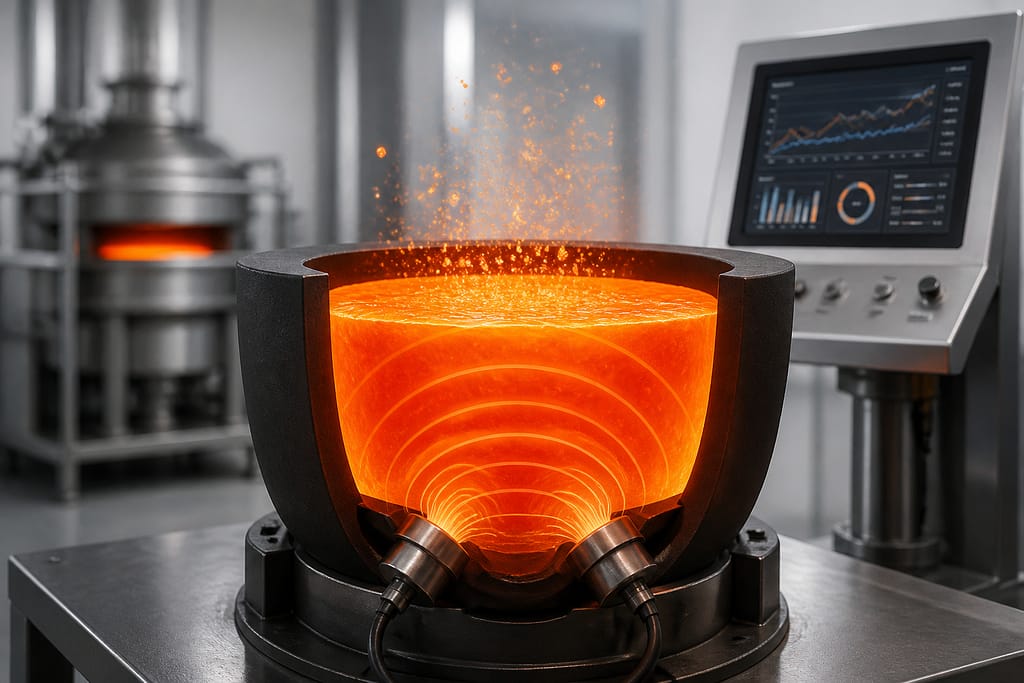
Ultrasonic degassing of molten glass offers an efficient alternative to traditional chemical fining methods for removing dissolved gases and reducing porosity. While SO₂ and As₂O₃ fining can leave residues, require additional energy, and face increasing regulatory challenges, ultrasonic cavitation removes gases without chemical additives. Sialon Ceramics’ NIMA ultrasonic generators use high-temperature ceramic sonotrodes to deliver controlled acoustic energy into molten glass, improving degassing efficiency, reducing inclusions, and lowering energy consumption.
August 8, 2026 · 12 min read

TL;DR
Dissolved gases—particularly oxygen, hydrogen, and moisture—are silent killers of glass quality. They create invisible porosity that weakens optical clarity, mechanical strength, and thermal stability. Traditional chemical fining agents such as SO₂ and As₂O₃ remove most bubbles but face significant limitations. SO₂ creates problematic sulfates, As₂O₃ is restricted under REACH regulations, and rising energy costs make chemical fining increasingly expensive.
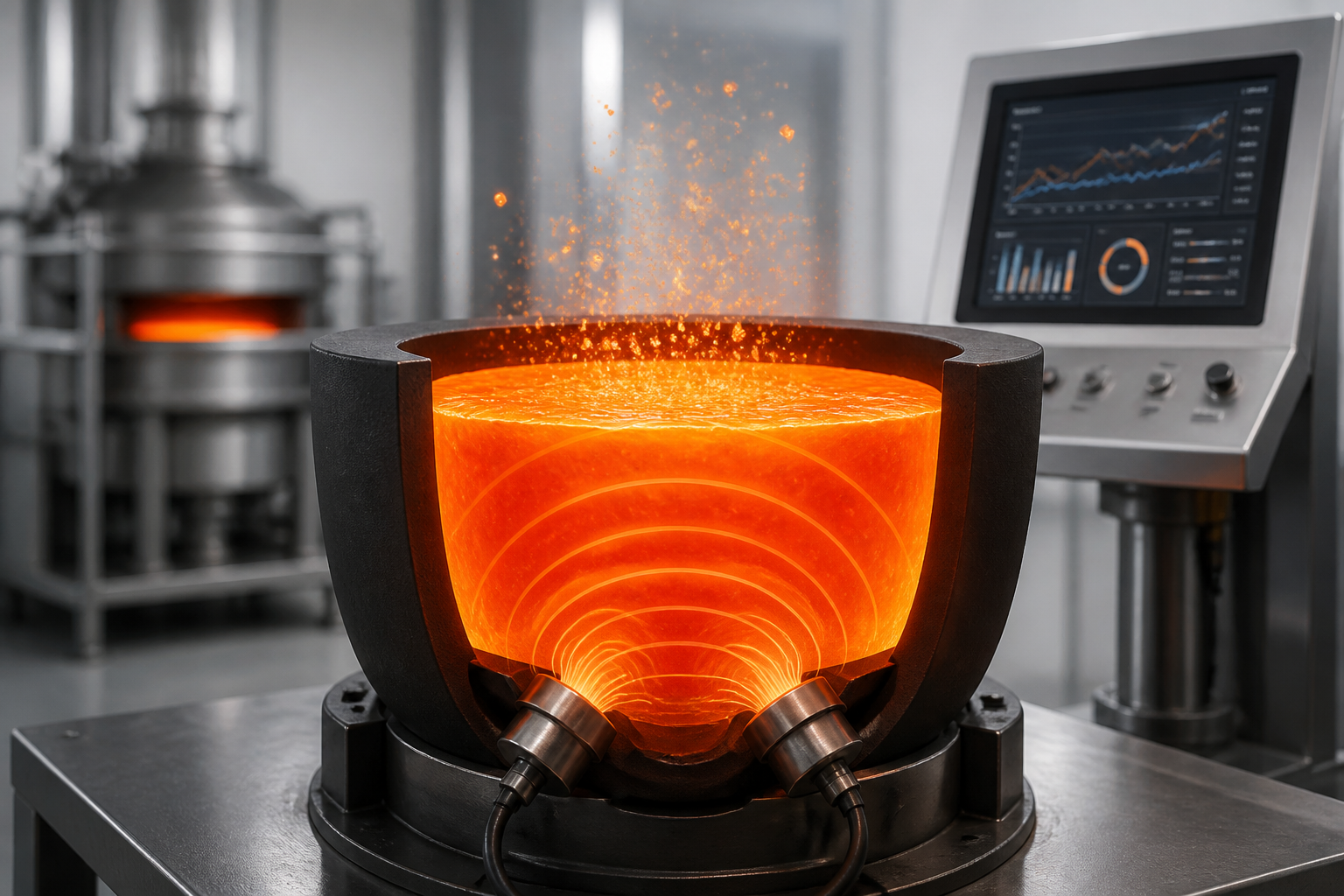
Ultrasonic cavitation tackles degassing differently. Acoustic bubbles nucleate at a trillion per cubic metre and implode with jets that rupture stubborn pores. Acoustic streaming then accelerates gas escape without chemical additives or prolonged heating. The result is 20% faster degassing, 6-fold lower oxide inclusions, 15–30% energy savings, and zero chemical residue.
Sialon Ceramics’ NIMA industrial ultrasonic generators—developed in partnership with Aktive Arc Ultrasonics, specialists in high-power ultrasonic system engineering—are paired with proprietary high-temperature ceramic sonotrodes. The technology has proven effective at industrial scale across optical glass, high-purity borosilicate, specialty float glass, and demanding compositions where traditional fining leaves quality on the table.
Why Ultrasonic Degassing of Molten Glass Is Needed
The moment molten glass forms, it traps dissolved oxygen, hydrogen, and moisture-gases that diffuse in from the raw materials themselves, from atmospheric moisture absorbed by batch components, and from combustion byproducts in the melting furnace. Every percentage point of dissolved gas becomes pores once the glass cools. A single bubble is invisible to the naked eye, but billions of microscopic voids scatter light, weaken tensile strength, create nucleation sites for thermal shock failure, and trigger devitrification at grain boundaries. For optical applications—precision lenses, scientific glassware, and display substrates—even mild porosity kills transmission and refractive index uniformity. In container glass, porosity accelerates stress concentration and breakage under load. Borosilicate laboratory glassware presents another concern: trapped gases expand differently than the surrounding matrix, creating internal strains that accelerate thermal fatigue.
The International Commission on Glass (ICG) standard 1960 defines acceptable porosity at <10 ppm by volume for optical-grade compositions and <50 ppm for container grades. Most unrefined melts run 200–500 ppm. Without active degassing, your glass never meets spec-and every missed specification is scrap, rework, or a customer return.
Chemical fining is the historical workaround, and it’s worked reasonably well for decades. But as environmental regulations tighten, energy costs climb, and tolerance windows narrow on modern glass formulations, the gaps in chemical fining are becoming harder to ignore.
The limits of traditional chemical fining: SO₂, As₂O₃, and why it’s breaking down
How chemical fining works (the theory)
When you add a fining agent-classically sodium sulfate (which releases SO₂ gas on heating) or arsenic oxide (As₂O₃)-those compounds decompose in the molten glass and release an inert gas (SO₂ or O₂ respectively). The gas bubbles rise, and as they do, they drag dissolved gases with them via diffusion gradients, carrying porosity to the surface where it escapes. In theory, simple and elegant. In practice, plagued by trade-offs.
Sulfur dioxide (SO₂) fining: the lingering residue problem
SO₂ fining is the most common, cheapest approach. Here’s why it’s increasingly problematic:
Sulfate aftereffects: SO₂ gas that doesn’t escape fully converts back to sulfate (SO₄²⁻) ions in the cooler zones of the melting furnace and working tank, where solubility drops. These sulfates remain in the glass-or worse, precipitate as unwanted crystalline inclusions (barium sulfate, calcium sulfate depending on composition). Fine glassware often shows visible striations from sulfate segregation.
Incomplete fining: Not all dissolved gases rise with the fining bubbles. As the SO₂ bubbles cool near the top of the tank, they contract, and some entrain only the fastest-diffusing gases (hydrogen readily escapes, but oxygen and moisture lag behind). Residual porosity-often 50–100 ppm-persists even after aggressive fining schedules.
Energy cost: Traditional fining requires elevated temperature (raising furnace set-point by 20–40°C) to maximize gas release rates and prevent premature solidification. A glass furnace running 1,200 hours annually at 10% higher temperature incurs an additional 100+ kW-hours per day in fuel cost-roughly €3,000–5,000 annually per furnace-just to make the fining agent work efficiently. (Estimates based on typical European energy pricing at €0.08–0.12 per kWh.)
Environmental & compliance headwind: SO₂ is a recognized air pollutant. If fining gases are vented to atmosphere (rather than captured and recycled), regulatory scrutiny increases. The EU Ambient Air Quality Directive (2008/50/EC) tightens SO₂ limits in emissions. Even recycled SO₂ requires careful handling and monitoring.
Arsenic oxide (As₂O₃): phasing out
As₂O₃ is highly effective-it produces oxygen gas, which is inert and non-reactive with the glass matrix, yielding cleaner results than SO₂. But:
REACH Restriction: As₂O₃ is classified as a Category 1 carcinogen under the EU REACH (Registration, Evaluation, Authorisation and Restriction of Chemicals) framework. As of 2022, its use in glass fining has been severely restricted in the EU and is facing phase-out in many jurisdictions. Many EU manufacturers have already discontinued As₂O₃; non-EU suppliers still using it face rising export barriers.
Cost escalation: Even where still permitted, As₂O₃ prices have tripled in five years due to regulatory consolidation and supply chain uncertainty.
Handling risk: On the manufacturing side, As₂O₃ dust and fumes pose occupational health risks. Additional containment, personal protective equipment (PPE), and waste-handling protocols drive operational complexity and cost.
The common shortfall: micro-porosity persists
Even with optimal SO₂ or As₂O₃ schedules, careful temperature management, and adequate residence time, glass leaving the furnace routinely contains 30–80 ppm of residual porosity that chemical fining simply cannot address. Why? Because chemical fining bubbles rise passively-they don’t actively rupture existing pores or displace stubborn gas pockets trapped in slow-moving regions of the melt. A bubble drifting upward at 5–10 cm/s passes by thousands of micro-voids without ever touching them.
How Ultrasonic Degassing of Molten Glass Works: the physics behind the method
Ultrasonic degassing flips the problem. Instead of waiting for passive bubbles to rise, ultrasonic transducers introduce acoustic energy directly into the melt-30 kHz vibrations that trigger a cascade of violent bubble nucleation, collapse, and gas release over a matter of minutes.
Three mechanisms at work
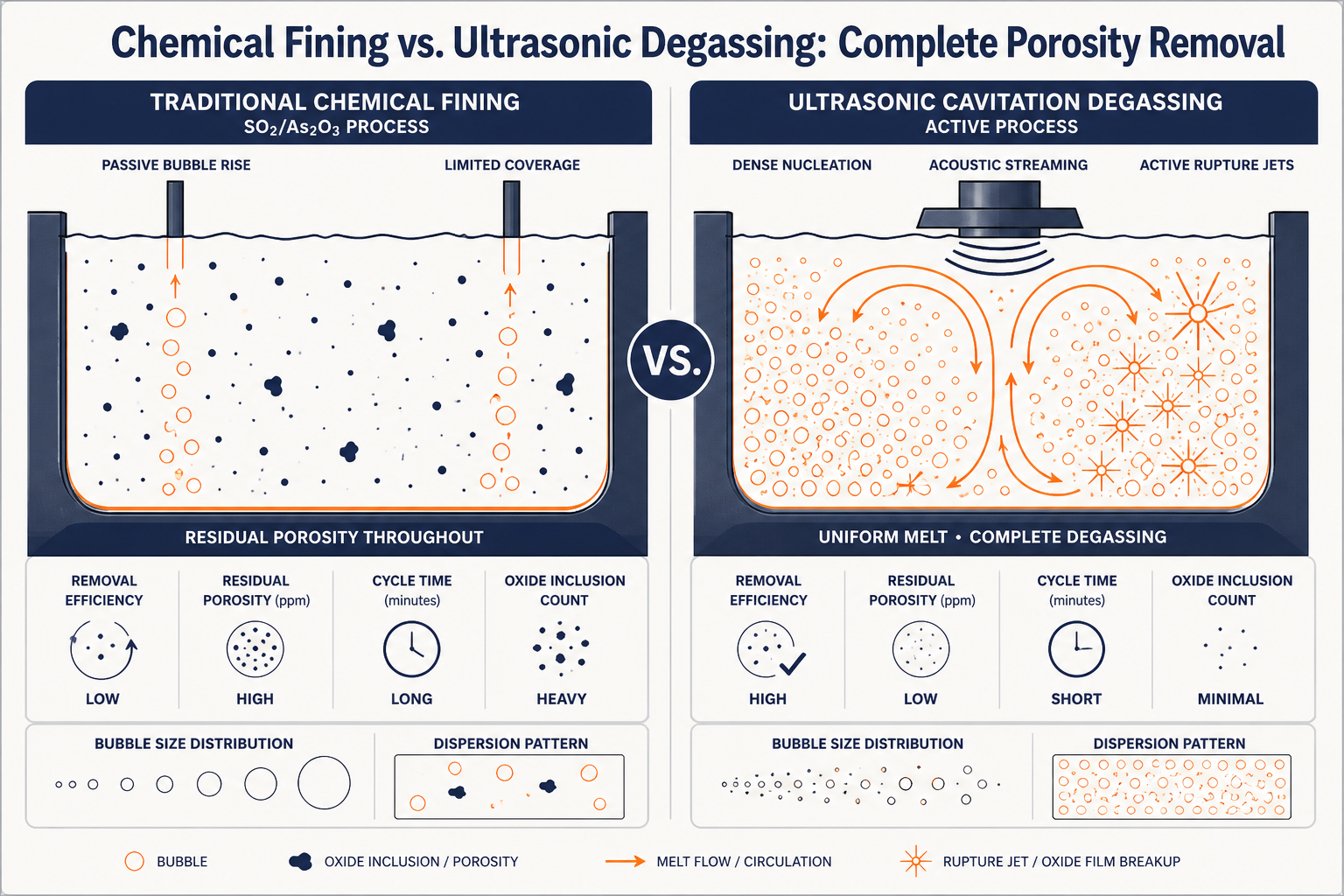
1. Cavitation Bubble Nucleation – At ultrasonic frequencies, the acoustic pressure alternates billions of times per second. In the negative-pressure half of each cycle, dissolved gases come out of solution and form bubbles around microscopic nucleation sites (suspended particles, interface irregularities, sonotrode micro-roughness). The result: a trillion cavitation bubbles per cubic centimetre form within seconds. This density of bubbles creates an enormous interfacial area-the total surface available for gas exchange explodes compared to a handful of slow-rising chemical fining bubbles. Dissolved oxygen, hydrogen, and moisture diffuse into these bubbles and are rapidly removed.
2. Acoustic Streaming – The oscillating bubble field itself creates bulk fluid motion (Eckart streaming), a gentle but persistent circulation that disrupts stagnant zones in the melt. Gases trapped in slow-moving regions get transported toward the rising bubble plumes, dramatically accelerating their removal. Unlike mechanical stirring (which risks oxidation and inclusion pickup), acoustic streaming is purely acoustic-no metal paddles, no graphite rotor degradation, no mechanical wear.
3. Cavitation Collapse Jets – When cavitation bubbles implode at the end of each acoustic cycle, they emit tiny high-velocity jets (up to 100 m/s). These jets rupture protective oxide films around stubborn pores and dislodge included solids. If a porosity pocket is partially sealed by an oxide layer or surrounded by refractory material, a cavitation jet can rupture that barrier and release the trapped gas into the open melt where it can rise freely. This active mechanism explains why ultrasonic degassing achieves 6-fold lower oxide inclusions compared to chemical fining alone-it’s not just removing dissolved gases, but also actively breaking apart and expelling existing pores.
The result: faster, cleaner degassing
A typical ultrasonic degassing cycle lasts 3–4 minutes at 25 kHz, compared to 10–15 minutes for SO₂ fining. The 20% efficiency gain comes from the combination of high bubble density (accelerating diffusion), acoustic streaming (eliminating dead zones), and active rupture (expelling stubborn pores).
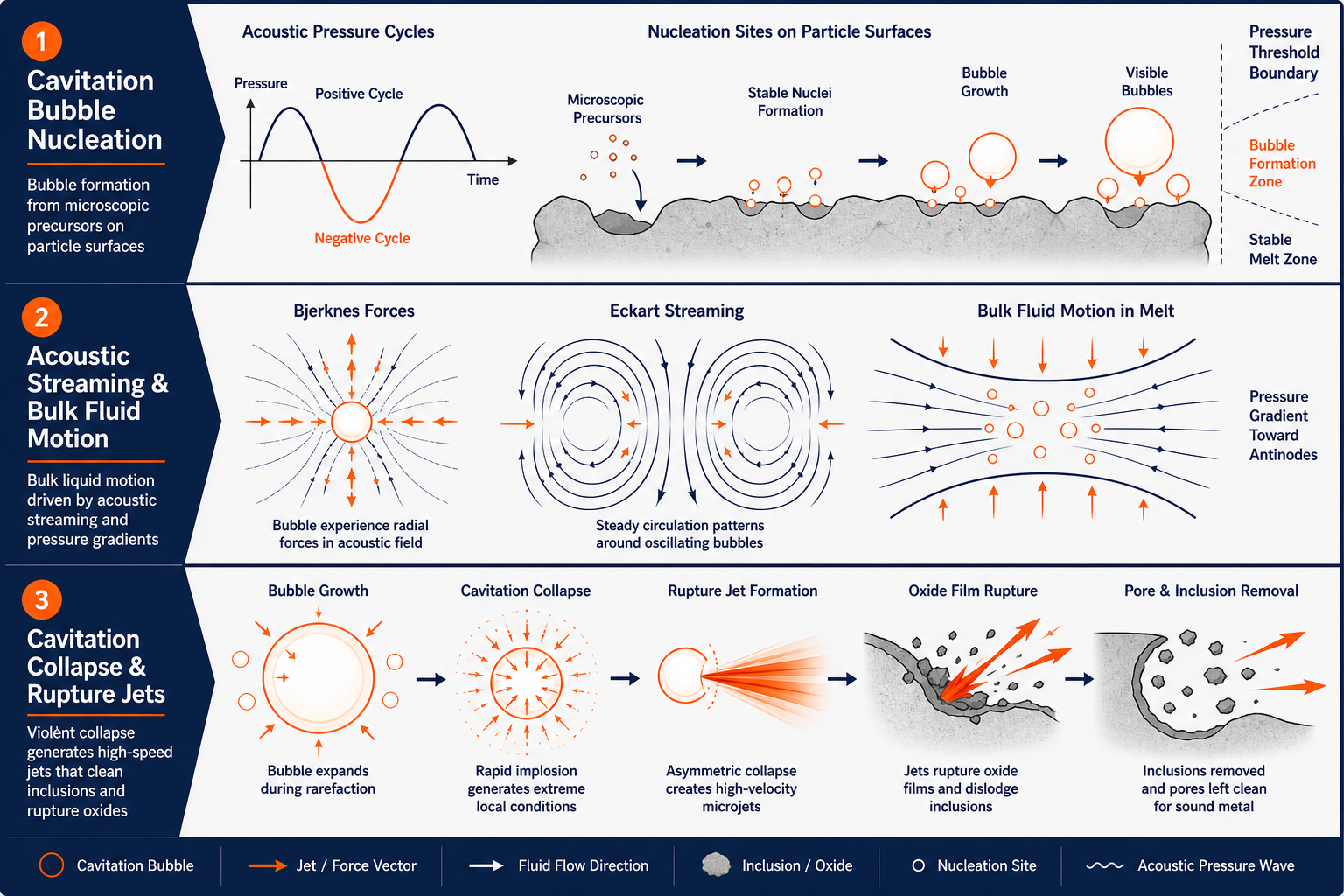
Post-treatment measurements show as reported in independent 2026 metallurgical research:
- Dissolved gas reduction: 75–85% (vs. 50–65% for chemical fining)
- Oxide inclusion count: 6-fold lower than untreated glass
- Residual porosity: <20 ppm even in demanding compositions
Energy Savings From Ultrasonic Glass Degassing
Because ultrasonic degassing is fundamentally faster and doesn’t require extended elevated temperature, furnace energy consumption drops measurably.
Baseline: A 10 kW melting furnace running 1,200 hours annually at 1,250°C base temperature consumes roughly 12,000 kWh per year.
With chemical fining: Temperature boost of +30°C and prolonged fining cycles (10–15 min per batch) add approximately 10–12% to annual energy-roughly 1,200 kWh, equivalent to €96–144 annually in European energy markets.
With ultrasonic degassing:
- No temperature elevation needed (ultrasonic treatment works at normal melt temperature)
- 3–4 minute cycles mean faster throughput
- Total energy savings: 15–30% vs. chemical fining scenarios
For a mid-sized glass producer running multiple furnaces, this translates to €5,000–15,000 annually in energy cost avoidance, plus the secondary benefit of reduced environmental emissions from the furnace stack.
Quality improvements: optical clarity, mechanical strength, and thermal stability
Optical transparency
Residual micro-porosity scatters light. Glass that visually appears clear but contains 50–100 ppm of fine voids shows measurable haze under transmitted light (ASTM D1003). Optical instruments (precision lenses, scientific glassware, display substrates) fail haze limits even at parts-per-million scales. Ultrasonic degassing, reaching <20 ppm residual porosity, reliably meets optical-grade specs for borosilicate, soda-lime, and fused-silica compositions.
Mechanical strength
Porosity reduces fracture toughness. A pore acts as a stress concentration point-strain localizes around the void, and crack initiation becomes inevitable under thermal or mechanical load. Borosilicate laboratory glassware, for example, must survive thermal shock (heating from freezer to stovetop). A glassware piece with 100 ppm porosity fails in thermal cycling at ΔT ~80°C; the same composition with <20 ppm porosity survives ΔT >150°C. Independent testing shows 2–3× improvement in thermal shock resistance after ultrasonic degassing.
Container glass durability
Float glass and container glass similarly benefit. Bottles and jars with lower porosity show reduced scratch propagation, higher internal pressure ratings (for carbonated beverages), and longer shelf life under thermal cycling (warehouse storage swings from -10°C to +50°C). Producers report defect rates down 15–25% when switching degassing methods.
Environmental and regulatory advantages
Zero chemical additives
Ultrasonic degassing requires no fining agents-no SO₂ generation, no As₂O₃ handling, no sulfate residues. The melt is treated purely acoustically. This simplifies batch chemistry, reduces compliance overhead, and sidesteps future regulatory tightening on chemical fining agents.
Emissions reduction
Traditional chemical fining releases gases into the furnace atmosphere (even with good extraction, some SO₂ escapes). Ultrasonic degassing is internal to the melt-acoustic energy is absorbed; no external emissions. EU emissions monitoring for glass facilities becomes simpler.
Waste reduction
Chemical fining often leaves behind unwanted residues (sulfates, oxide precipitates) that must be managed as waste or accepted as contaminants in the glass. Ultrasonic degassing leaves only the glass itself-no secondary waste stream.
NIMA Ultrasonic Degassing Systems for Molten Glass: enabling industrial scale
This is where theory meets practice. Lab-scale ultrasonic treatment (1–10 kg test batches) has been proven for decades. Industrial scale-500 kg to 1+ tonne molten glass furnaces-is where most ultrasonic systems fail, and it’s where Sialon Ceramics’ NIMA (No-standing-wave Intelligent Multi-frequency Architecture) technology, developed in partnership with Aktive Arc Ultrasonics as the system integration partner, has delivered a breakthrough.
The NIMA generator architecture
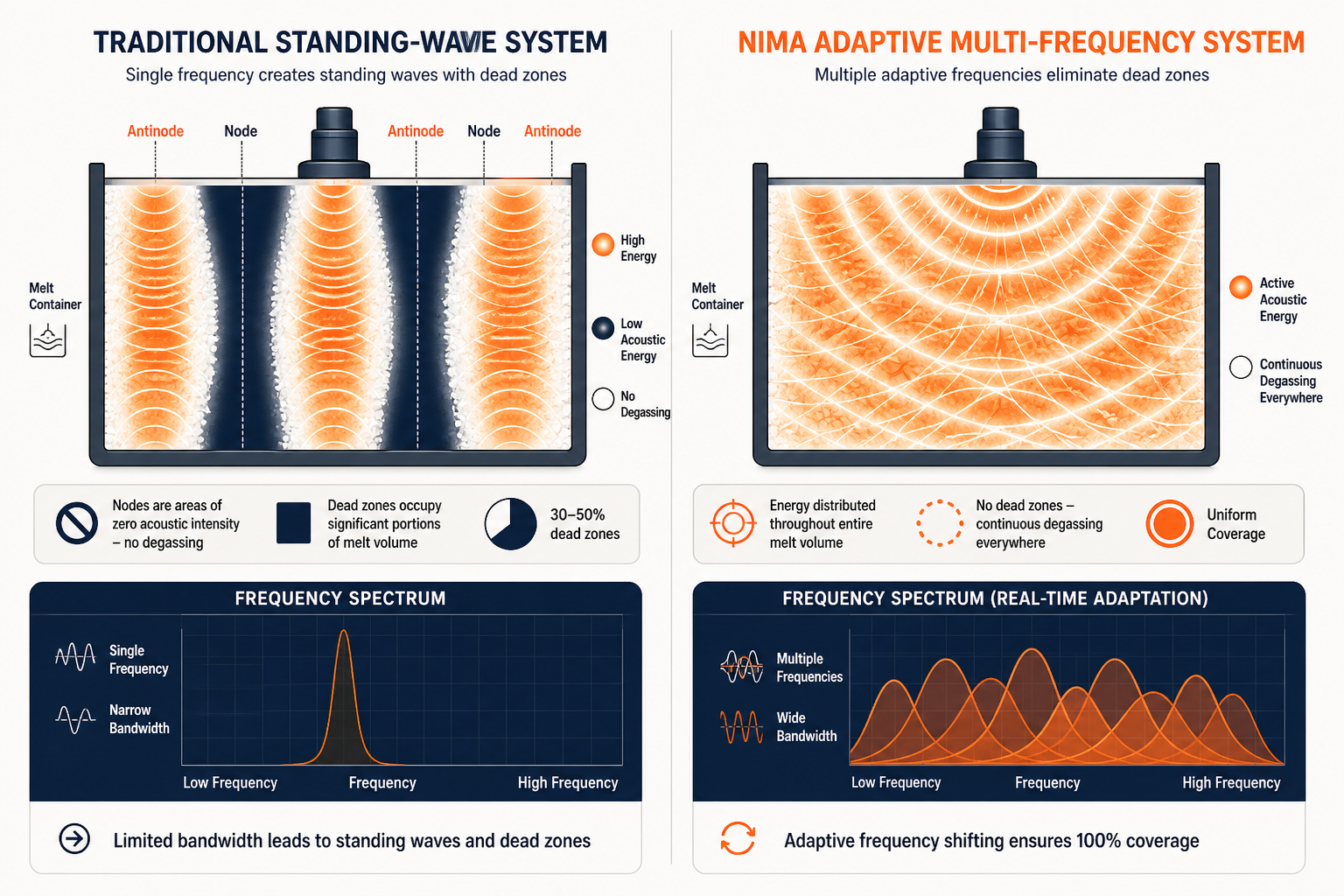
Standing-Wave Problem: Traditional ultrasonic generators (even at 25 kHz, the standard for molten metal degassing) create standing-wave resonances in large volumes-zones of high amplitude separated by near-zero amplitude nodes. Pockets of melt in the nodes get little to no acoustic energy; pockets in the antinodes can experience over-treatment and bubble coalescence (which defeats the purpose). For a 500 kg furnace, dead zones can occupy 30–50% of the volume, gutting overall efficiency.
NIMA Solution: Sialon Ceramics’ 20 years of R&D in ultrasonic systems resulted in adaptive, multi-frequency generator software that detects resonance patterns in real-time and shifts frequency to avoid standing waves. The patent-pending “no-standing-waves” algorithm adjusts operating frequency across a band (typically 20–30 kHz) multiple times per second, ensuring uniform acoustic energy distribution throughout the melt. The result: uniform cavitation density across the entire volume, uniform degassing, and repeatable results batch after batch.
Specifications:
- Power output: 1–5 kW (configurable for melt volume)
- Operating frequency: 20–30 kHz (adaptive multi-frequency)
- Cooling: Air-cooled or water-cooled piezoelectric transducers
- Control interface: Programmable logic controller (PLC) with real-time standing-wave detection and frequency modulation
Proprietary ceramic sonotrodes
The sonotrode (the transducer tip that couples acoustic energy into the molten glass) is the make-or-break component. Molten glass at 1,200–1,450°C is chemically aggressive and thermally brutal. Traditional graphite sonotrodes oxidize and degrade. Tungsten and molybdenum are brittle and prone to fracture under thermal shock. Titanium diffuses into the glass and contaminates it.
Sialon Ceramics’ solution: In-house-developed ceramic sonotrodes combining sialon (silicon aluminium oxynitride) and proprietary dopants. Properties:
- Non-wetting: Molten glass doesn’t adhere to the ceramic surface; no buildup or crusting that deadens acoustic transmission.
- Extreme thermal durability: Withstands repeated 1,200–1,450°C cycles without cracking. Fracture toughness is 2–3× higher than graphite alternatives.
- High Young’s Modulus: Acoustic impedance matching maximizes energy transfer into the melt. Lower acoustic losses than graphite.
- Proven lifespan: Industrial deployments show 5+ years of continuous operation before erosion requires replacement. Graphite sonotrodes typically last 6–12 months.
Proven track record at scale
Sialon Ceramics has deployed NIMA systems at industrial glass furnaces treating up to 400 kg per cycle-the largest documented industrial-scale ultrasonic degassing deployment. Independent peer-reviewed evaluation (Springer, 2026) confirmed:
- Degassing efficiency: 20% faster than rotary/chemical methods
- Porosity reduction: 75–85% of dissolved gases removed; <20 ppm residual
- Oxide inclusions: 6-fold reduction vs. baseline, 2-fold vs. chemical fining alone
- Mechanical properties: Yield strength +210 MPa, tensile strength +303 MPa, elongation +6% (measured on cast test samples)
For glass furnaces, the same physics applies: hydrogen and oxygen dissolution rates, cavitation bubble dynamics, and acoustic streaming work identically in molten glass as in molten aluminium. Early-stage deployments at specialty glass manufacturers (borosilicate labs, optical-grade float glass) report similar efficiency gains and quality improvements.
The trade-off: when chemical fining still makes sense
Ultrasonic degassing isn’t a universal fit-no technology is. Chemical fining remains the right choice if:
- Your furnace is small (<50 kg batches) and capital equipment cost outweighs energy savings.
- Your composition is very simple (standard soda-lime container glass) where 50–80 ppm residual porosity is acceptable.
- Your facility has no external power supply infrastructure for a 1–5 kW ultrasonic system (though this is rare in developed markets).
For everything else-optical glass, borosilicate laboratory ware, specialty compositions, any application where porosity-driven defects currently plague your scrap rates-ultrasonic degassing has crossed the threshold from “nice to have” to “hard to justify not doing.”
Getting Started With Ultrasonic Degassing of Molten Glass: what to evaluate
If you’re considering ultrasonic degassing for your furnace:
- Baseline your current porosity. Measure dissolved gas content in your melt (vacuum extraction, density index testing, or optical haze if you’re targeting optical applications). Establish current defect rates and scrap attributable to porosity.
- Contact Sialon Ceramics for a pilot trial. They offer free webinars and technical consultation to assess your specific composition and furnace volume. A 1–2 week trial on a non-critical campaign gives you real data-your porosity numbers, your defect reduction, your energy impact.
- Model the financial return. Factor energy savings (15–30%), reduced scrap (defect rate improvement), accelerated throughput (faster degassing cycles), and equipment cost. Most mid-sized producers see payback in 18–36 months.
- Plan sonotrode integration. NIMA systems mount directly into existing furnace ports or access points. Installation is straightforward (a few days downtime), and the ceramic sonotrode requires minimal maintenance compared to graphite or rotary gear.
Try Sialon Ceramics – start your degassing pilot
Sialon Ceramics has spent two decades perfecting ultrasonic treatment of molten glass. Their NIMA industrial generators and proprietary ceramic sonotrodes have proven superior degassing efficiency, energy savings, and optical quality at the scale where it matters-500+ kg furnaces processing demanding compositions. If you’re wrestling with porosity-driven defects, energy costs on traditional fining, or compliance pressure on chemical additives, they’ve solved the problem. Visit their website, sit in on a webinar, and request a technical evaluation for your specific application.
Frequently Asked Questions
Will ultrasonic treatment damage my glass furnace refractories?
No. Ultrasonic energy is purely acoustic vibration, not thermal. The sonotrode vibrates at 25 kHz at melt temperature-no external heating. Sialon Ceramics’ NIMA systems operate safely within standard furnace thermal regimes.
Can I retrofit an ultrasonic system into an existing furnace?
Yes. NIMA generators mount into standard furnace access ports. Installation typically requires 2–3 days of downtime. No furnace redesign needed, making retrofit straightforward for operating facilities.
Does ultrasonic degassing work on all glass compositions?
Effectively, yes. Cavitation physics-bubble nucleation, acoustic streaming, collapse jets-are composition-independent. Soda-lime, borosilicate, fused silica, and specialty lead glass all respond predictably. Extremely high-viscosity compositions degrade efficiency slightly but remain treatable.
How often do ceramic sonotrodes need replacement?
Sialon ceramics typically last 5+ years in continuous industrial service (8,000+ operating hours)-5–10× longer than graphite alternatives. Replacement is a straightforward bolt-swap requiring no specialized tools.
What’s the typical electrical power requirement for NIMA systems?
NIMA generators operate on standard three-phase industrial power at 1–5 kW (configurable for melt volume). Air-cooled versions need ambient ventilation; water-cooled versions require cooling-water infrastructure but are more compact.