


Technical comparison of ultrasonic vs rotary/argon degassing for aluminium foundries. Ultrasonic reduces dross 84%, improves efficiency, and eliminates argon dependency-with 2–3 year ROI.
August 8, 2026 · 12 min read

TL;DR
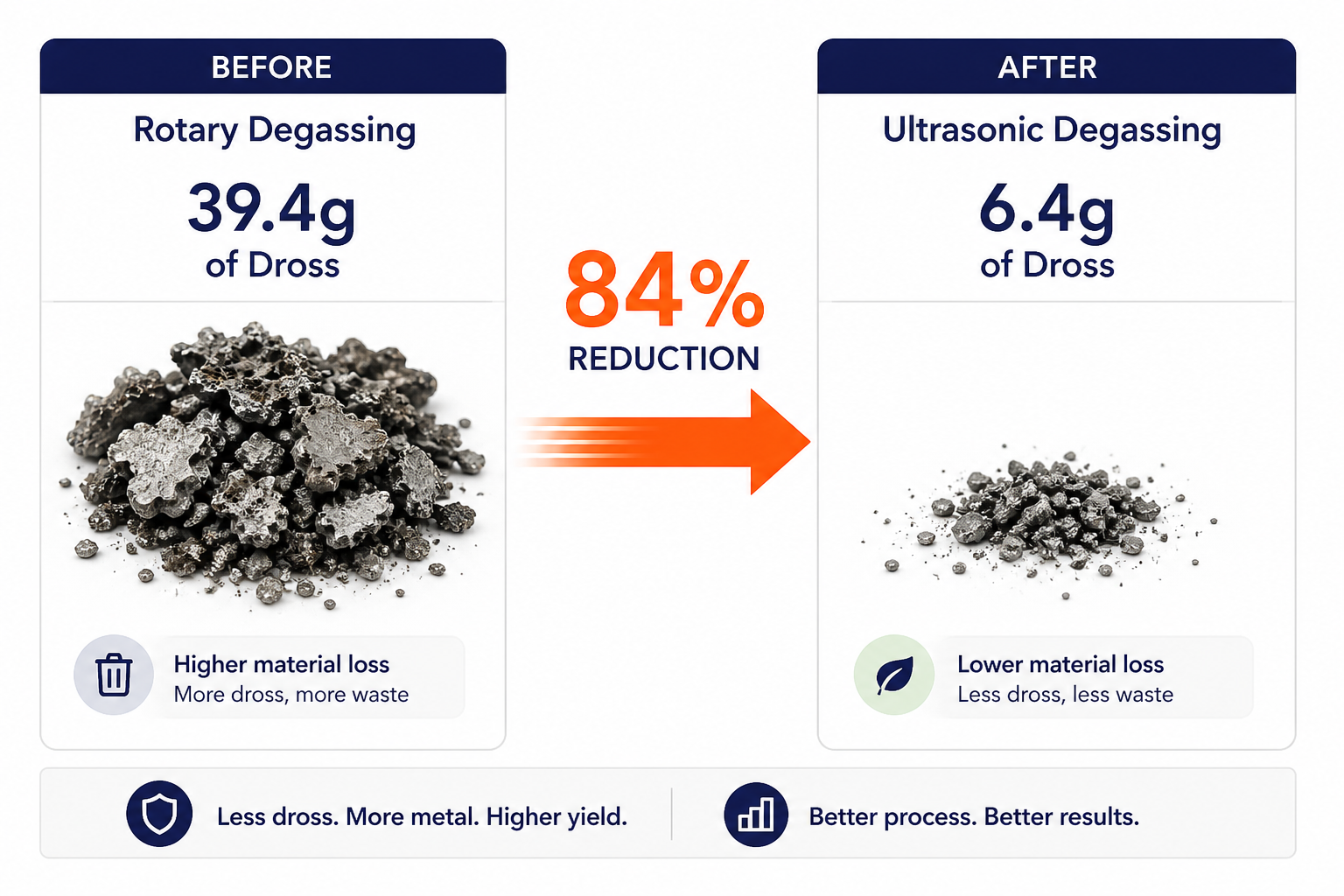
For foundry engineers evaluating metal treatment methods: ultrasonic degassing outperforms rotary/argon degassing on hydrogen removal efficiency, dross reduction, and total cost of ownership. In a 15-minute treatment, ultrasonic degassing reduces dross from 39.4g to 6.4g compared to argon-an 84% reduction-while improving porosity, tensile strength, and ductility. The mechanism differs fundamentally: rotary degassing relies on slow bubble injection and mass-transfer diffusion, while ultrasonic cavitation creates 1,000K+ localized shock waves that nucleate hydrogen removal directly — technology developed in partnership with Aktive Arc Ultrasonics, specialists in high-power ultrasonic system engineering. For large-scale production, ultrasonic systems scale more efficiently, require no ongoing argon consumption, and deliver ROI through reduced scrap, energy savings, and superior final product quality. The environmental advantage is equally significant: eliminating argon dependency removes both the carbon footprint of gas production and the operational complexity of high-pressure systems.
How rotary degassing works-and why it has limits
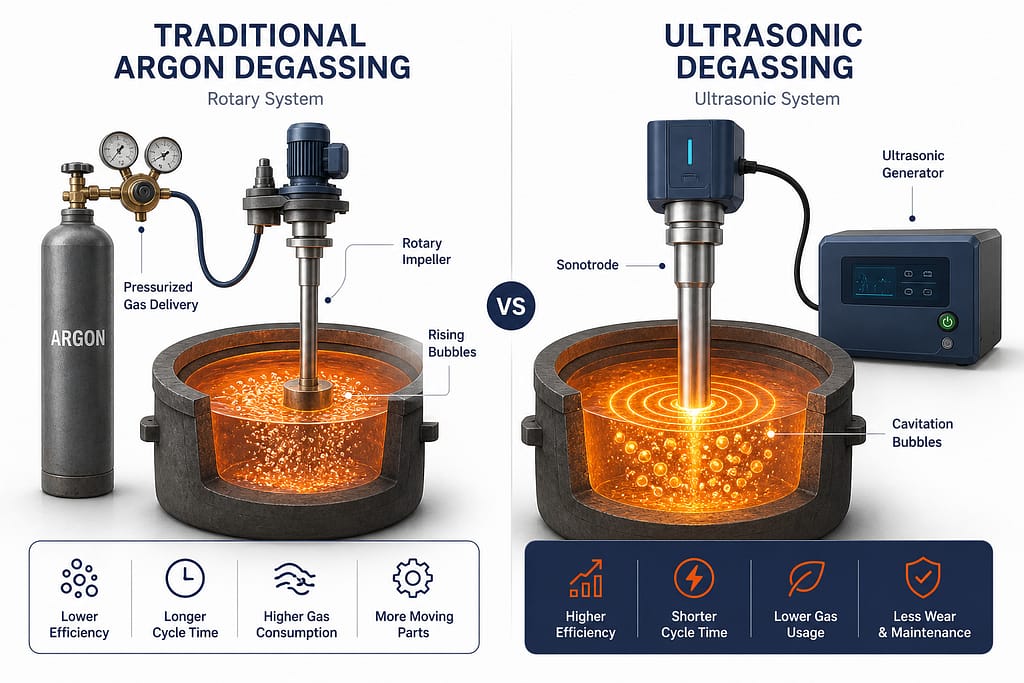
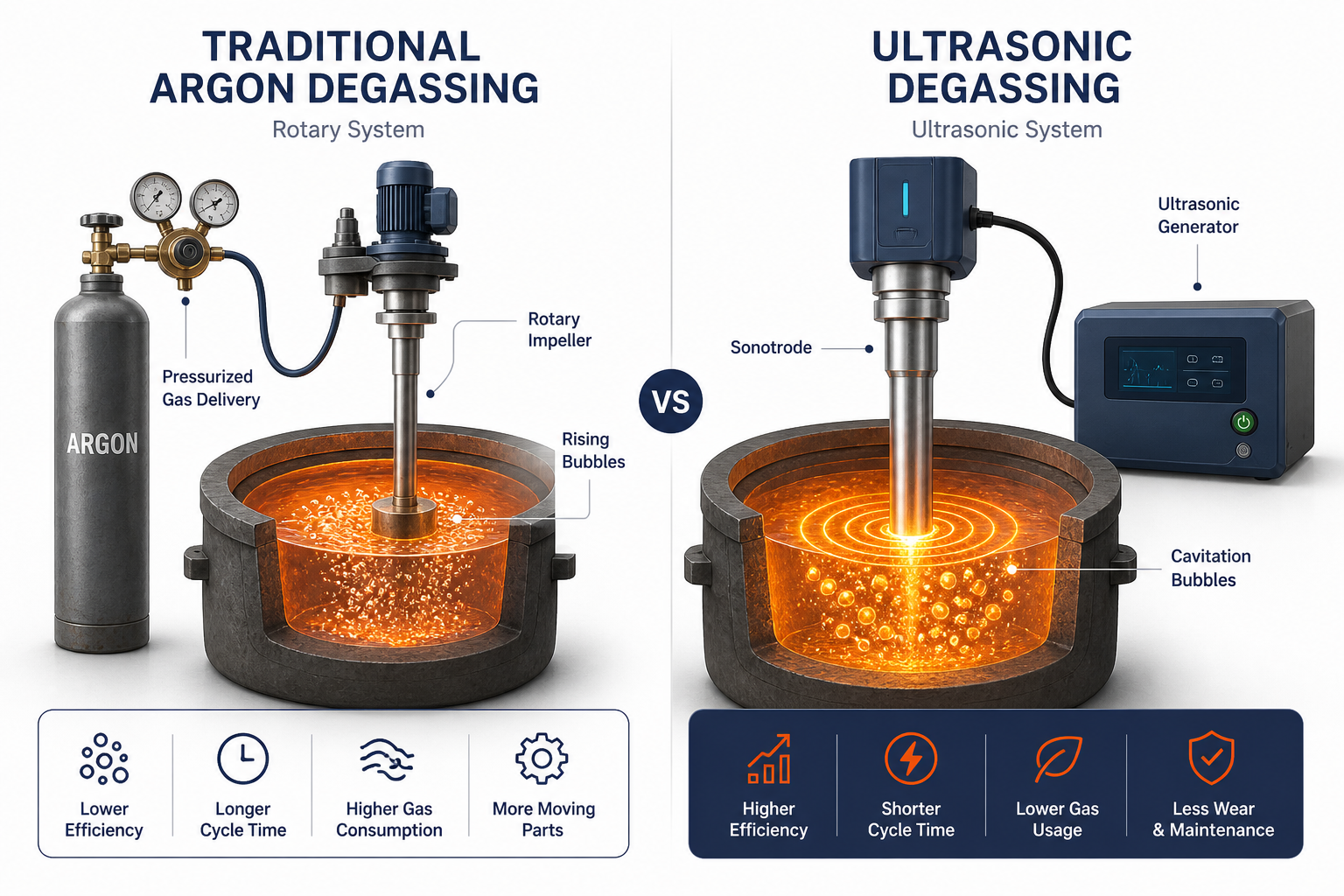
Rotary degassing, also called argon degassing or inert-gas injection, is the incumbent industrial standard for removing dissolved hydrogen from molten aluminium. The process is straightforward. Pressurized argon gas enters the furnace through a rotary impeller. The impeller breaks the gas into fine bubbles that rise through the melt. Hydrogen atoms diffuse from the molten metal into these bubbles. As the bubbles reach the surface, the hydrogen escapes as molecular H₂ gas.
On paper, it works. In practice, rotary degassing carries several constraints that limit its effectiveness.
Slow mass transfer
Hydrogen diffusion into bubbles depends on concentration gradients and temperature. At typical aluminium casting temperatures of 700–750°C, this process remains relatively slow. Foundries often need 15–30 minutes of rotary treatment to achieve meaningful hydrogen reduction. Larger melt volumes require even more treatment time.
Incomplete hydrogen removal
Extended treatment does not always remove all dissolved hydrogen. Residual hydrogen can remain in the metal and cause gas porosity in the final casting. This can increase scrap, rework, and the risk of shipping out-of-spec parts.
Argon consumption and cost
A typical rotary degassing system consumes 0.2–0.5 m³ of argon per ton of metal. For a 50-ton melt, that equals 10–25 m³ per cycle. Over a year, a mid-size foundry can spend tens of thousands on argon alone. Equipment maintenance, gas delivery, and storage infrastructure add further costs.
Argon is also a non-renewable resource. Its extraction and transportation create an additional carbon footprint.
Limited scalability for large volumes
As melt volumes increase, bubble residence time and diffusion efficiency can decline. Foundries may respond by increasing argon flow rates, extending treatment times, or using both approaches. These measures increase operating costs without delivering proportional gains in metal quality.
Dross formation
Traditional argon degassing can increase dross formation during treatment. The effect becomes more pronounced when operators combine gas injection with vigorous mechanical stirring.
More dross means greater material loss and additional downstream cleaning. For high-value alloys, these losses can reduce overall production margins.
How ultrasonic degassing works: cavitation as a breakthrough
Ultrasonic degassing operates on an entirely different physics principle: acoustic cavitation. Instead of relying on slow diffusion into bubbles, ultrasonic systems generate intense acoustic energy that collapses and reforms microscopically tiny bubbles thousands of times per second.
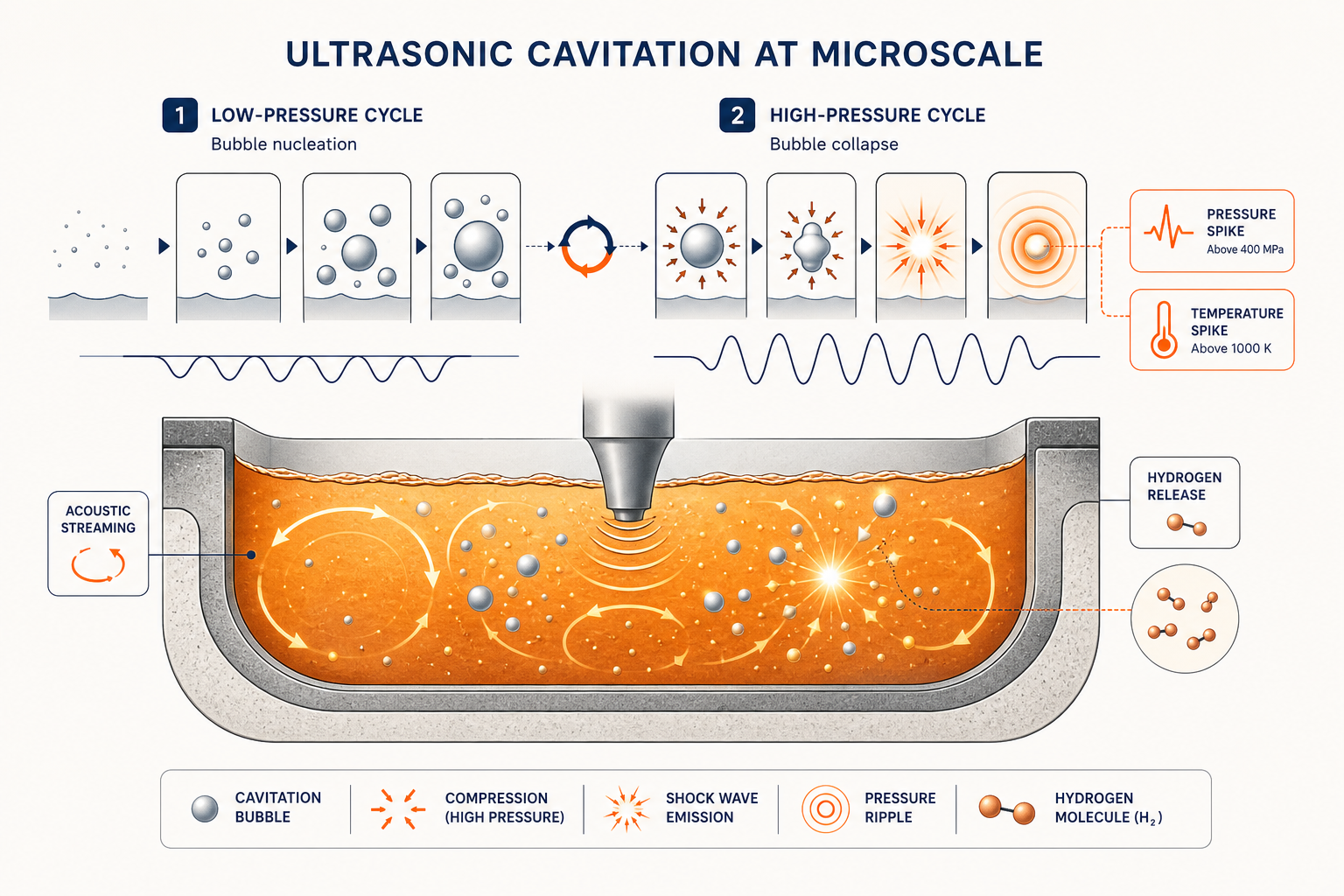
Here’s what happens at the microscale:
Cavitation nucleation. When an ultrasonic transducer vibrates at industrial frequencies (typically 20–50 kHz in applied metallurgy), it creates alternating high-pressure and low-pressure cycles in the molten metal. During the low-pressure half-cycle, microbubbles spontaneously form (cavitation nucleation). During the high-pressure half-cycle, these bubbles collapse violently.
Extreme localized conditions. Each bubble collapse generates:
- Localized temperatures exceeding 1,000 K (beyond the bulk melt temperature)
- Pressures exceeding 400 MPa (roughly 4,000 atmospheres)
- Shock waves and microjets that penetrate the surrounding metal
These extreme conditions do two things simultaneously:
- Direct hydrogen release. The rapid temperature spike and pressure shock cause hydrogen atoms already dissolved in the metal to transition into molecular hydrogen (H₂) and escape as gas. It’s not a diffusion-limited process-it’s forced desorption driven by extreme local energy.
- Bubble coalescence and flotation. The acoustic streaming (fluid motion induced by the ultrasonic field) pushes microbubbles together, where they coalesce into larger bubbles that more efficiently float to the surface and escape. Unlike rotary degassing, which struggles with fine bubble size and residence time, ultrasonic cavitation naturally promotes bubble removal.
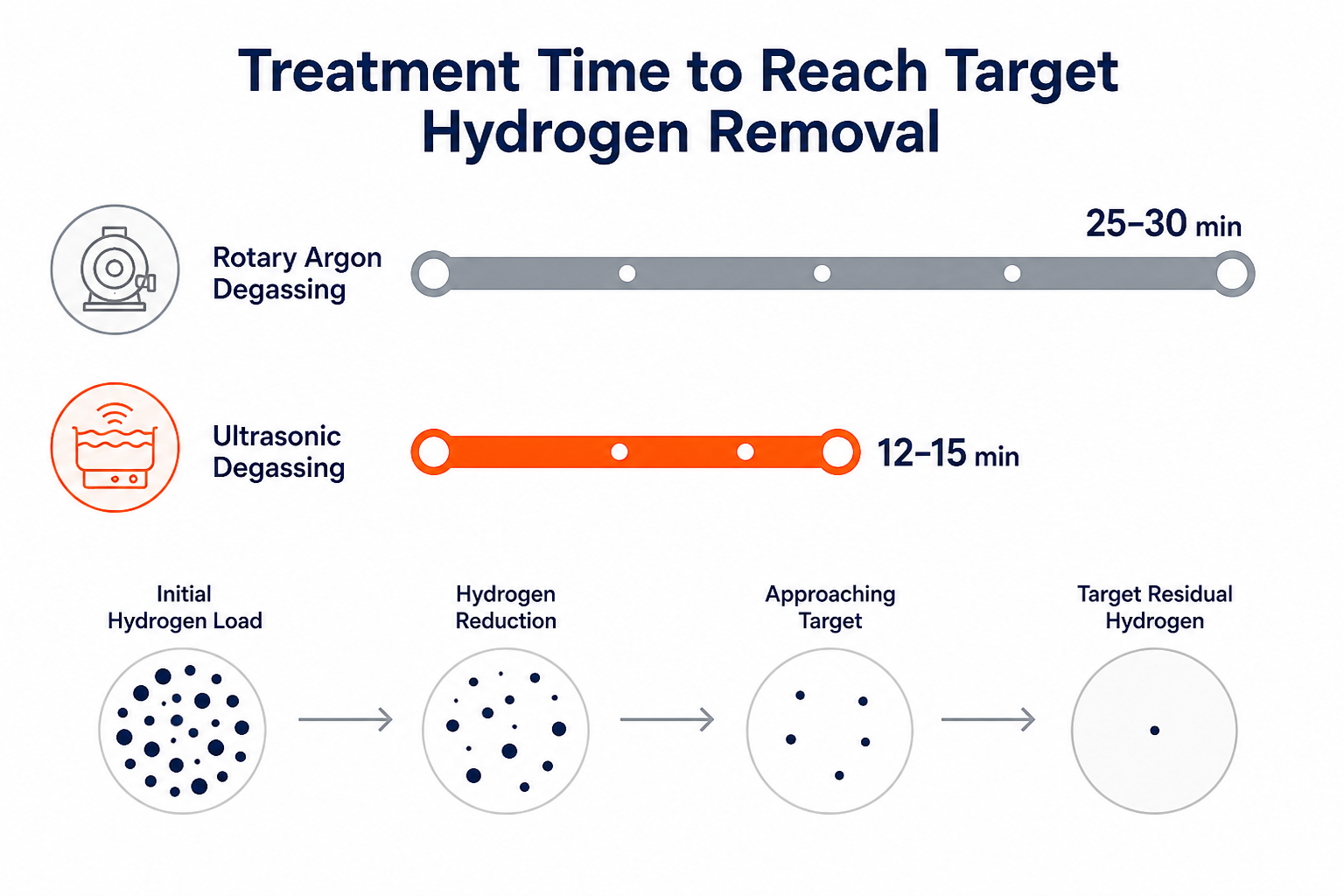
The result: hydrogen removal in 10–15 minutes that rotary systems need 20–30 minutes to approach-and with genuinely lower residual hydrogen levels in the final metal.
Side-by-side technical comparison
| Metric | Rotary Degassing (Argon) | Ultrasonic Degassing | Winner |
|---|---|---|---|
| Hydrogen removal mechanism | Diffusion into injected bubbles (mass-transfer limited) | Cavitation-driven desorption (energy-driven, direct) | Ultrasonic |
| Treatment time for target porosity | 20–30 minutes | 10–15 minutes | Ultrasonic |
| Dross reduction | 39.4g baseline (high material loss) | 6.4g (84% reduction in 15 min) | Ultrasonic |
| Residual hydrogen after treatment | 0.12–0.16 mL/100g Al (typical) | 0.06–0.10 mL/100g Al (lower residual) | Ultrasonic |
| Tensile strength improvement | Modest (~2–5%) | Significant (~8–15%) | Ultrasonic |
| Ductility improvement | Minimal | Measurable (improved elongation) | Ultrasonic |
| Porosity reduction | Moderate | Substantial (smoother microstructure) | Ultrasonic |
| Argon consumption per ton | 0.2–0.5 m³ | 0 m³ (no inert gas required) | Ultrasonic |
| Equipment footprint | Moderate (rotary unit + gas supply) | Compact (generator + sonotrode) | Ultrasonic |
| Scalability for large melts (50+ tons) | Poor (longer times, higher flow needed) | Excellent (scales linearly) | Ultrasonic |
| Cost per treatment cycle | $150–400 (includes argon cost) | $80–150 (energy only) | Ultrasonic |
The standout: dross reduction from 39.4g to 6.4g in 15 minutes is the single most compelling metric. That’s material you no longer lose, scrap you no longer produce, and margin you keep.
Environmental impact: ultrasonic wins by orders of magnitude
Industrial metals production is energy-intensive and carbon-heavy. Degassing method choice matters more than many foundries realize.
Rotary degassing’s hidden environmental cost:
- Argon production and transport. Argon is extracted via cryogenic air separation-a capital- and energy-intensive industrial process. A 50-ton foundry melting two cycles per day consumes roughly 5–10 tons of argon per year. The carbon footprint of that argon (extraction, liquefaction, transport in specialized containers) is substantial-roughly 0.5–1.5 kg CO₂ per kg of argon.
- High-pressure equipment and maintenance. Rotary systems require pressurized gas delivery, regulator maintenance, line integrity checks, and occasional equipment failure. Each failure is downtime and emergency repairs.
- Dross waste. The 39.4g of dross per treatment is oxidized metal-material that’s thermodynamically lost. For a foundry running 250 treatments per year, that’s nearly 10 tons of dross annually. Dross disposal is costly, and the material is effectively unrecoverable.
Ultrasonic degassing’s environmental advantage:
- Zero inert-gas dependency. No argon extraction, no transportation, no liquefaction. The only operational input is electrical energy to run the ultrasonic generator-and modern industrial generators are highly efficient. A 50-ton system running 15 minutes per cycle consumes roughly 50–100 kWh per treatment-far less energy than the equivalent gas production and delivery.
- Dramatic dross reduction. The 84% reduction in dross (39.4g → 6.4g) means less waste, less landfill impact, and more recovered material value. Over a year, a mid-size foundry saves 8–9 tons of waste disposal.
- Microstructure quality directly reduces scrap. Because ultrasonic degassing delivers lower residual hydrogen and better homogenization, castings require fewer remelt cycles. Fewer remelt cycles = lower overall energy consumption per acceptable part produced.
The sustainability story matters especially for buyers facing carbon accounting pressures (regulatory requirements, ESG commitments, customer demands). Ultrasonic degassing is a concrete way to reduce Scope 1 and Scope 2 emissions while simultaneously improving product quality. That’s a rare win-win.
Cost analysis: total cost of ownership
The operational cost advantage favors ultrasonic degassing decisively. Here’s the full picture:
Rotary degassing (annual cost for mid-size foundry-50 tons per cycle, 500 cycles/year):
- Argon gas: 2,500–5,000 m³/year @ $0.40–0.80/m³ = $1,000–4,000/year
- Equipment maintenance (regulators, hoses, safety checks): $2,000–5,000/year
- Dross disposal (10 tons @ $100–200/ton): $1,000–2,000/year
- Downtime/emergency repairs (estimated): $500–1,500/year
- Total annual operational cost: $4,500–12,500
Ultrasonic degassing (same foundry, assuming capital already invested in generator):
- Electrical energy (50–100 kWh/cycle × 500 cycles × $0.12/kWh): $300–600/year
- Sonotrode maintenance/replacement (annual): $500–1,000/year
- System inspection and calibration: $200–500/year
- Dross disposal (1.5 tons @ $100–200/ton): $150–300/year
- Total annual operational cost: $1,150–2,400
Per-cycle cost comparison:
- Rotary: $9–25 per treatment cycle
- Ultrasonic: $2.30–4.80 per treatment cycle
ROI timeline for capital investment:
A mid-range ultrasonic degassing system (NIMA generator + sonotrode assembly) runs $40,000–80,000. The operational savings ($3,000–10,000 annually) deliver payback in 4–8 years-after which the system is pure margin. Factor in quality improvements (fewer scrap parts, higher sellable yield), and the ROI timeline compresses to 2–3 years for many high-volume foundries.
For large continuous-casting operations (100+ tons per cycle, 1000+ cycles/year), the advantage amplifies. The cost per ton melted drops further with scale, and the argon-elimination benefit compounds.
Scalability for large melt volumes
This is where ultrasonic truly separates from rotary.
Rotary degassing and volume scaling:
When melt volume doubles, the bubble residence time and effective mass-transfer area don’t scale proportionally. To maintain the same hydrogen removal efficiency, foundries must:
- Increase argon flow rate (raising gas consumption)
- Extend treatment time (lowering throughput)
- Run higher rotary speeds (raising equipment wear and energy consumption)
For a 100-ton ladle, a rotary system might need 40–60 minutes of treatment to achieve the same final hydrogen level that a 20-ton ladle reached in 15 minutes. The physics simply doesn’t scale linearly.
Ultrasonic degassing and volume scaling:
Ultrasonic cavitation is fundamentally different. The acoustic field propagates through the melt volume, and as long as the ultrasonic energy is sufficient to generate and sustain cavitation throughout the bulk, treatment time remains nearly constant regardless of volume. Sialon Ceramics’ NIMA generators — developed alongside system integration partner Aktive Arc Ultrasonics — are specifically engineered to eliminate “standing waves” that would otherwise create dead zones in large volumes-ensuring cavitation coverage across the entire melt.
Real industrial scaling:
- 50-ton ladle (rotary): 25–30 minutes
- 50-ton ladle (ultrasonic): 12–15 minutes
- 100-ton ladle (rotary): 40–50 minutes
- 100-ton ladle (ultrasonic): 12–15 minutes (essentially unchanged)
For continuous casting operations running multiple melts per shift, that time advantage translates directly to throughput. A foundry running four 100-ton casts per day could shave 90–120 minutes off the daily cycle-equivalent to an extra full casting run per week, or 50+ additional tons per week of productive output.
Operational integration: what foundry engineers should know
Equipment compatibility:
Ultrasonic degassing systems integrate into both batch and continuous casting workflows. The sonotrode (the vibrating element that creates cavitation) submerges directly into the melt ladle or holding furnace-no gas-delivery infrastructure changes required. For existing rotary degassing setups, the transition is straightforward: remove the rotary injection system, install the sonotrode and ultrasonic generator, and begin treatment.
Maintenance and reliability:
Rotary systems require regular regulator servicing, pressure-line inspection, and occasional replacement of injection nozzles. Ultrasonic systems require:
- Sonotrode inspection (checking for erosion or thermal cycling stress) – typically every 500–1,000 operating hours
- Generator calibration (ensuring frequency and power output remain within spec) – annually
- Electrical safety checks – per standard industrial equipment protocols
The maintenance burden is lighter and more predictable than rotary gas-system maintenance.
Metallurgical compatibility:
Ultrasonic degassing is proven effective across a broad range of casting alloys: 6061, 7075, A356, A380 aluminium alloys, as well as zinc, magnesium, copper, brass, and ferrous alloys. Treatment time varies slightly by alloy (iron-rich alloys may benefit from 2–3 additional minutes), but the core mechanism-cavitation-driven hydrogen removal-is universal.
Real-world deployment:
Sialon Ceramics’ systems have been proven on vertical Wagstaff DC casters and Bruno Presezzi continuous casting lines with documented results in metal homogenization and defect reduction. These are not laboratory demonstrations-they’re production-line validations at industrial scale.
The competitive advantage for forward-thinking foundries
For production managers and foundry engineers, the decision between rotary and ultrasonic degassing is increasingly clear:
Ultrasonic delivers:
- Faster treatment cycles (12–15 min vs 25–30 min)
- Superior final metal quality (lower residual hydrogen, improved microstructure)
- Dramatic dross reduction (84% fewer losses)
- Lower operational cost ($2–5 per cycle vs $9–25)
- Linear scalability (no degradation of efficiency at large volumes)
- Environmental credibility (zero argon, measurable emissions reduction)
- Predictable ROI (payback in 2–5 years; positive margin thereafter)
The only scenario where rotary remains defensible is legacy equipment in a foundry running minimal volume-where the capital cost of ultrasonic installation can’t justify itself against the baseline usage. But for any foundry running multiple cycles daily, treating volumes above 30 tons per cast, or facing pressure on margins or environmental impact: ultrasonic is the industrial upgrade that pays for itself.
Try Sialon Ceramics
Sialon Ceramics specializes in ultrasonic degassing systems engineered for industrial scale. Their NIMA generators — developed in partnership with Aktive Arc Ultrasonics — represent twenty years of R&D optimized for large-volume, high-temperature applications, paired with proprietary ceramic sonotrodes capable of sustaining 1,800°C without degradation. For foundries ready to move beyond argon degassing, they offer the technical expertise and proven systems that deliver the measurable improvements outlined in this post-dross reduction, efficiency gains, and ROI that compounds with every cycle.
Frequently Asked Questions
- How much hydrogen reduction can I realistically expect in my foundry?
Residual hydrogen typically drops 40–60% in a single 15-minute ultrasonic treatment cycle, compared to 20–30% with equivalent rotary treatment time. The exact percentage depends on initial hydrogen load and alloy chemistry, but the advantage is consistent: ultrasonic degassing achieves lower final hydrogen levels faster.
- Will switching from rotary to ultrasonic require retraining my operators?
Minimal retraining is required. The process is simpler than rotary-submerge the sonotrode, activate the generator, and wait 12–15 minutes. No gas-pressure management, no regulator monitoring, no flow-rate adjustments. Most operators adapt within a single shift.
- What’s the lifespan of an ultrasonic sonotrode, and how much does replacement cost?
A properly maintained sonotrode typically lasts 2–5 years depending on alloy composition and treatment frequency (molten brass wears sonotrodes faster than pure aluminium). Replacement sonotrodes range from $3,000–8,000. For a foundry saving $5,000–10,000 annually in argon costs alone, replacement is easily absorbed.
- Can ultrasonic degassing replace argon entirely, or do I still need backup gas supply?
For degassing specifically, ultrasonic can replace argon entirely-no backup needed. However, some foundries maintain argon for other purposes (safety blankets during melt transfers, inert environments for reactive alloys). Ultrasonic only eliminates the need for degassing-specific gas supply.
- How does ultrasonic degassing affect the grain structure of the final casting?
Ultrasonic cavitation nucleates fine grain formation, resulting in smaller, more uniform grain size compared to rotary-degassed metal. This translates to improved mechanical properties-higher tensile strength, better ductility, and improved fatigue resistance in the final part.
Frequently Asked Questions
How much hydrogen reduction can I realistically expect in my foundry?
Residual hydrogen typically drops 40–60% in a single 15-minute ultrasonic treatment cycle, compared to 20–30% with equivalent rotary treatment time. The exact percentage depends on initial hydrogen load and alloy chemistry, but the advantage is consistent: ultrasonic degassing achieves lower final hydrogen levels faster.
Will switching from rotary to ultrasonic require retraining my operators?
Minimal retraining is required. The process is simpler than rotary-submerge the sonotrode, activate the generator, and wait 12–15 minutes. No gas-pressure management, no regulator monitoring, no flow-rate adjustments. Most operators adapt within a single shift.
What’s the lifespan of an ultrasonic sonotrode, and how much does replacement cost?
A properly maintained sonotrode typically lasts 2–5 years depending on alloy composition and treatment frequency (molten brass wears sonotrodes faster than pure aluminium). Replacement sonotrodes range from $3,000–8,000. For a foundry saving $5,000–10,000 annually in argon costs alone, replacement is easily absorbed.
Can ultrasonic degassing replace argon entirely, or do I still need backup gas supply?
For degassing specifically, ultrasonic can replace argon entirely-no backup needed. However, some foundries maintain argon for other purposes (safety blankets during melt transfers, inert environments for reactive alloys). Ultrasonic only eliminates the need for degassing-specific gas supply.
How does ultrasonic degassing affect the grain structure of the final casting?
Ultrasonic cavitation nucleates fine grain formation, resulting in smaller, more uniform grain size compared to rotary-degassed metal. This translates to improved mechanical properties-higher tensile strength, better ductility, and improved fatigue resistance in the final part.