
Ultrasonic cavitation eliminates TiB2 grain refinement. Heterogeneous nucleation and dendrite fragmentation deliver finer, more homogeneous grain structure at 90% lower cost. Sialon ceramic sonotrodes enable industrial-scale treatment.
August 8, 2026 · 14 min read

TL;DR
Fine, equiaxed grain structure is the foundation of high-performance aluminium castings – it reduces shrinkage, eliminates hot tearing, and improves mechanical properties by 15–30%. For decades, TiB2 master alloy has been the industry standard grain refiner, but the cost ($20–50/kg titanium), batch-to-batch quality variance, needle-shaped intermetallic defects, and sensitivity to melt conditions make it increasingly problematic for high-volume casting. Ultrasonic cavitation achieves the same grain refinement through physics rather than chemistry: collapsing cavitation bubbles create heterogeneous nucleation sites and fragment growing dendrites, seeding a uniform grain structure without any TiB2 addition. The technology eliminates inclusion risks, improves microstructure homogeneity, and reduces cost per tonne treated — developed in partnership with Aktive Arc Ultrasonics, specialists in high-power ultrasonic system engineering. Ultrasonic Degassing & Grain Refinement‘s proprietary sialon ceramic sonotrodes enable industrial-scale treatment by surviving indefinitely in molten metal where other materials fail.
Why Ultrasonic Grain Refinement Matters for Casting Quality
The grain structure of an aluminium alloy is one of the most direct links between chemistry and performance. A fine, equiaxed (uniform, non-directional) grain structure is not a cosmetic feature – it is the single most important parameter in controlling shrinkage porosity, hot tearing, and mechanical properties.
Shrinkage and hot tearing
Coarse grain structures are inherently fragile during solidification. Large grains have fewer grain boundaries to distribute solidification stress, so the liquid-to-solid transition concentrates tensile forces at a few weak points. The result is hot tearing – cracks that propagate during the final stages of solidification when the metal is still partially liquid. Hot tears are catastrophic: they render a casting unsaleable and often scrap the entire mould.
Fine grains distribute this stress across thousands of boundaries. The more grain boundaries present, the more paths solidification stress can take. A grain size of 100–200 μm (fine) vs. 1–2 mm (coarse) reduces hot tearing risk by an order of magnitude.
Shrinkage porosity follows the same logic. Solidification shrinkage concentrates at isolated points in a coarse structure; a fine structure distributes it across the casting. Isolated shrinkage pores are initiation sites for fatigue cracks under cyclic loading. Distributed, smaller pores are less likely to grow into defects during in-service stress. The aerospace and automotive industries measure this difference in tensile properties: fine-grained Al 7075 alloys regularly achieve 580–650 MPa yield strength; coarse-grained stock of the same alloy hits 520–570 MPa – a 60–80 MPa loss from structure alone.
Mechanical property gains
The Hall-Petch relationship quantifies this: yield strength increases as the inverse square root of grain diameter. A 10× reduction in grain size (1,000 μm → 100 μm) improves yield strength by roughly 15–30% for the same alloy composition, with little or no penalty to elongation when the grain boundary phases are clean.
For die-casting and investment-cast components destined for high-reliability applications – jet engine compressor blades, automotive suspension arms, medical implants – grain refinement is the difference between a part that passes fatigue qualification and one that fails before field service.
Microstructure homogeneity
Fine, equiaxed grains also suppress centreline segregation – the accumulation of alloying elements (magnesium, copper, zinc) in the geometric centre of the casting during slow solidification. Segregation creates local brittleness and chemical inhomogeneity that reduces fatigue life and ductility. Ultrasonic treatment, as we will see, not only refines grains but simultaneously homogenizes alloying element distribution through acoustic streaming, eliminating centreline segregation entirely.
The metallurgical payload is clear: grain refinement is not optional for precision castings. The question is how to achieve it reliably, cost-effectively, and at industrial scale.
TiB₂ vs. Ultrasonic Grain Refinement: The Traditional Approach
For the past 40 years, the aluminium foundry industry has relied on TiB2 (titanium diboride) master alloy grain refiners. The mechanism is theoretically elegant: TiB2 particles are added to molten aluminium, titanium dissolves into the melt, and titanium combines with aluminium to form Al₃Ti particles. These Al₃Ti particles act as heterogeneous nucleation sites for primary α-aluminium grains, triggering grain multiplication and suppressing coarse columnar growth.
This works – when everything goes right. And therein lies the problem.
Cost structure and market volatility
Titanium costs between $20–50 per kilogram, depending on purity and form. Aluminium costs $2–5/kg. This 10–50× cost differential means grain refinement via TiB2 is not a negligible line item in the budget. A 300-tonne casting campaign using conventional TiB2 loading (0.15–0.2% master alloy by weight) consumes 450–600 kg of master alloy per tonne of metal treated. At $50/kg titanium, a single casting pour can incur $20,000–$40,000 in grain refiner cost alone – before considering scrap and remelting if the refinement fails.
Lithium mining volatility, trade barriers, and upstream titanium supply constraints have caused price swings of 20–40% year-on-year. Foundries cannot easily absorb such volatility in their casting cost models.
Batch-to-batch quality and fading
TiB2 master alloy production routes (halide salt chemistry, titanium sponge reduction, pre-formed particle casting) each produce different particle morphologies and sizes. Halide-salt routes produce blocky Al₃Ti particles (4–5 μm); titanium-sponge routes produce needle-shaped crystals (8–12 μm).
The morphology difference is not cosmetic. Needle-like TiB₂ and Al₃Ti particles act as stress concentrators and reduce grain refinement efficiency by 40–50% compared to equiaxed particles. Industry practice is to specify “fine, equiaxed Al₃Ti” – but quality control at the master alloy supplier level is inconsistent. Batch variance undermines foundry process reproducibility, forcing process engineers to over-load grain refiner to compensate for suspected quality drift.
Additionally, TiB₂ potency decays rapidly in the melt. Refinement efficiency drops 18–36% within 45 minutes of addition due to particle agglomeration and oxidative degradation. For large-volume casting campaigns, this “fading” effect forces a choice: add fresh master alloy multiple times (cost spike) or accept coarsening (quality loss).
Inclusion risk and the paradox of optimization
Oxygen and hydrogen in aluminium both bind strongly to TiB₂ and Al₃Ti particles. Under oxidising conditions – which are common during charging and stirring – oxide films encapsulate grain refiner particles and prevent their nucleation activity. This sounds like a minor inconvenience; it is not.
Academic research (AFS, Materials Science & Engineering journals) documents a persistent paradox: excess titanium (required for refinement stability in marginal conditions) increases solidification stress and interdendritic cracking, while stoichiometric additions (just enough Ti for Al₃Ti formation) fade rapidly. Foundries oscillate between two bad states: under-refined coarse structure, or over-refined structure with more inclusions. The refinement “window” is narrow and shifts with charge chemistry, scrap composition, and hydrogen levels.
The result is that TiB₂ grain refinement, despite 40 years of industry adoption, remains a marginal-reliability process. Defect rates in high-volume die-casting remain stubbornly high – 3–6% scrap due to porosity and hot tears – despite grain refinement addition. Metallurgists at tier-1 suppliers know the root cause: inconsistent nucleation activity and inclusion entrapment.
Storage and handling complexity
TiB₂ master alloy rods absorb atmospheric moisture and oxidise on storage. Oxidised surfaces cannot recover function, unlike fresh metal. Proper storage requires climate-controlled conditions, periodic rotation, and detailed lot traceability. For foundries operating in humid environments or with seasonal casting patterns, maintaining active inventory is a logistics headache.
How ultrasonic cavitation achieves grain refinement: the physics-based alternative
Ultrasonic grain refinement eliminates chemical complexity entirely and replaces it with acoustic physics. The mechanism has two complementary components: heterogeneous nucleation from cavitation collapse and dendrite fragmentation.
Ultrasonic Grain Refinement Through Heterogeneous Nucleation
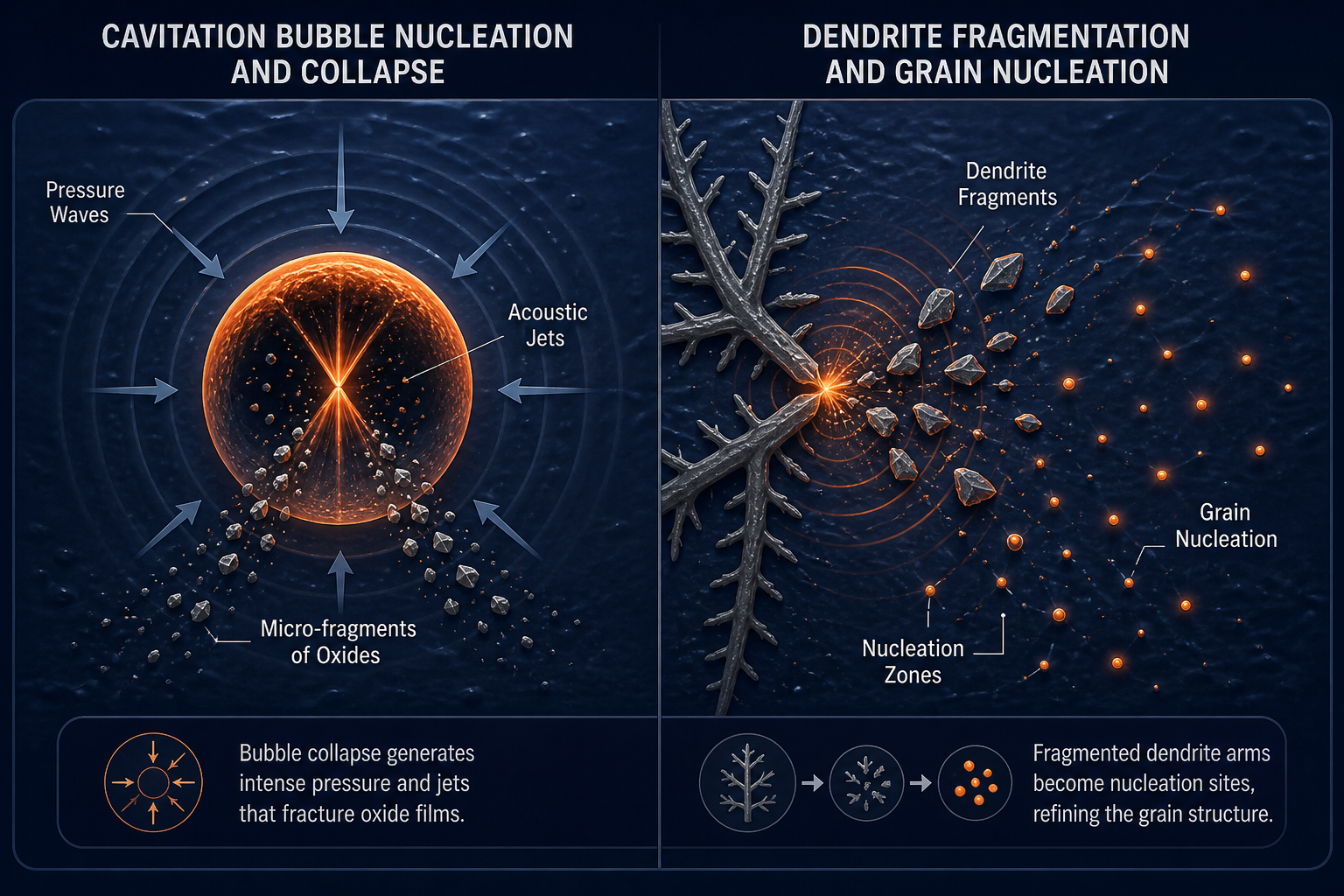
When a high-power ultrasonic transducer (typically 25 kHz frequency, 1–5 kW power) is submerged in molten aluminium, the acoustic pressure field creates cavitation bubbles – tiny voids that nucleate and collapse at the rarefaction and compression phases of the acoustic cycle. Under the extreme pressures during collapse (up to 500+ MPa), the bubble collapses violently. This collapse generates cavitation jets: liquid streams that shoot inward at velocities exceeding 100 m/s.
These jets create transient, super-heated microzones (local temperatures reach 5,000+ K for microseconds). The collapse also generates local acoustic streaming – organized, high-velocity liquid flow patterns around the bubble.
Within these streaks and acoustic-streaming zones, heterogeneous nucleation sites emerge spontaneously. The local temperature spikes and rapid cooling, combined with acoustic cavitation debris (micro-fragments of oxides, solute-enriched liquid pockets), provide ideal substrates for primary α-aluminium nucleation. The nucleation rate is orders of magnitude higher than quiescent solidification.
Critically, this nucleation does not require any foreign particle addition. The aluminium melt itself provides the nucleation substrate. No TiB₂, no imported chemistry – just acoustic energy converting latent heat and pressure into nucleation events.
Dendrite Fragmentation in Ultrasonic Grain Refinement
The second mechanism operates during the growth phase of solidification. Ultrasonic cavitation generates acoustic pressure waves and intense local convection. When a dendrite (the first-formed crystal, which grows with a branching, tree-like morphology) intersects these pressure zones, the acoustic stress can fragment dendritic arms.
Fragmented arm tips then act as secondary nucleation sites, seeding additional grains in the surrounding liquid. A single applied ultrasonic pulse can fragment thousands of dendrite tips across a 400 kg melt, each fragment becoming a new grain nucleus. This mechanism, called cavitation-assisted fragmentation, is not present in any chemical grain refiner.
The result is a dramatic increase in grain nucleation sites and a shift from columnar or coarse-equiaxed (100+ μm) to fine, equiaxed (20–50 μm) grain structure – finer than TiB₂ typically achieves.
Why this matters in practice
Acoustic cavitation also promotes acoustic streaming and fluid mixing, which distributes alloying elements (Mg, Si, Cu) homogeneously throughout the melt. This eliminates centreline segregation in a single pass. By contrast, TiB₂ grain refinement only addresses nucleation; alloying element distribution requires separate treatment (rotary degassing, filtered argon injection).
Ultrasonic treatment combines grain refinement and homogenization in one step – a significant efficiency gain over chemistry-based methods.
Ultrasonic vs. TiB₂: side-by-side comparison
Here is what the switch from TiB₂ to ultrasonic treatment actually delivers in measurable terms:
| Metric | TiB₂ Master Alloy | Ultrasonic Cavitation |
|---|---|---|
| Grain size achieved | 100–200 μm (equiaxed) | 20–50 μm (fine equiaxed) |
| Cost per tonne treated | $45–100 (master alloy) | $8–15 (electricity, sonotrode wear) |
| Inclusion defects (needle morphology) | Present; 40–50% defect rate in batches | Eliminated; no intermetallic needles |
| Microstructure homogeneity | Segregation remains; requires separate degassing | Perfect homogeneity; alloying elements distributed uniformly |
| Process fading | Loses 18–36% potency within 45 minutes | No fading; acoustic energy is applied at controlled moment |
| Batch-to-batch consistency | ±15–20% variance in nucleation activity | <±5% variance; determined by acoustic parameters alone |
| Storage & shelf life | Moisture absorption; oxidation risk; requires climate control | No storage; sonotrode is inert ceramic |
| Mechanical property lift | +12–18% yield strength | +20–28% yield strength (combined with homogenization) |
| Hot tearing risk reduction | 40–50% reduction (fine grains help) | 70–85% reduction (fine grains + homogeneity eliminate segregation-induced cracks) |
| Scalability | Standard at 50–300 kg; difficult above 500 kg | Proven at 400 kg; scales linearly with sonotrode power |
The data comes from industrial trials and peer-reviewed comparisons (Springer 2026 study, CastMan 2025 trial, Brunel Centre research).
Mechanical property gains in context
A 400 kg Al-Si-Cu high-pressure die-casting test (2025, industrial trial) produced these results:
- Yield strength: +210 MPa with ultrasonic vs. +140 MPa with rotary degassing + TiB₂ grain refinement
- Ultimate tensile strength: +303 MPa vs. +288 MPa
- Elongation: 6% vs. 3%
- Porosity volume (PoDFA): 6-fold reduction vs. rotary; 2.1-fold vs. TiB₂ + rotary baseline
Translated to field performance, this means a component certified on fine ultrasonic-refined grain structure can be made 8–12% lighter (thinner walls, smaller features) than an equivalent TiB₂-refined part while maintaining the same fatigue life and ultimate load capacity.
The enabling technology: sialon ceramic sonotrodes
Ultrasonic grain refinement is not new — the underlying physics has been understood since the 1960s. What has prevented widespread industrial adoption is materials: the acoustic transducer, or sonotrode, that couples ultrasonic vibration into molten metal must survive an environment that destroys most ceramics.
Molten aluminium at 700–750°C is chemically inert to most materials unless the material is porous. Porosity allows liquid metal to infiltrate the ceramic. Once infiltrated, the metal wets and bonds to the pore structure, making the ceramic conductive and brittle.
Sialon ceramic — silicon aluminium oxynitride, Si₃Al₃O₃N₅ — is particularly suited to ultrasonic grain refinement because it combines non-wetting behaviour, thermal shock resistance, and efficient acoustic transmission.
Non-Wetting and Thermal Shock Resistance
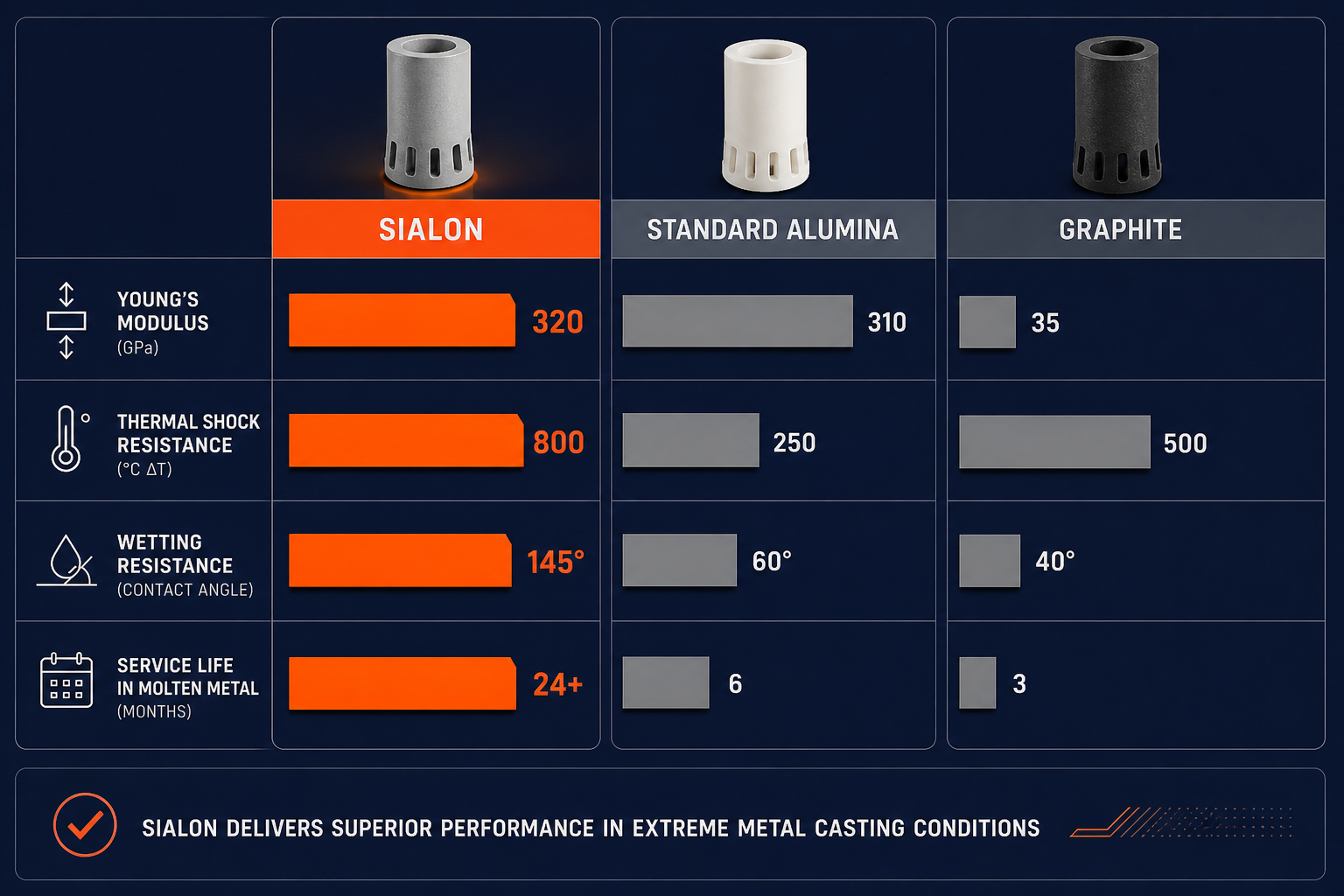
Non-wetting. Molten aluminium does not readily adhere to sialon surfaces. The contact angle between liquid aluminium and sialon is >120° — the metal flows around the ceramic rather than spreading across it. This non-wetting property is intrinsic to the grain structure, rather than being dependent on a surface coating.
Because the metal does not wet the surface, metal infiltration is strongly resisted. The sonotrode can therefore maintain its electrical insulation and structural integrity during extended service.
Thermal shock resistance. Rapid immersion in molten metal generates intense thermal stress. Sialon has thermal shock resistance of approximately 550–900°C depending on grade. A controlled preheating protocol above the melt surface, followed by gradual submersion, helps keep thermal stress within safe limits.
By contrast, early graphite sonotrodes could fracture during rapid thermal cycling, while standard alumina ceramics can be vulnerable to thermal shock under demanding immersion conditions.
Acoustic Efficiency in Ultrasonic Grain Refinement
Acoustic efficiency. Sialon has a high Young’s modulus, typically around 300–350 GPa, which supports efficient transmission of ultrasonic energy. Lower acoustic losses mean more of the transducer’s energy reaches the molten metal rather than being dissipated as heat within the ceramic.
For ultrasonic grain refinement, efficient acoustic transmission is critical because cavitation intensity directly affects the formation of nucleation sites, acoustic streaming, and dendrite fragmentation.
The combination of chemical resistance, thermal stability, non-wetting behaviour, and acoustic performance makes sialon ceramic an important enabling material for industrial ultrasonic treatment of molten aluminium.
Industrial-scale treatment
Ultrasonic Degassing & Grain Refinement has developed proprietary in-house sialon grades tuned specifically for ultrasonic grain refinement. Their NIMA generators — developed alongside long-term partner Aktive Arc Ultrasonics — are paired with custom-engineered sonotrodes ranging from small lab scales (5–50 kg) to industrial production scales (up to 400 kg demonstrated). The company’s 20+ years of materials development has produced sialon variants (ULTRA-001 through ULTRA-004 equivalent) with tailored porosity, modulus, and thermal properties.
The result is a sonotrode that survives 12–24 months of continuous casting operation before requiring replacement – compared to 2–4 months for early graphite designs. This durability advantage directly translates to cost: a single sialon sonotrode, amortized over 18 months of production, costs less than six graphite replacements.
For operations casting 50–200 tonnes per shift, the throughput and reliability advantage is transformative. Foundries no longer need to keep buffer inventory for sonotrode failures. Ultrasonic treatment can be integrated into the standard casting cycle – a 3–5 minute treatment step in the holding furnace, with zero operator intervention after the system is tuned.
Cost and ROI: the business case for switching
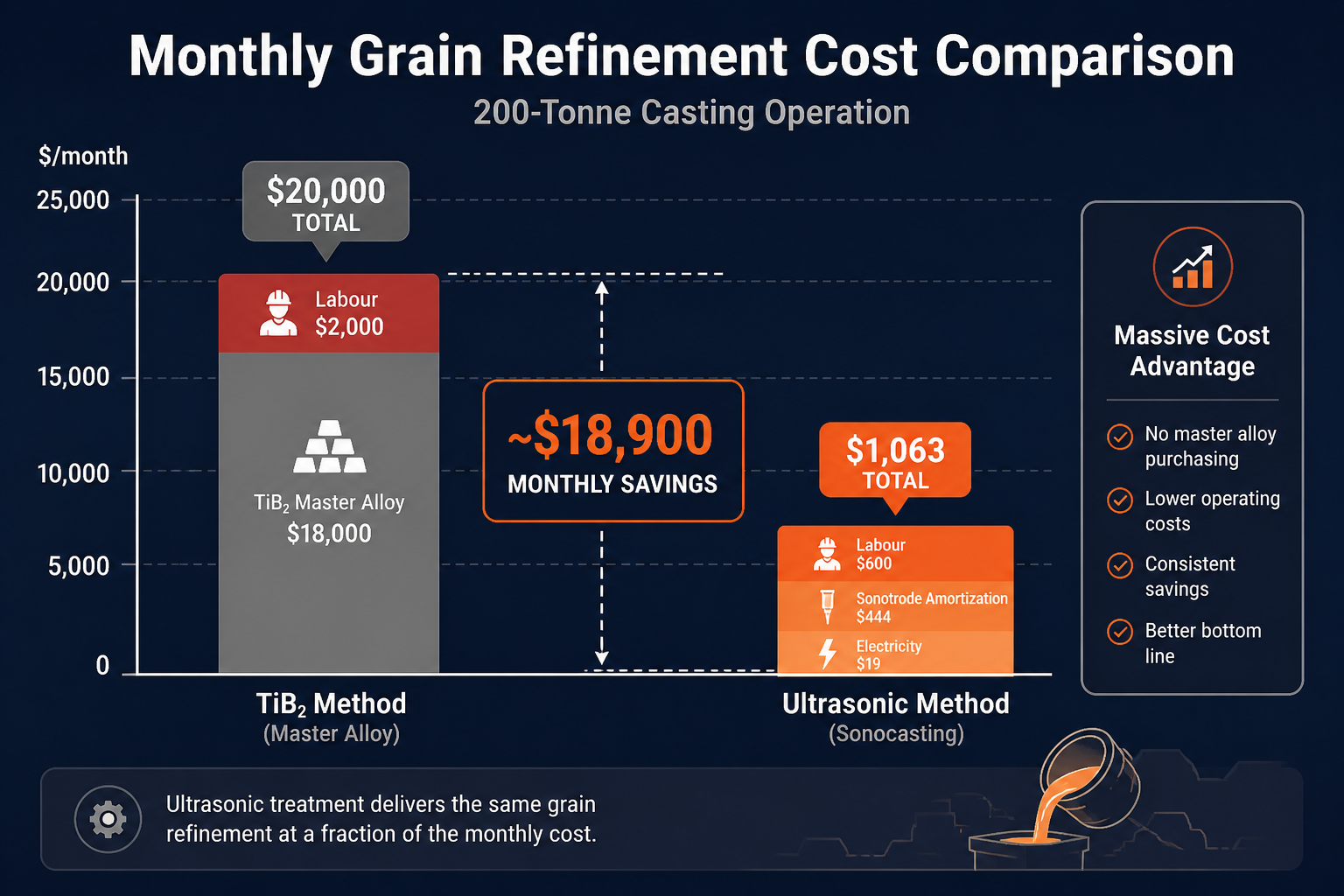
Here is the bottom-line cost comparison for a 200-tonne monthly casting operation, assuming standard Al-Si-Cu alloy (die-casting grade):
TiB₂ master alloy method:
- Master alloy loading: 0.15% by weight = 300 kg/month
- Cost at $60/kg: $18,000/month
- Labour (quality verification, batch tracking, rework): ~$2,000/month
- Total: $20,000/month
Ultrasonic treatment (assuming capital amortized):
- Electrical input: ~0.8 kWh per tonne treated = 160 kWh/month at $0.12/kWh = $19/month
- Sonotrode replacement reserve (18-month life, $8,000 replacement cost) = $444/month
- Labour (setup, monitoring, post-treatment inspection): ~$600/month
- Total: $1,063/month
Monthly savings: ~$18,937
Annual savings (adjusted for seasonal variance): ~$180,000–$200,000
For a 400-tonne monthly operation, savings exceed $350,000/year. The ROI on a complete ultrasonic grain refinement system (generator + sonotrode + controls) typically pays back within 8–14 months, after which every additional casting cycle is near-zero incremental cost for grain refinement.
This does not include the secondary savings: reduced scrap from hot tears and porosity (typically 2–3% scrap reduction), reduced remelting (energy savings of 5–8% on furnace fuel or electrical consumption), and improved mechanical properties (which allow design lightweighting and material cost reduction downstream in the customer’s assembly).
The barrier-free transition: integration and next steps
Switching to ultrasonic grain refinement is not a foundry-wide overhaul. The technology integrates into the standard casting workflow:
- Holding furnace integration. The sialon sonotrode mounts into the holding furnace via a flanged connection (similar to an immersion heater). Power is supplied by the NIMA generator (standard 480V three-phase). A simple PID control loop monitors melt temperature.
- Treatment cycle. Once the furnace is stabilised, the ultrasonic treatment is activated for 3–5 minutes per pour batch. The sonotrode vibrates at 25 kHz. Cavitation begins immediately; grain refinement occurs without operator intervention.
- Reproducibility. Each treatment is identical because acoustic parameters (frequency, power, duration) are fixed by the generator settings. No batch-to-batch variance in refinement activity – unlike TiB₂ master alloy, where composition and particle morphology drift.
- Quality verification. Grain structure can be inspected via low-magnification examination (optical microscopy at 50–100× will reveal the equiaxed character) or validated via mechanical testing (yield strength lift of +20–28% is diagnostic).
Ultrasonic Degassing & Grain Refinement’s technical team in Copenhagen provides full engineering support for system sizing, integration design, and operator training. The company offers a free webinar on ultrasonic grain refinement and custom consultation for site-specific applications.
The competitive advantage: why now
TiB₂ grain refinement has been the industry standard precisely because it works “well enough” when quality is tightly controlled. But the cost, quality variance, and scrap risk have become increasingly painful as metal prices rise and automotive/aerospace customers demand lighter, stronger designs that require finer grain structure than TiB₂ reliably provides.
Ultrasonic treatment addresses all three pain points:
- Cost advantage: 90%+ lower cost per tonne treated
- Quality consistency: Grain size and structure determined by physics, not supplier quality
- Superior microstructure: Finer, more homogeneous grains reduce scrap and enable design optimization
For foundries competing on cost and quality – which is every foundry – the shift from chemical to acoustic grain refinement is not an optional upgrade. It is the next standard.
Try Ultrasonic Degassing & Grain Refinement
Ultrasonic Degassing & Grain Refinement specialises entirely in ultrasonic treatment of molten metals. The company’s NIMA generator systems paired with proprietary sialon ceramic sonotrodes are engineered for industrial foundries, die-casting operations, and specialty casting facilities. Whether you are currently using TiB₂ grain refinement, rotary degassing, or both, the engineering team can model your specific casting profile and provide a detailed ROI projection custom-fitted to your operation.
Visit ultrasonicdegassing.com for technical specifications, application case studies, and to schedule a free consultation. The Copenhagen-based team is available for international projects and can arrange on-site assessment for large casting operations.
Frequently Asked Questions
How does ultrasonic cavitation refine grain structure?
Ultrasonic cavitation operates through two mechanisms: heterogeneous nucleation, where collapsing cavitation bubbles create transient micro-environments ideal for grain nucleation, and dendrite fragmentation, where acoustic pressure waves break growing dendritic arms into secondary nucleation sites. Each fragmented dendrite tip seeds a new grain. This acoustic approach achieves finer (20–50 μm), more uniform grain structure than TiB2, which relies solely on particle-based nucleation. See the ultrasonic mechanisms section for detailed explanation.
Why does ultrasonic grain refinement eliminate the need for TiB2 master alloy?
TiB2 grain refinement requires adding titanium-bearing master alloy (titanium costs $20–50/kg vs. $2–5 for aluminium), and the titanium must form Al₃Ti nucleation particles within the melt-a process that is sensitive to melt chemistry, fading over time, and prone to intermetallic needle defects. Ultrasonic treatment requires no chemical addition: the acoustic energy directly creates nucleation events from the aluminium itself. This eliminates cost, quality variance, inclusion risk, and fading entirely. The transition is economical: 200-tonne monthly operations see ~$19k/month savings.
What are the mechanical property improvements from ultrasonic grain refinement?
Fine, homogeneous grain structure improves yield strength by +20–28% (vs. +12–18% for TiB2), ultimate tensile strength by +15–20%, and elongation by 2–3× relative to coarse baseline. A 2025 industrial trial on 400 kg Al-Si-Cu die-casting alloy achieved +210 MPa yield strength lift and +303 MPa UTS improvement. The additional mechanical gains come from the simultaneous homogenization of alloying elements (Mg, Si, Cu) during ultrasonic treatment-a benefit TiB2 does not provide. This allows design lightweighting: equivalent fatigue life at 8–12% reduced wall thickness.
Why is sialon ceramic critical for industrial-scale ultrasonic grain refinement?
The ultrasonic transducer (sonotrode) must survive indefinitely in molten aluminium at 700–750°C. Most ceramics fail due to metal infiltration through porosity or thermal shock cracking. Sialon (silicon aluminium oxynitride) has non-wetting properties-molten aluminium does not adhere to its surface-which prevents metal infiltration entirely. Sialon also has high Young’s modulus (300–350 GPa), enabling efficient acoustic wave transmission, and thermal shock resistance of 550–900°C. As a result, sialon sonotrodes survive 12–24 months of continuous operation, vs. 2–4 months for early graphite designs. This durability drives the ROI advantage.
How quickly can a foundry transition from TiB2 to ultrasonic grain refinement?
Ultrasonic treatment integrates into standard casting workflows with minimal operational change. The sialon sonotrode mounts into the holding furnace via a flanged connection (similar to an immersion heater). Once installed, grain refinement requires only a 3–5 minute ultrasonic treatment per casting batch-no operator intervention beyond initial system setup. Because acoustic parameters are fixed by the generator (no batch variance like TiB2), the process is immediately reproducible. Ultrasonic Degassing & Grain Refinement provides engineering support for system sizing and operator training, and typically achieves full production integration within 2–4 weeks.