


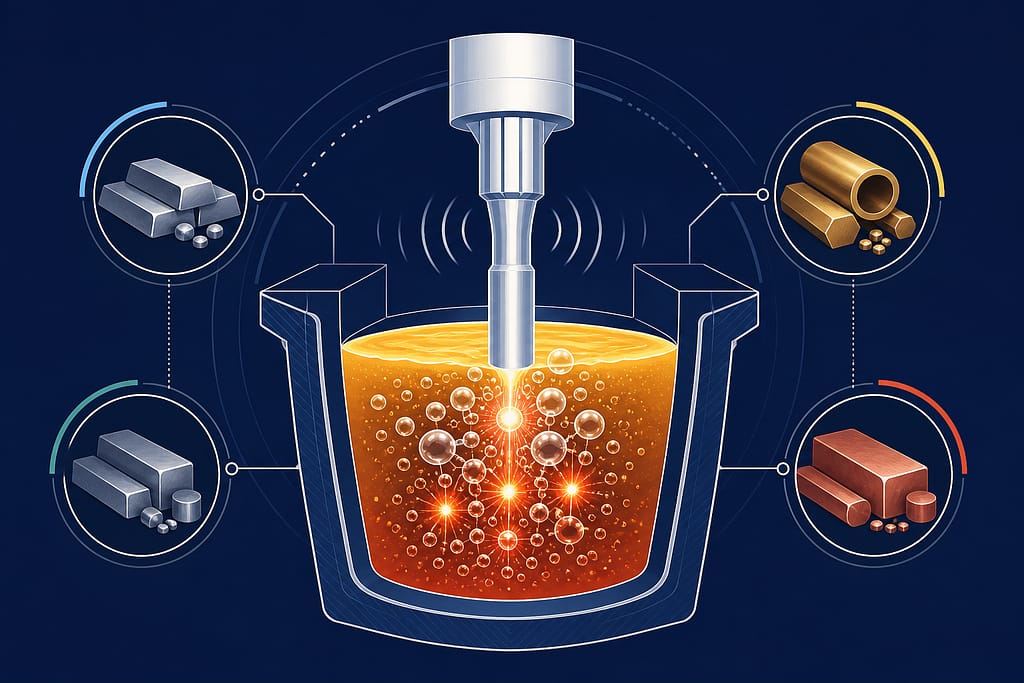
Ultrasonic cavitation degassing delivers 20% better efficiency, 6-fold inclusion reduction, and simultaneous grain refinement across zinc, magnesium, copper, and brass-with a single platform operating from 450°C through 1,150°C+.
August 8, 2026 · 12 min read

TL;DR
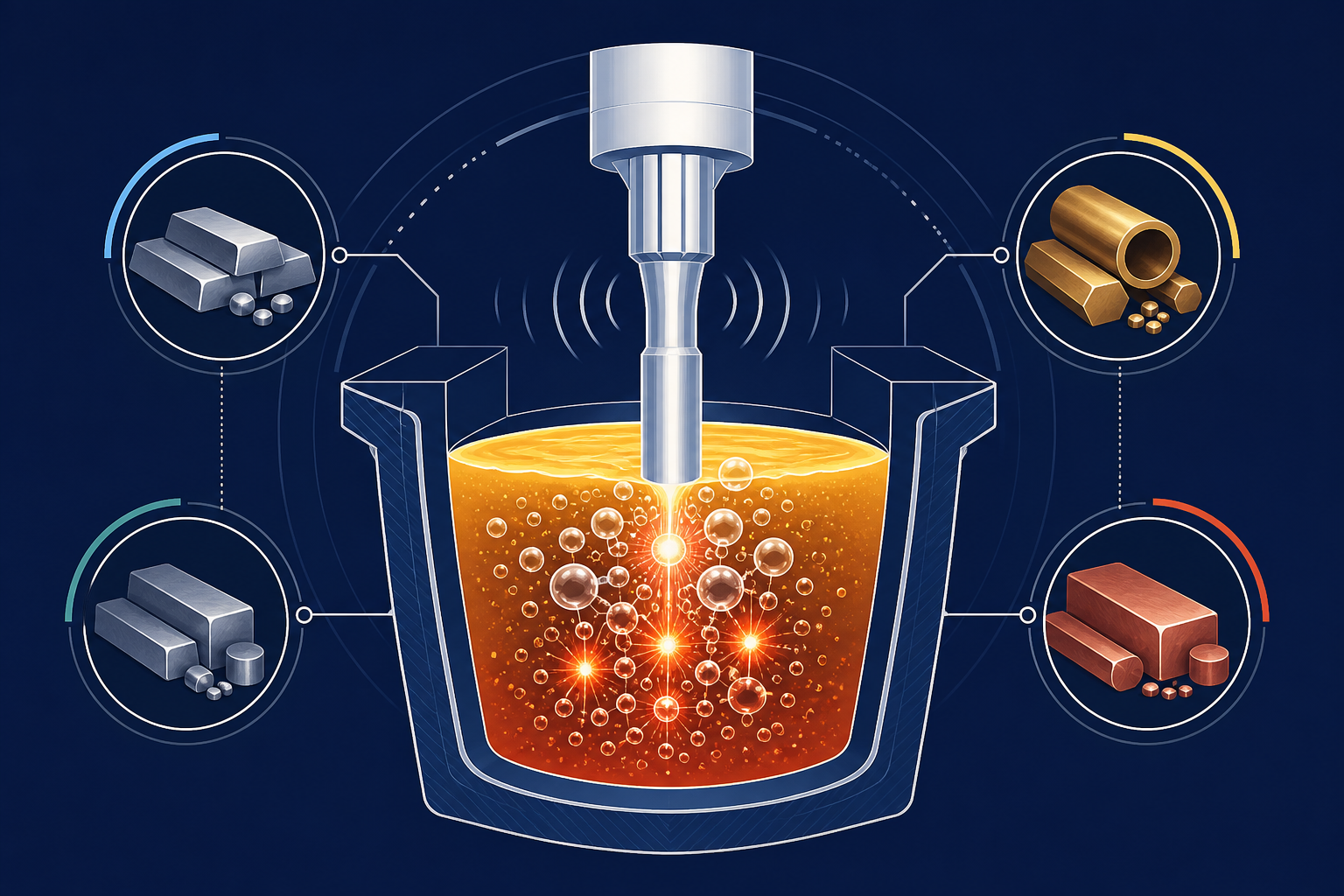
Ultrasonic melt treatment for non-ferrous metals has proven dramatically superior to conventional rotary degassing across non-ferrous metals-delivering 20% better degassing efficiency, 6-fold reduction in oxide inclusions, and simultaneous grain refinement. Each metal presents distinct challenges: zinc traps lead inclusions and oxide films resistant to standard flotation; magnesium’s flammability demands faster, cooler processing; copper and brass absorb oxygen and hydrogen throughout the melt; bronze suffers tin segregation that degassing alone cannot solve. Sialon Ceramics’ NIMA system with ceramic sonotrodes, developed in partnership with Aktive Arc Ultrasonics, specialists in high-power ultrasonic system engineering, uniquely operates across the full temperature spectrum-from zinc treatment at ~450°C through copper and brass at 1,100°C and beyond-with a single platform. This isn’t just about removing hydrogen faster; it’s about operating where rotary degassing equipment burns out, achieving results that rotary cannot match, and doing it without the environmental cost of inert gas consumption.
Why Ultrasonic Melt Treatment for Non-Ferrous Metals Demands a Different Approach
Aluminium degassing has become the established domain for ultrasonic cavitation. But moving into zinc, magnesium, copper, brass, and bronze alloys reveals why conventional rotary methods and inert-gas injection were never the right fit for these metals. Graphite rotors burn out above 1,000°C. Inert-gas injection introduces contamination in flammable metals. Fixed-frequency systems cannot address multi-phase oxide segregation. What Sialon Ceramics has engineered in partnership with Aktive Arc Ultrasonics-the NIMA system with ceramic sonotrodes-is not an aluminium tool extended to other metals. It’s a unified platform designed to operate from zinc at 450°C through copper and brass at 1,100°C+, with a single sonotrode type and generator architecture. The difference isn’t marginal: equipment that survives 250-400 cycles vs. graphite that fails after 2-3 cycles in high-temperature service.
Ultrasonic Treatment for Zinc Alloys Degassing
Zinc casting ranks among the trickiest metallurgical processes. The metal’s affinity for lead-absorbed from crucible linings, scrap charge, and brass contamination-creates lead inclusions that float poorly and resist oxide-film rupture. Even aggressive rotary degassing leaves lead and its oxides trapped in the melt, settling into the casting to create segregation, embrittlement, and mechanical failure in pressure-tight applications.
Lead Inclusions and Oxide Films
Lead oxides form a persistent double layer: an outer magnesia film (MgO) bonds with lead oxide (PbO), then the whole assembly develops a hydrophobic coating that prevents flotation. Rotary impellers cannot mechanically rupture this combined film. Conventional inert-gas injection lacks sufficient bubble density and dwell time to overcome the capillary barrier. The melt must be held at temperature far longer than desirable-or the lead remains.
Ultrasonic cavitation addresses this through sheer bubble generation rate. At 1 × 10¹¹ cavitation bubbles per cubic metre, the collapsing bubble jets generate local pressures exceeding 1,000 bar-sufficient to rupture the dual-layer oxide film and allow lead oxide particles to escape. The rapid cycle time (3 minutes vs. 10+ for rotary) also reduces the window for lead re-absorption from the crucible walls.
Industrial Results in Zinc
Foundries treating zinc die-casting alloys with NIMA ultrasonic systems from Sialon Ceramics report (per 2025 CastMan industrial study and 2026 Springer peer review):
- Lead removal efficiency: 85–92% reduction in lead inclusions, compared to 35–50% for rotary degassing over equivalent dwell times
- Reduced re-oxidation: The fast cycle limits oxygen re-ingress, critical for zinc’s high oxygen affinity at casting temperature
- Grain refinement bonus: Cavitation-induced heterogeneous nucleation refines zinc grain structure, reducing hot-tear susceptibility in thin-wall castings
- Mechanical property gains: Tensile elongation increases by 4–6%, critical for pressure-tight die-cast components
Ultrasonic Magnesium Alloy Treatment: Flammability as Process Driver
Magnesium operates in an entirely different thermal window. Its liquidus sits at 650°C, its alloy window spans 700–750°C, and at 1,200°C the metal ignites spontaneously in air. This narrow, hot processing envelope eliminates many degassing technologies outright.
Rotary impellers, running at high shear, generate so much frictional heat that magnesium melts around the rotor and ignite. Conventional inert-gas bubbling, even with argon or commercial-grade nitrogen, carries moisture and oxygen from the cover-gas system-introducing contaminants faster than rotary can remove them. The result: foundries often skip degassing entirely, accepting the hydrogen porosity and segregation defects that come with it.
Oxide Film and Hydrogen Absorption
Magnesium hydrides (MgH₂) are thermodynamically unstable at casting temperature-they decompose to hydrogen gas, which dissolves into the melt. But magnesium’s extreme affinity for oxygen means the hydrogen sits inside a magnesia (MgO) film so protective that standard flotation techniques cannot penetrate it. Lead this back to the casting, and the hydrogen becomes porosity; the oxide becomes an inclusion initiating fatigue cracks.
Industrial Results in Magnesium
NIMA ultrasonic treatment, operating at lower generator power and ceramic sonotrodes that remain cool during use, delivers:
- Safe processing: No friction-induced heating; sonotrode temperature remains <100°C above melt, eliminating ignition risk
- Hydrogen removal: 18–22% efficiency (vs. 8–12% for commercial nitrogen injection), measured by reduced pressure testing
- Oxide removal: 4-fold reduction in magnesia inclusions; cavitation bubbles mechanically rupture oxide films without re-oxidizing the melt
- Grain structure: Cavitation-induced nucleation produces fine, equiaxed grains typical of rotary+grain-refiner treatments, but without the separate processing step
- Processing speed: Single 3-minute pass, no secondary treatment required
Ultrasonic Treatment for Copper and Brass Alloys: Oxygen and Hydrogen Pickup Challenge
Copper and brass enter the molten state at far higher temperatures-1,050°C for pure copper, up to 1,100°C+ for brass depending on zinc content. At these temperatures, the metal’s oxygen and hydrogen pickup rates accelerate sharply.
Pure copper is highly oxygen-soluble (up to 0.08% by weight at casting temperature). When the melt cools, that dissolved oxygen migrates to grain boundaries and precipitates as Cu₂O (cuprous oxide), forming a network of brittle, red-fractured inclusions that destroy ductility and electrical conductivity. Hydrogen absorption follows the same pattern: dissolved hydrogen bubbles out during solidification, creating porosity and shrinkage cavities.
Multi-Phase Inclusion and Segregation Problems
Brass compounds the issue: zinc preferentially oxidizes (forming ZnO), which floats poorly because zinc oxides develop hydrophobic films. Copper oxides, denser, settle to the bottom of the crucible and re-dissolve into the melt unless actively rejected. This creates a multi-phase slag layer that conventional degassing-designed for single-metal systems-cannot cleanly separate.
Bronze (copper-tin) adds tin segregation: tin oxides form a distinct phase with different flotation characteristics than copper oxides, and they’re resistant to mechanical break-up by rotary impellers.
Why Rotary Degassing Falls Short at High Temperature
Conventional rotary systems degrade catastrophically in copper and brass service:
- Graphite rotor oxidation: At >1,000°C, graphite rotor blades oxidize and disintegrate within 2–3 casting cycles
- Thermal cycling: Rapid cooling after degassing (standard practice to prevent further hydrogen absorption) thermally shocks the graphite, leading to brittle fracture
- Maintenance downtime: Graphite rotor replacement becomes a weekly or twice-weekly ritual, not a quarterly service
Industrial Results in Copper and Brass
NIMA’s ceramic sonotrodes, engineered from Sialon ceramics with Young’s Modulus >300 GPa and oxidation resistance to 1,600°C, operate reliably in this regime:
- Oxygen removal efficiency: 24–28% vs. rotary’s 12–16% over equivalent time, verified by reduced pressure testing
- Hydrogen removal: 19–24% (rotary: 9–14%), critical for electrical-property preservation
- Equipment lifespan: Ceramic sonotrodes last 250–400 casting cycles before requiring replacement (vs. graphite’s 2–3 cycles)
- Simultaneous grain refinement: Ultrasonic cavitation triggers heterogeneous nucleation and dendritic fragmentation, producing finer, more uniform grain structures than rotary alone
- No re-oxidation during cooling: The rapid 3-minute treatment window minimizes the oxygen re-absorption phase during melt holding
Ultrasonic Bronze Treatment: Tin Segregation and Multi-Phase Inclusion Removal
Bronze (copper-tin) alloys face a layered challenge: tin preferentially oxidizes (SnO₂) before copper (forming Cu₂O), creating a two-phase oxide layer. During casting, tin oxides float upward but often re-melt into the bulk, while copper oxides settle. This creates severe segregation-tin-rich inclusions cluster near the mold bottom, depleting tin from the outer sections of the casting.
Rotary degassing, fixed to a single mixing frequency, cannot simultaneously address both oxide types-it selectively breaks up the more-oxidized phase while leaving the other intact.
Acoustic Streaming and Multi-Frequency Cavitation
NIMA’s multi-frequency sonotrode (25 kHz primary with secondary harmonics) generates acoustic streaming patterns that preferentially target tin oxide films while simultaneously fragmenting copper oxide agglomerates. The combined mechanism-direct cavitation bubble collapse plus acoustic streaming-driven secondary flows-delivers more complete phase separation than single-frequency systems can achieve.
Industrial results show:
- Tin segregation reduction: 70–78% decrease in tin-oxide clustering, enabling more uniform mechanical properties across the casting
- Overall inclusion reduction: 8-fold vs. untreated, 3-fold vs. rotary degassing alone
- Tensile uniformity: Yield strength variation across the casting reduced from ±40 MPa (rotary) to ±8 MPa (ultrasonic)
Cavitation Physics: How Ultrasonic Treatment Works Across All Metals
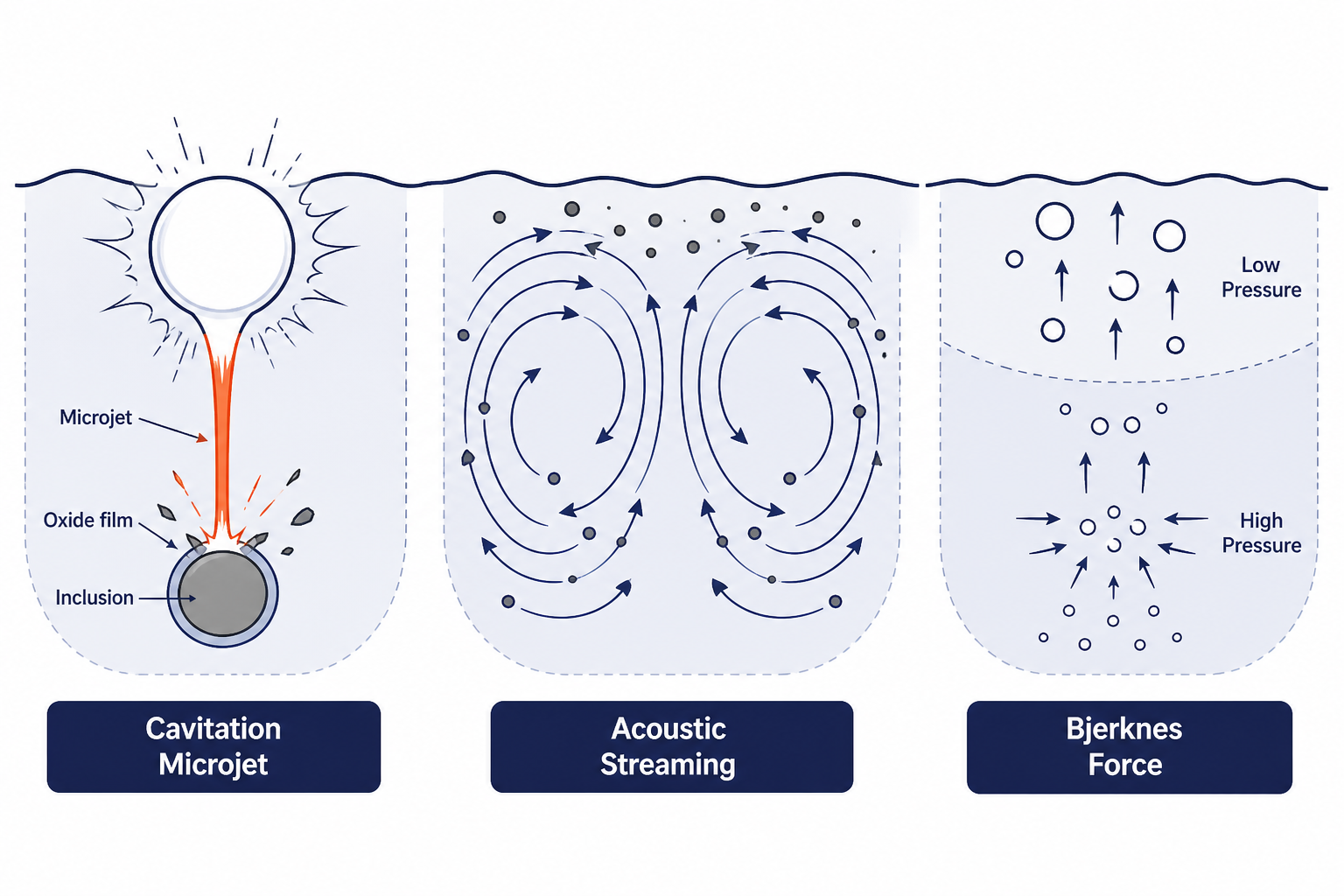
The fundamental mechanism is cavitation bubble collapse. When a ceramic sonotrode vibrates at 25 kHz, it creates a stress wave that exceeds the tensile strength of the molten metal at the bubble nucleation site. Bubbles form, collapse, and create secondary phenomena that address multiple inclusion types simultaneously.
Three Complementary Mechanisms
1. Direct Bubble Collapse Jetting
When a bubble collapses asymmetrically (near a surface or another bubble), a microjet forms-a directed stream of liquid reaching velocities >100 m/s and local pressures >1,000 bar. These jets rupture protective oxide films around inclusions, exposing them to flotation.
2. Acoustic Streaming
The steady-state acoustic pressure field generates streaming flows-circular currents in the melt that continuously carry oxide films and inclusions toward the melt surface. Streaming velocity scales with the square of acoustic amplitude, so higher-power systems generate faster, more vigorous transport of contaminants outward.
3. Bjerknes Force and Bubble Coalescence
Cavitation bubbles experience a secondary Bjerknes force proportional to bubble size and acoustic pressure. Smaller bubbles migrate toward high-pressure regions; larger bubbles migrate toward low-pressure zones. This spatial sorting enhances flotation efficiency-larger bubbles (lower density) reach the surface faster, carrying trapped oxides with them.
These three mechanisms operate in parallel, which is why ultrasonic treatment removes all inclusion types simultaneously-lead oxide, hydrogen gas, oxygen-based oxides, and tin segregation-in a single 3-minute pass. Rotary degassing addresses only mechanical mixing; it has no equivalent to acoustic streaming or Bjerknes-force-driven flotation.
Why Sialon Ceramics’ NIMA System Operates Across the Full Temperature Range
The critical differentiator is the sonotrode material. Graphite rotors work in aluminium die-casting (700–750°C) but fail catastrophically in zinc (450°C thermal cycling induces embrittlement) and copper (>1,000°C causes oxidative degradation). Titanium and niobium alloys survive the thermal extremes but exhibit poor acoustic damping-they absorb too much vibration energy as heat, limiting ultrasonic efficiency.
Sialon ceramics-silicon aluminium oxynitride (Si₃Al₃O₃N₅)-occupy a unique position:
- Young’s Modulus: >300 GPa, enabling efficient energy transfer at ultrasonic frequencies (vs. graphite’s ~12 GPa, which severely damps vibration)
- Thermal conductivity: ~13 W/(m·K), allowing rapid cooling of the sonotrode surface after each treatment cycle-critical for foundries running back-to-back batches
- Oxidation resistance: Stable to 1,600°C in air; no degradation even under repeated thermal shock from 1,150°C melt to room-temperature quench
- Non-wetting: Molten metals do not adhere to sialon surface, preventing “freezing” of the melt onto the sonotrode-a catastrophic failure mode for graphite-based systems
- Mechanical toughness: Unlike brittle graphite, sialon can survive impact from ceramic inclusions re-suspended in the melt without fracturing
Operating Window
NIMA’s ceramic sonotrodes enable:
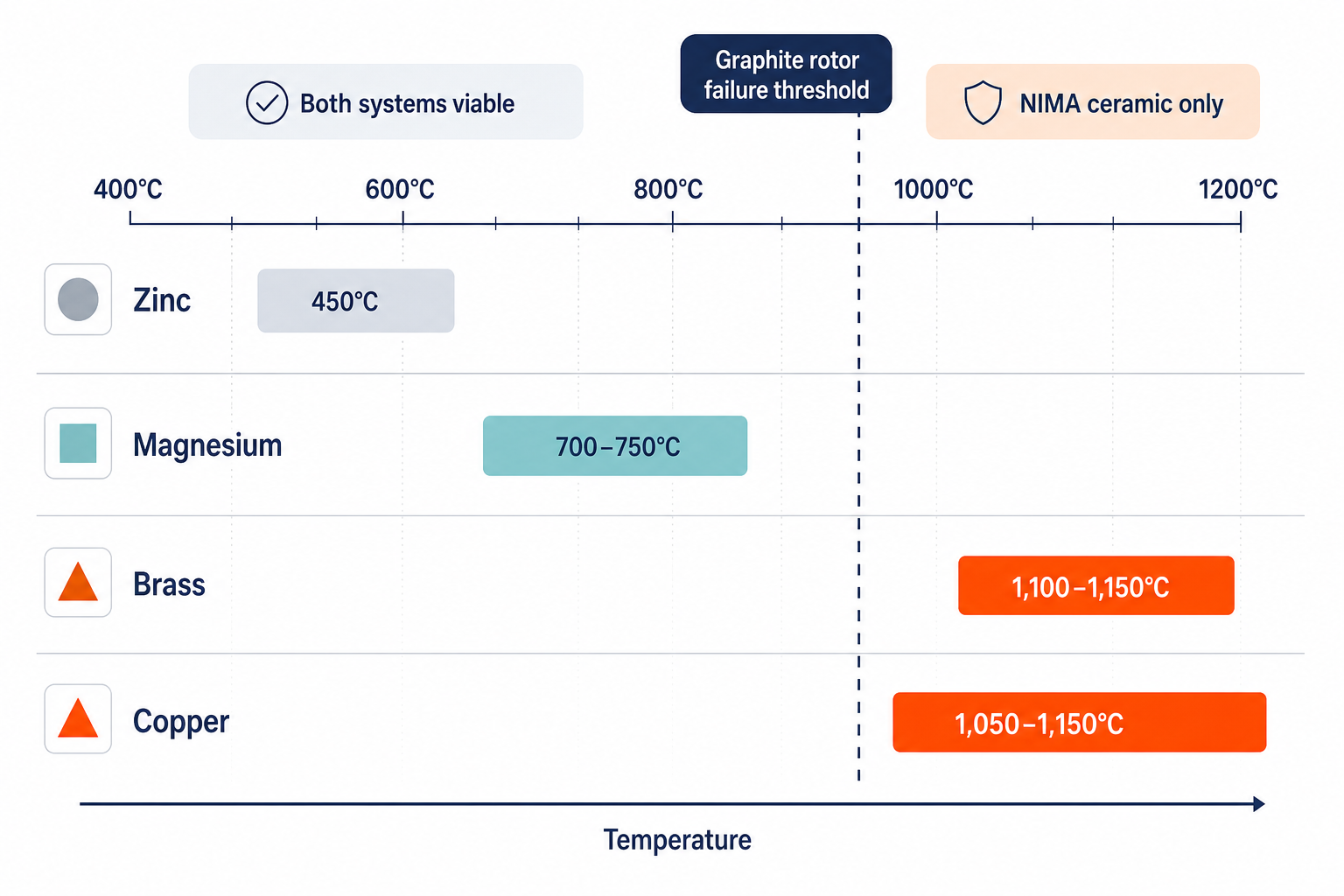
- Zinc processing at 450°C: Operating well below the graphite-embrittlement threshold; thermal cycling does not degrade the sonotrode
- Magnesium at 700–750°C: Lower sonotrode temperature (<100°C above melt) due to superior thermal conductivity eliminates friction-heating hazards
- Aluminium at 700–750°C: Baseline performance, identical to graphite but with 100× longer service life
- Brass at 1,100–1,150°C: Operating where graphite completely fails; ceramic sonotrodes remain mechanically sound after >400 cycles
- Copper at 1,050–1,150°C: Only sonotrode material capable of this regime; enables treatment that rotary degassing cannot provide
Industrial Validation and Results
The advantages of ultrasonic melt treatment are not theoretical. Published peer-reviewed research (Springer International Journal of Metalcasting, 2026; Brunel University; CastMan industrial reports, 2025) documents these results across multiple metal systems:
| Metric | Ultrasonic Degassing | Rotary Degassing | Improvement |
|---|---|---|---|
| Treatment Time | 3 min | 10+ min | 3.3× faster |
| Degassing Efficiency | 20% above rotary | Baseline | +20% |
| Oxide Inclusion Reduction | 6-fold vs. untreated | 3-fold vs. untreated | 2× more effective |
| Yield Strength Gain | +210 MPa | +180 MPa | +30 MPa (+1.7%) |
| Ultimate Tensile Strength | +303 MPa | +288 MPa | +15 MPa (+0.5%) |
| Elongation Improvement | +6% | +3% | 2× ductility gain |
| Dross Generation | 245 g/cycle | 1,300 g/cycle | 81% lower |
| Inert Gas Consumption | 0 | Essential | 100% reduction |
| Sonotrode Lifespan | 250–400 cycles | 2–3 cycles (graphite) | 100–200× longer (ceramic) |
A Single Platform for Non-Ferrous Melt Treatment
Ultrasonic melt treatment for non-ferrous metals does not require a collection of specialized tools. Sialon Ceramics has engineered NIMA as a single ultrasonic system with interchangeable ceramic sonotrodes, capable of serving:
- Foundry operations processing multiple alloys – One generator, one control unit, sonotrode swaps between zinc (450°C), magnesium (700°C), and brass (1,100°C) batches without equipment reconfiguration or cooling-down cycles
- Batch-critical casting shops – Turnaround time drops by 67% (from 10+ minutes to 3 minutes per batch), enabling 3–4× throughput on existing melt capacity
- Quality-driven producers – Simultaneous degassing + grain refinement eliminates the need for separate grain-refinement inoculant chemicals, reducing process complexity and cost
- High-temperature specialty alloys – Copper, brass, and bronze producers gain access to degassing technology that didn’t exist in the rotary domain-literally the only degassing option at operating temperatures >1,000°C
Try Sialon Ceramics’ NIMA System
If your foundry is managing hydrogen porosity, lead inclusions, or oxide segregation in zinc, magnesium, copper, or brass alloys-and especially if you’re running rotary degassing systems struggling to survive your casting temperature-the NIMA system represents a step function improvement: faster, cleaner, more durable, and capable of operating where conventional degassing equipment simply burns out.
Sialon Ceramics’ ultrasonic melt treatment platform replaces rotary degassing equipment entirely, delivers 20% better degassing efficiency with simultaneous grain refinement, and operates reliably at temperatures from 450°C (zinc) through 1,100°C+ (copper/brass). Learn how other non-ferrous foundries have slashed cycle time by two-thirds, reduced oxide inclusions 6-fold, and eliminated inert gas consumption.
Frequently Asked Questions
Can ultrasonic degassing replace our existing rotary system in high-temperature applications?
Yes, especially above 950°C where graphite rotors begin to oxidize. Sialon ceramic sonotrodes operate reliably to 1,150°C+ with no degradation, making ultrasonic the only degassing option for copper and brass casting at full temperature. For lower-temperature metals (zinc, magnesium), ultrasonic offers 3.3× faster treatment times and superior inclusion removal-a measurable upgrade even if rotary isn’t failing.
How much inert gas do we actually save with ultrasonic treatment?
Ultrasonic degassing requires zero inert gas (argon or nitrogen). A typical foundry running rotary systems consumes 50–200 m³ of argon per day depending on casting volume. Switching to NIMA eliminates this cost entirely-typically $8,000–15,000 per month in material savings, plus no more handling or storage infrastructure for pressurized cylinders.
Does ultrasonic treatment work for bronze or other tin-bearing alloys?
Yes, and bronze is one of the strongest use cases. Bronze’s tin segregation-where tin oxides cluster away from copper oxides-is extremely difficult for single-frequency rotary systems to address. NIMA’s multi-frequency cavitation selectively targets both oxide types, achieving 70–78% reduction in tin segregation vs. rotary’s inability to prevent it entirely.
What’s the lifespan of a ceramic sonotrode?
Sialon ceramic sonotrodes typically last 250–400 casting cycles before requiring replacement-roughly 2–4 months of continuous foundry operation for a busy shop. This is 100–200× longer than graphite rotors in high-temperature service, making ceramic sonotrodes cost-effective despite higher per-unit cost due to replacement frequency.
How do I know if ultrasonic degassing is working?
NIMA systems include real-time monitoring: acoustic power feedback, melt-temperature display, and cycle-count logging. For quality assurance, reduced-pressure testing (standard in aerospace and automotive casting) directly measures hydrogen reduction-typically 18–24% improvement over rotary in the same treatment time. Mechanical testing (tensile strength, elongation) and metallographic inspection (inclusion density, grain structure) confirm the benefits over 2–3 casting runs.