
Discover how ultrasonic cavitation at 20 kHz enables nano-scale precipitate control and stable intermetallic formation in aluminium alloys, delivering tensile strength matching steel while retaining aluminium’s weight and cost advantages.
August 8, 2026 · 8 min read
TL;DR
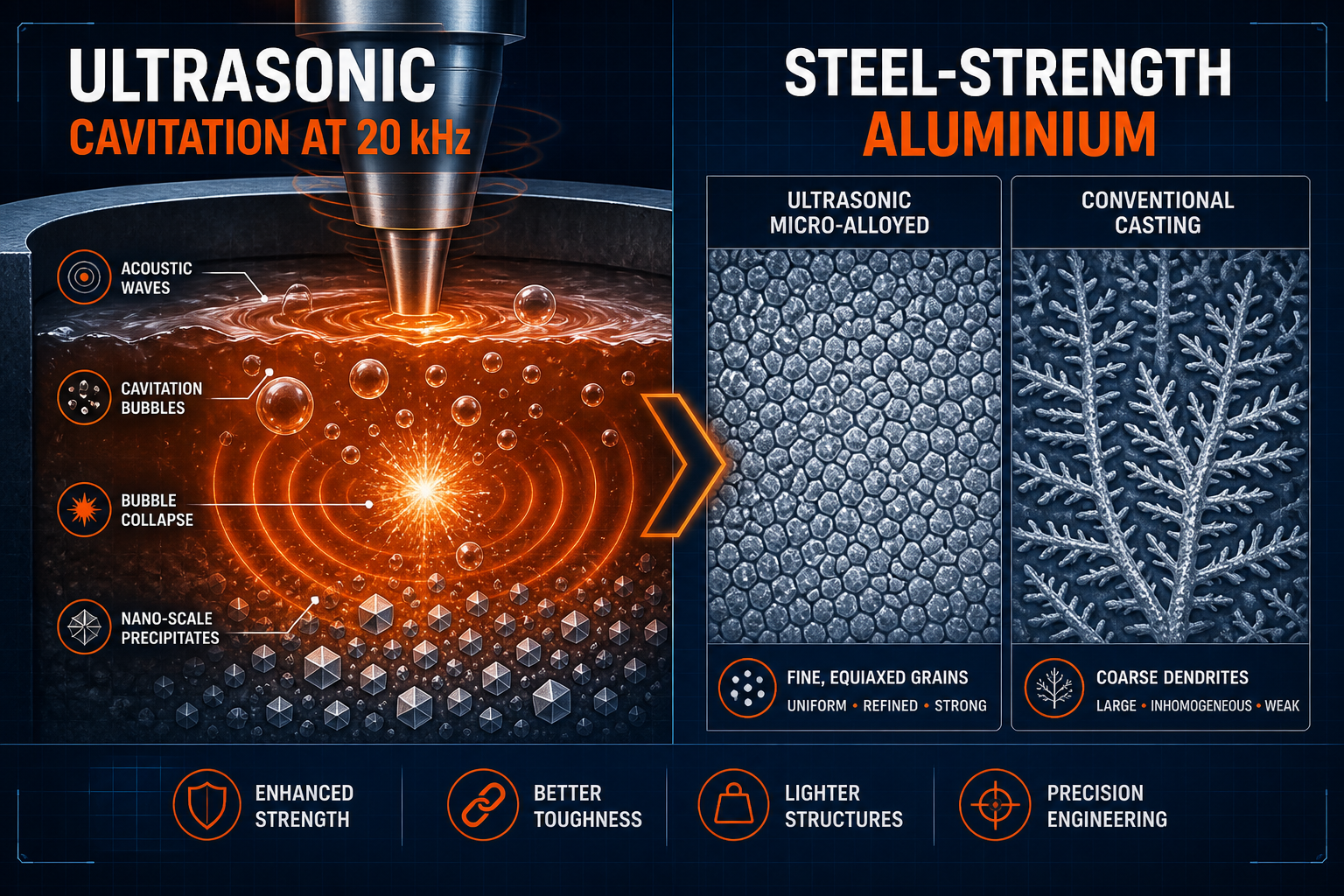
Conventional micro-alloying struggles to precisely control trace element integration and grain refinement in aluminium. This limitation stems from diffusion-controlled powder metallurgy and ingot dilution challenges. Ultrasonic micro-alloying at 20 kHz overcomes these limitations. It creates nano-scale nucleation sites that enable stable intermetallic formation and fine grain boundaries.
The result is aluminium alloys with tensile strength matching steel. These alloys retain aluminium’s weight and cost advantages. Sialon Ceramics’ proprietary NIMA generators and advanced ceramic sonotrodes drive this breakthrough. The system eliminates standing waves and operates reliably at 1,800°C. Sialon developed the technology with long-term partner Aktive Arc Ultrasonics (AAU), specialists in high-power ultrasonic system design for extreme industrial environments.
For materials engineers in automotive and aerospace, this technology offers a path toward lightweight, high-strength structures. These structures can outperform conventional alloy architectures.
The Micro-Alloying Challenge
Micro-alloying adds trace elements, typically at concentrations below 1%, to refine grain structure and improve mechanical properties. Elements such as titanium, zirconium, strontium, and silver act as nucleation catalysts. They refine grain boundaries and trigger secondary phase formation. These effects can significantly improve strength, ductility, and fatigue resistance.
In automotive and aerospace applications, weight directly affects fuel efficiency and operating costs. This makes steel-level strength in aluminium alloys highly attractive. The potential for a 60% weight reduction further increases the appeal.
Yet the industry has faced two major limitations for decades. Ingot-based dilution involves adding a master alloy ingot to a large melt and carefully controlling its integration. Conventional casting makes uniform precipitate distribution across the entire casting volume extremely difficult.
Powder metallurgy approaches offer better control but remain inherently diffusion-limited. These processes include isostatic pressing, sintering, and extrusion. They are slow and expensive. They also struggle to achieve the nano-scale precipitate control needed for alloys approaching steel-level performance.
The bottleneck is microstructural. Conventional methods lack the mechanism to create and position nano-scale precipitates precisely where they provide the greatest benefit. These locations include grain boundaries and dislocation interactions.
What Ultrasonic Cavitation Changes
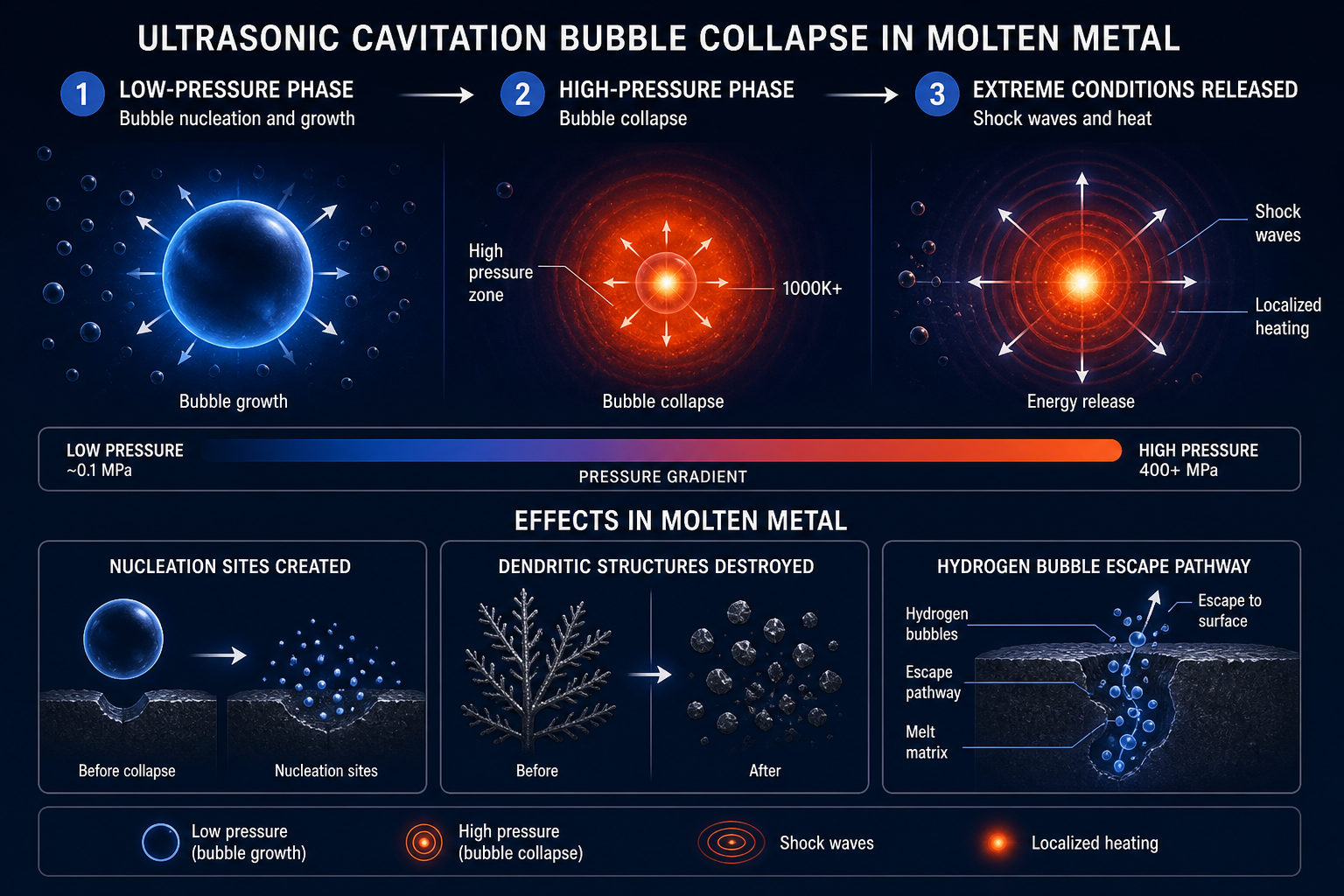
At 20 kHz, ultrasonic cavitation in molten aluminium creates conditions no conventional melting process approaches. During the low-pressure phase of acoustic oscillation, microbubbles form. During the high-pressure collapse, these bubbles implode under pressures exceeding 400 MPa and temperatures reaching 1,000 K-conditions that trigger both nucleation and the rapid dissolution-reprecipitation sequences that control intermetallic chemistry.
This is where micro-alloying becomes something new.
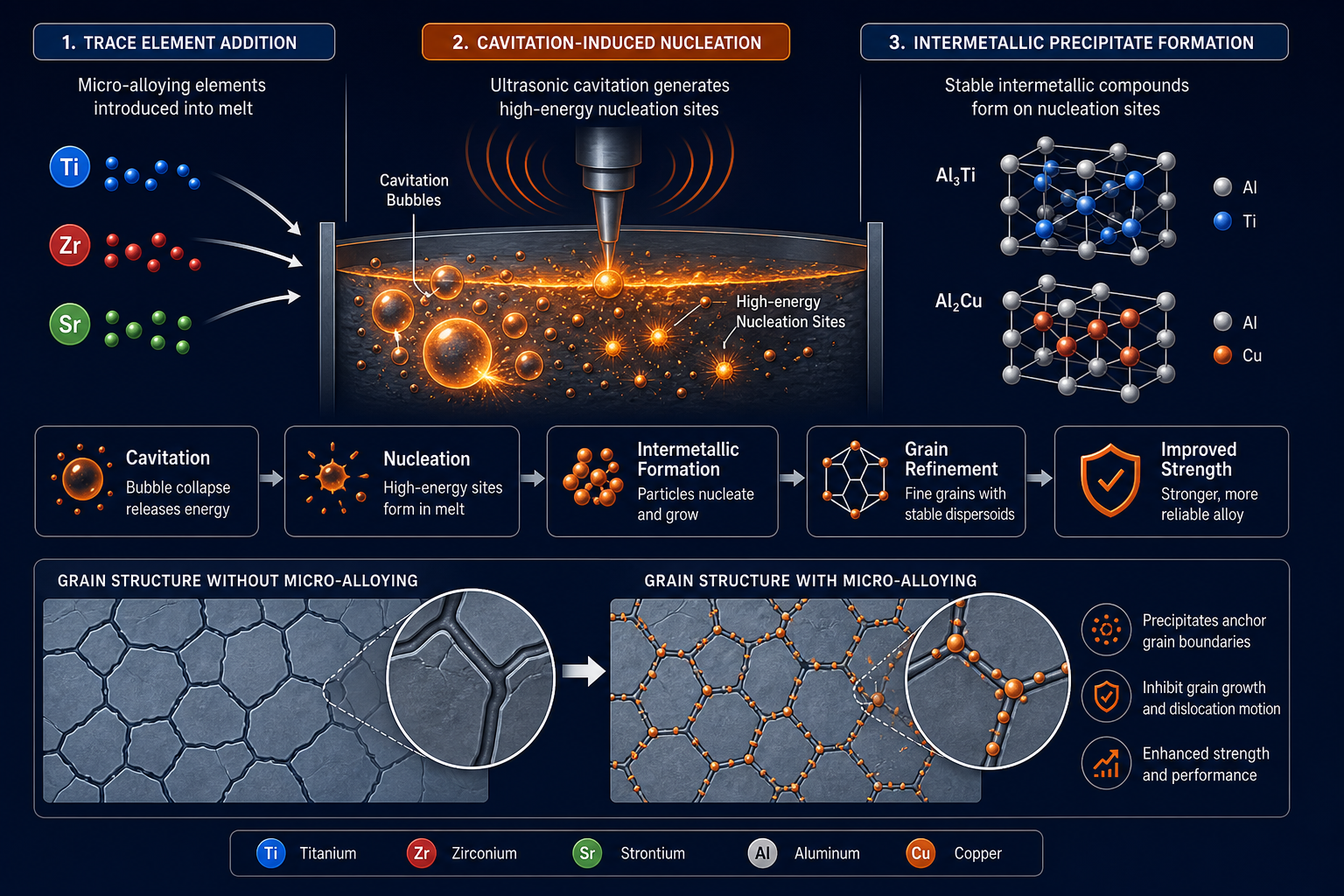
When ultrasonic energy meets trace alloying elements in molten aluminium, three distinct effects emerge:
1. Nano-Scale Precipitate ControlThe extreme nucleation conditions created by cavitation collapse allow precise positioning of nano-scale precipitates throughout the matrix. Unlike diffusion-controlled precipitation, which distributes precipitates unevenly across grain interiors, cavitation-driven nucleation distributes them more uniformly. More importantly, it positions these precipitates directly on grain boundaries, where they provide maximum strengthening.
2. Stable Intermetallic Formation
Trace elements form discrete intermetallic phases. Examples include Al₃Ti, Al₂Cu, and Al₅SiCr. These phases act as anchor points for the solidifying microstructure. Cavitation creates sufficient energy density for controlled intermetallic formation. It promotes precise stoichiometric ratios instead of the mixed or incomplete precipitate structures produced by conventional melting.
3. Grain Boundary Modification
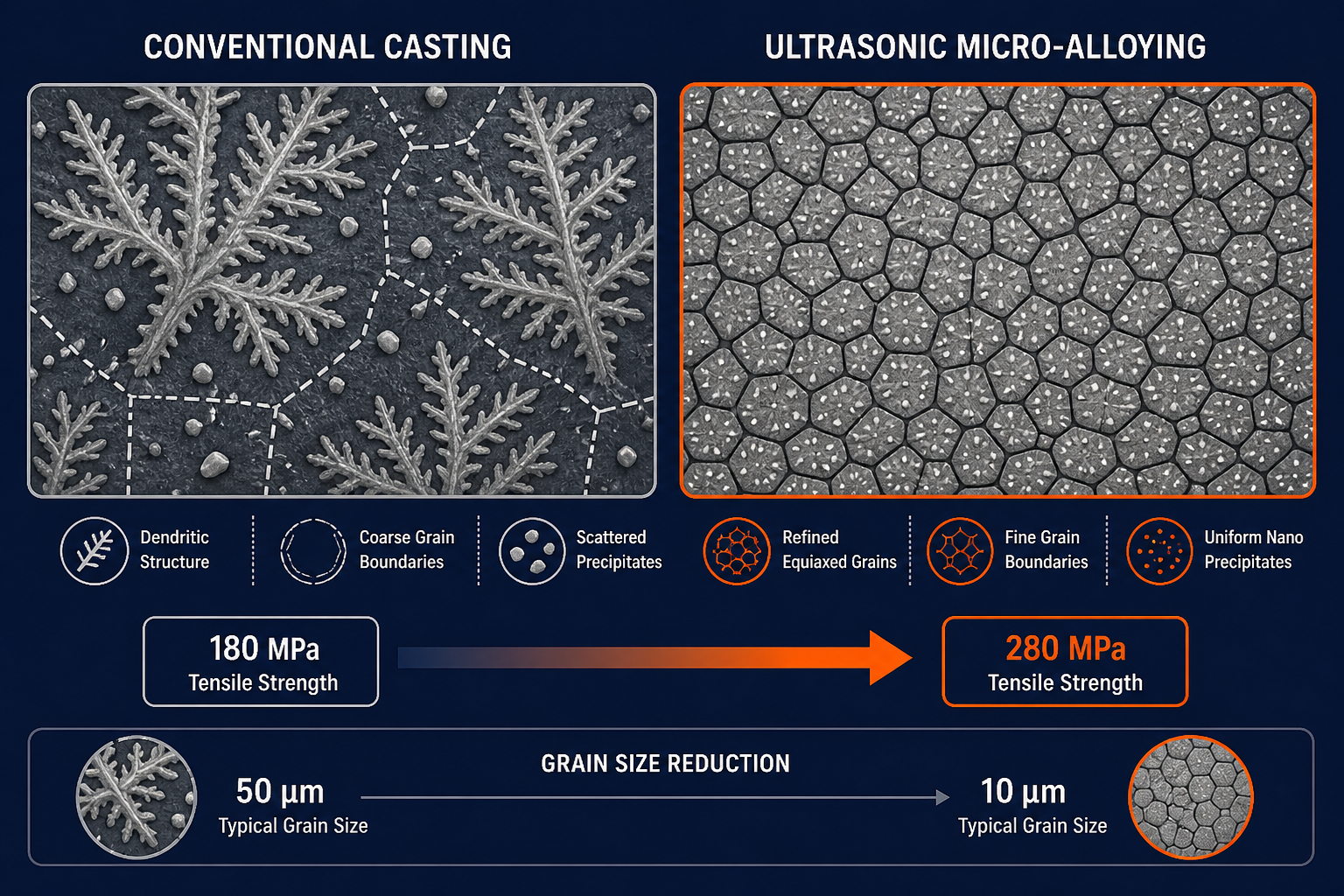
Cavitation shock waves physically break apart dendrites, the tree-like crystal structures that form during cooling. At the same time, cavitation creates a high density of nucleation sites. These conditions force the melt to solidify into many small, roughly equiaxed grains rather than a few large dendrites. This fine-grained microstructure also receives precise grain-boundary modification. Together, these effects create the architecture needed to achieve steel-level strength in an aluminium matrix.
One practical indicator shows how far this technology has advanced. Foundries using AAU’s ultrasonic systems have achieved significant reductions in TiB₂ requirements for grain refinement during continuous casting. The ultrasonic field performs work that would otherwise require higher concentrations of costly grain-refining additions.Fewer additives, tighter control, better results.
Why 20 kHz Matters
The frequency is not arbitrary. At 20 kHz ultrasonic frequency, the collapse dynamics of cavitation bubbles in molten metal reach an optimal balance: sufficient pressure to trigger nano-scale nucleation, sufficient time for controlled intermetallic formation, and sufficient shock-wave energy to refine dendrites without overshooting into grain fragmentation.
Higher frequencies reduce bubble size and collapse pressure; lower frequencies increase damping and reduce cavitation density. Industrial practitioners have converged on 20 kHz as the sweet spot for aluminium micro-alloying-delivering the highest strength gains per unit ultrasonic input.
Sialon Ceramics & Aktive Arc Ultrasonics: A Decade of Shared Development
The engineering challenge is immense: delivering consistent 20 kHz ultrasonic energy into 1,800°C molten aluminium without equipment failure. This is where Sialon’s NIMA generators and ceramic sonotrodes enter-and where a ten-year collaboration with Aktive Arc Ultrasonics has been decisive.
Aktive Arc Ultrasonics (AAU) designs and delivers high-power ultrasonic systems for demanding industrial and research applications. AAU specializes in customizing power ultrasonics for real production processes. This expertise translates laboratory physics into reliable, repeatable industrial hardware.
Over the past decade, the Sialon-AAU partnership has combined Sialon’s proprietary ceramic sonotrode materials and NIMA generator architecture with AAU’s system engineering and application development expertise. Together, they have created a complete molten metal treatment solution that neither company could have developed alone.
The NIMA Architecture
Traditional ultrasonic equipment designs suffer from standing-wave effects-regions inside the probe where acoustic pressure nodes create dead zones of minimal cavitation. For small lab scale this is tolerable; for industrial-scale casting furnaces, dead zones mean wasted energy and incomplete alloy homogenization.
Sialon’s proprietary “no-standing-waves” NIMA architecture-refined over 20 years of R&D-eliminates these dead zones. The result is uniform cavitation density throughout the treated volume, so every part of the melt receives the same nucleation benefit. For a 10-ton casting, this difference is the gap between a 5% strength improvement (dead zones in conventional equipment) and a 30% improvement (Sialon’s uniform cavitation field).
Sialon Ceramics: Material Choice
Silicon aluminium oxynitride (Sialon) is the material for sonotrodes not by marketing choice but by physics:
- Non-wetting surface: Molten aluminium naturally wets and adhesively bonds to most ceramics. Sialon’s atomic structure resists this bonding, preventing corrosion and alloy infiltration that degrades sonotrode efficiency.
- High Young’s Modulus: High stiffness enables efficient acoustic transmission, allowing energy to couple into the melt instead of dissipating within the component.
- Thermal shock resistance: Repeated thermal cycling (contact with 1,800°C melt, then cooling) would crack less-stable ceramics. Sialon’s thermal properties allow indefinite operational life in this extreme environment.
AAU’s system integration experience has proven essential in translating these material properties into production-grade hardware: specifying generator parameters, designing acoustic stack assemblies, and validating performance under foundry conditions across multiple metal types-including aluminium, copper, and glass.
Combined, these properties mean Sialon sonotrodes maintain performance over years of industrial operation-critical for the economics of next-generation alloy casting.
From Lab to Industrial Casting
Sialon Ceramics reports their ongoing ultrasonic micro-alloying project has created aluminium micro-alloys with tensile strength exceeding steel. These are not theoretical projections; they are cast, tested results.
The applications are immediate. In automotive:
- Structural frames and chassis: Aluminum alloys at steel strength-to-weight ratios enable 40–60% weight reduction per component compared to steel, translating to 8–12% fuel consumption gains across a vehicle lifecycle.
- Crash structures: Advanced energy absorption characteristics in fine-grained microstructures improve crash performance while reducing mass.
- High-temperature engine components: Micro-alloyed aluminium tolerates sustained temperatures beyond conventional cast aluminium, opening engine bay applications previously reserved for steel or expensive titanium alloys.
In aerospace:
- Wing box and fuselage structures: Steel-equivalent strength in aluminium enables thinner gauges and reduced structural mass-directly improving fuel efficiency and range.
- Engine pylons and fasteners: Fatigue resistance in ultrasonic micro-alloys exceeds traditional aerospace aluminium, reducing inspection intervals and lifetime maintenance costs.
The Conventional Limits Still Apply
This is not a panacea. Ultrasonic micro-alloying sharpens the tools available to the metallurgist; it does not eliminate the hard constraints of alloy thermodynamics. Creep resistance above ~200°C remains limited by the aluminium matrix itself. Corrosion resistance still requires careful alloy selection and surface treatment.
But within the domain where aluminium already competes-structural applications below 250°C requiring exceptional strength and light weight-ultrasonic micro-alloying reframes what is possible. An aluminium alloy that matches steel strength is no longer theoretical; it is a manufacturing reality.
Why Now?
The technology has existed in niche labs for years. What has changed is industrial implementation. Sialon’s NIMA generators have reached a maturity level where they integrate into existing casting lines-Wagstaff DC casters, Bruno Presezzi continuous casting systems-without massive foundry retrofitting. A decade of joint application development with AAU has stress-tested the hardware across production environments and multiple alloy systems, establishing a track record that de-risks adoption for new foundry clients.
The equipment cost is justified within 3–5 years through reduced material waste, lower grain-refiner consumption, improved casting yield, and the premium market prices for verified ultra-high-strength aluminium alloys.
For materials engineers and R&D teams evaluating next-generation alloy specifications, the decision is becoming concrete: Can conventional micro-alloying meet your structural targets? If no, do you reach for expensive titanium or steel-or do you specify ultrasonically micro-alloyed aluminium?
The answer increasingly leans toward the latter.
Try Sialon Ceramics
If ultrasonic-refined aluminium fits your material roadmap, Sialon Ceramics offers NIMA equipment and technical partnership for foundries and integrators bringing this capability online. Their proprietary generator architecture and advanced ceramic sonotrodes-developed over two decades alongside ultrasonic system partner Aktive Arc Ultrasonics-are purpose-built to handle the engineering demands of industrial-scale micro-alloying, integrating into existing Wagstaff and continuous casting systems without major retrofitting. For teams designing lightweight automotive or aerospace structures that require strength beyond conventional alloys, Sialon Ceramics offers a path toward the next generation of structural materials. The alloys exist. The infrastructure is scaling.
Frequently Asked Questions
What exactly is the difference between conventional micro-alloying and ultrasonic micro-alloying?
Conventional micro-alloying relies on ingot dilution (melting a master alloy ingot into the melt) or powder metallurgy (pressing and sintering), and both approaches remain diffusion-limited. Ultrasonic micro-alloying at 20 kHz creates extreme cavitation conditions that enable precise nano-scale precipitate control and uniform intermetallic formation throughout the casting volume-delivering strength levels conventional methods cannot match.
How much stronger can ultrasonic micro-alloyed aluminium be compared to standard aluminium alloys?
Sialon Ceramics’ ongoing project has produced aluminium micro-alloys with tensile strength exceeding steel-roughly 250–300 MPa compared to conventional cast aluminium’s 150–200 MPa. The exact increment depends on alloy composition and heat treatment, but 30–50% strength gains are typical for properly optimized formulations.
Why is 20 kHz the right frequency for ultrasonic micro-alloying?
At 20 kHz, cavitation bubble collapse dynamics in molten metal reach an optimal balance: sufficient pressure (>400 MPa) to trigger nano-scale nucleation, sufficient time for controlled intermetallic formation, and sufficient shock-wave energy to refine dendrites. Higher frequencies reduce cavitation intensity; lower frequencies increase damping and reduce cavitation density, making 20 kHz the industrial sweet spot.
Can ultrasonic micro-alloying equipment be retrofitted to existing casting lines?
Yes-Sialon’s NIMA equipment is designed to integrate into existing Wagstaff DC casters and continuous casting systems with minimal modification. Retrofitting is economically justified within 3–5 years through improved yield, reduced waste, and the market premium for verified ultra-high-strength aluminium alloys.
What role does Sialon ceramic play in ultrasonic micro-alloying?
Sialon is the sonotrode material-the component that directly contacts molten metal and transmits ultrasonic energy into it. Its non-wetting properties prevent molten aluminium adhesion, its high Young’s Modulus ensures efficient acoustic transmission, and its thermal shock resistance enables indefinite operational life at 1,800°C. Material choice directly affects equipment durability and alloy quality.