
9 August 2026 · 11 min read
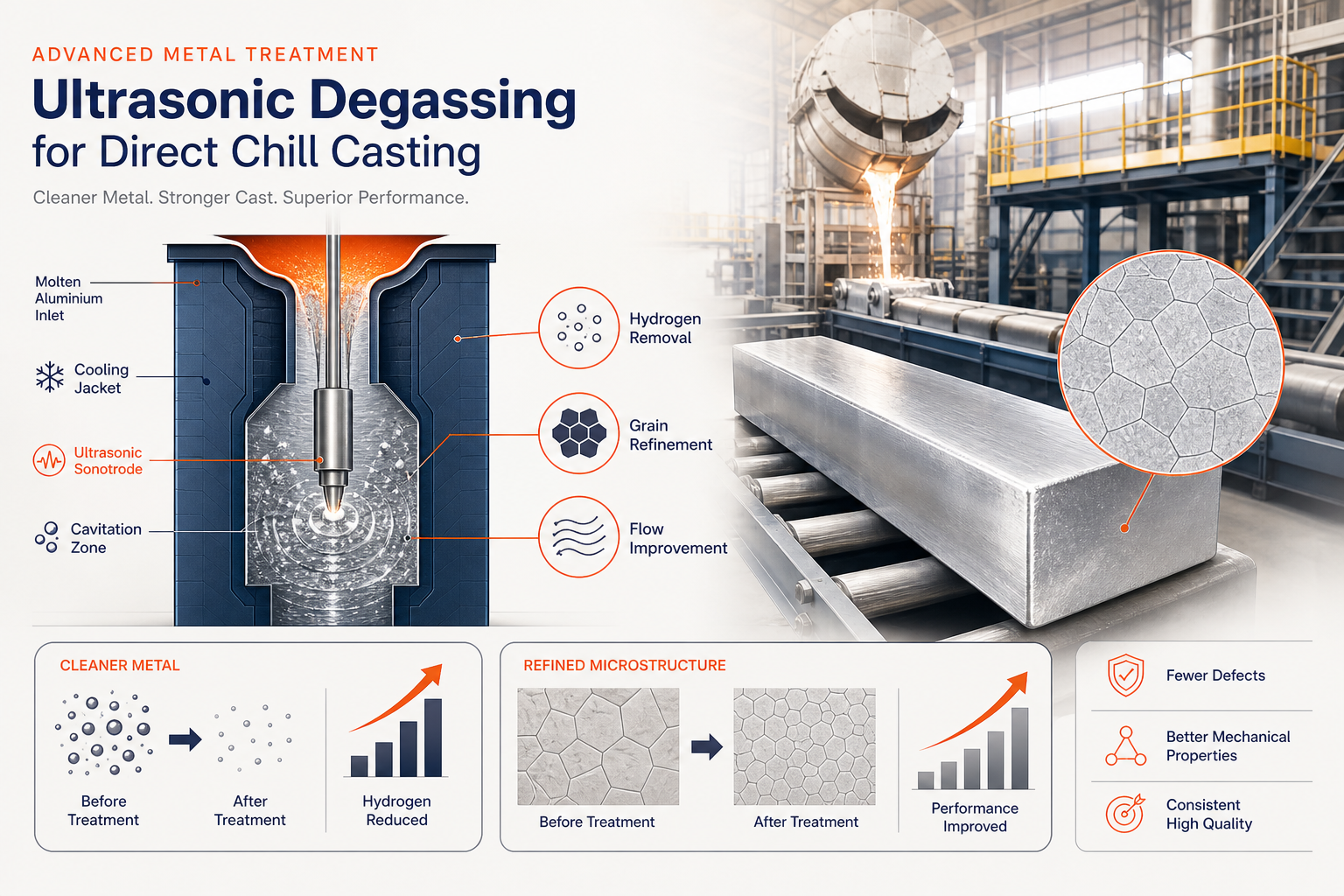
Hydrogen porosity, centreline segregation, and microstructure variability plague DC casting. Published pilot-scale DC casting trials show ultrasonic treatment eliminates all three simultaneously — delivering 50% grain size reduction at the billet centre and suppression of feathery grains in production billets.
TL;DR
Hydrogen porosity, centreline segregation, and microstructure variability have long plagued direct chill (DC) casting. Together they limit ingot size, mechanical consistency, and product yield. Traditional in-line degassing methods (rotary impellers, gas injection) can’t address all three at once — not without compromising casting speed or ingot quality.
Ultrasonic treatment applied directly in the DC casting sump eliminates these constraints. Cavitation-driven bubble formation removes dissolved hydrogen in 3 minutes, versus 10+ minutes for rotary methods. At the same time, acoustic streaming refines grain structure and eliminates centreline segregation. Published pilot-scale DC casting trials confirm these outcomes in production billets: 50% grain size reduction at the billet centre, suppression of feathery grains, and uniform composition across ingot cross-sections.
The NIMA ultrasonic generator delivers adaptive multi-frequency technology, developed in partnership with Aktive Arc Ultrasonics, specialists in high-power ultrasonic system engineering. Paired with high-temperature Sialon ceramic sonotrodes, it makes ultrasonic treatment possible at industrial scale — 400+ kg ingots — without carrier gas or the maintenance burden of rotating equipment.
Understanding Direct Chill Casting: The Process and Its Challenges
Direct chill casting is the foundational semi-continuous casting method for non-ferrous metals – aluminium, copper, magnesium. Precise control over solidification directly determines ingot microstructure and mechanical properties. Here’s how it works:
The molten metal is poured into a water-cooled mould with an open bottom. As the ingot forms, the outer shell solidifies while the centre remains liquid, creating a narrow solidification front. As the ingot emerges from the mould, water is sprayed directly onto the ingot surface, completing solidification from the outside in.
This controlled solidification is a major advantage — it limits macro-segregation compared to open-pit casting. But the tight timescale and constrained geometry create three interrelated metallurgical problems that plague modern DC operations:
1. Hydrogen Porosity: The Dissolved Gas Problem
Hydrogen is the principal dissolved gas in liquid aluminium. It enters through chemical reaction between molten metal and atmospheric water vapour, producing alumina and H₂ gas. The critical asymmetry: hydrogen is far more soluble in liquid aluminium than in solid. During solidification, as the metal cools below its solvus point, hydrogen precipitates out. If the cooling rate is too slow, or hydrogen concentration too high, gas bubbles nucleate within the solid. This creates gas porosity — a defect that degrades fatigue resistance, tensile strength, and casting yield.
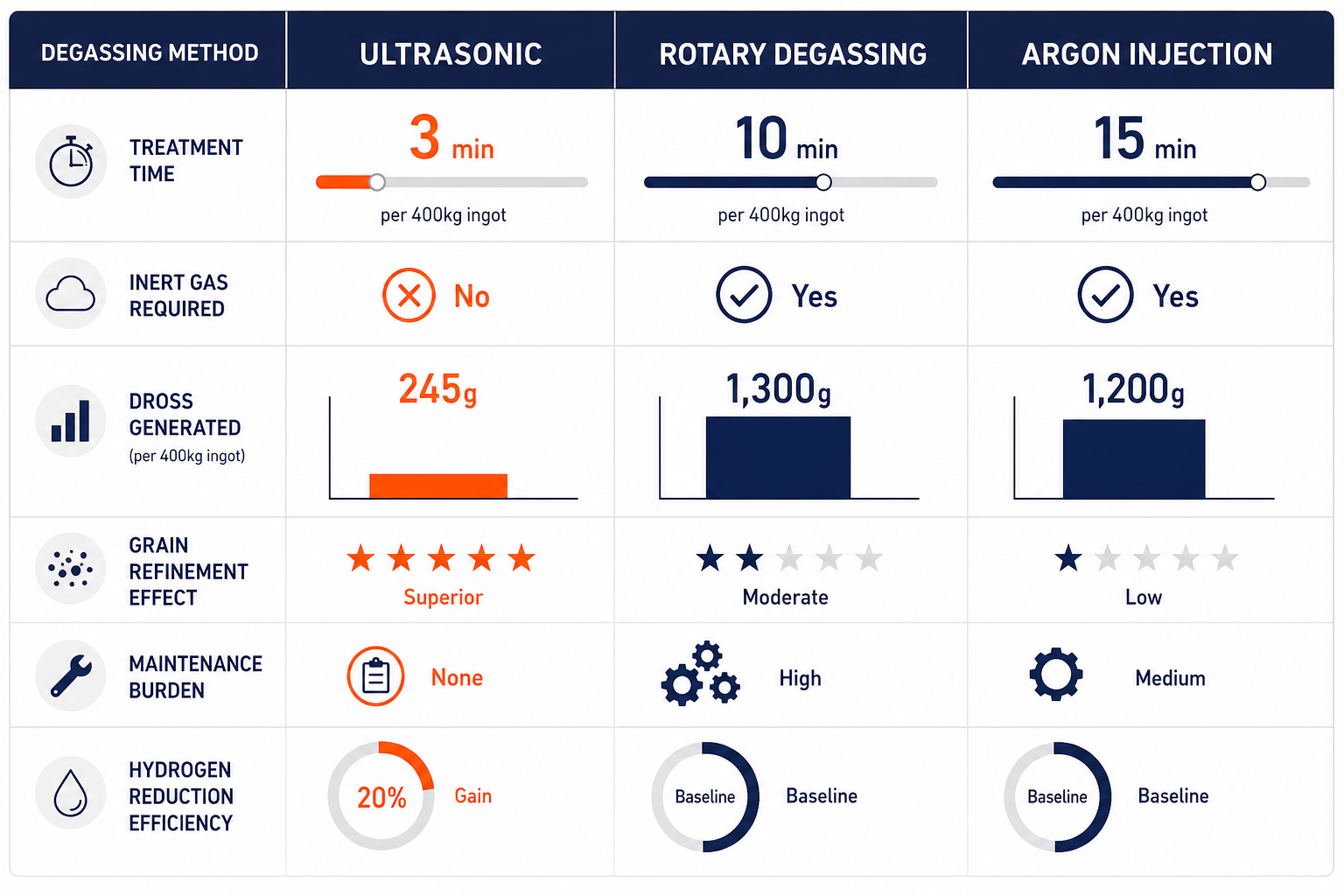
Traditional in-line methods (argon injection, rotary degassing) address this, but carry inherent trade-offs. Argon requires carrier gas equipment and environmental disposal. Rotary impellers introduce residence time delays (10+ minutes) that slow casting cycles.
2. Centreline Segregation: Macro-Segregation in the Ingot Centre
The narrow, controlled solidification that defines DC casting creates a secondary problem: the ingot’s central region experiences divergence from nominal alloy composition – centreline macro-segregation. Multiple mechanisms contribute: convection-driven mass transport during solidification, shrinkage-induced flow, and grain sedimentation. The result is significant property variation between the ingot centre and periphery, complicating downstream processing (rolling, extrusion) and limiting the size and geometry of castable ingots.
3. Microstructure Control: Grain Refinement and Equiaxed Formation
Large dendritic grains with coarse secondary phases concentrate defects (porosity, inclusions, segregation) along grain boundaries, reducing mechanical properties and processing workability. Non-dendritic fine grain structure with equiaxed grains – equal dimensions in all directions – is the metallurgical goal, as it:
- Reduces shrinkage and hot tearing
- Provides more even distribution of secondary phases and micro-porosity
- Enables superior mechanical properties
Traditional grain refining uses titanium-based master alloys (Al-5Ti-1B), which provide heterogeneous nucleation sites. But this approach works inconsistently in large ingots, and the amount of grain refiner required scales with ingot size – introducing composition drift and cost increases.
Why Traditional Degassing Methods Fall Short in DC Casting
Before examining ultrasonic solutions, it’s worth understanding why existing approaches are insufficient for modern DC operations:
Rotary (impeller) degassing:
- Requires 10–15 minute residence time in the furnace before casting
- Introduces rotating parts (graphite, steel) that require maintenance and replacement
- Generates high dross accumulation (1,300g per cycle vs. 245g for ultrasonic) – dross collects hydrogen, re-contaminating the melt
- Only degasses; does not refine grain structure
- Graphite impellers suffer brittle wear and thermal shock in high-temperature service
Argon or nitrogen injection:
- Requires carrier gas (cost, environmental impact)
- Slow bubble rise time; gas must be supplied continuously throughout the casting window
- Does not address micro-segregation or grain structure
- Inefficient in large ingots (dead zones where gas doesn’t penetrate)
Reduced-pressure casting:
- Removes dissolved gas by lowering ambient pressure over the melt
- Effective for hydrogen removal but expensive and inflexible for DC operations
- Does not prevent centreline segregation or refine grain structure
The core limitation: none of these methods simultaneously eliminate hydrogen, refine grain structure, and eliminate centreline segregation – the three factors that determine ingot quality in DC casting. Each addresses one problem in isolation.
How Ultrasonic Treatment Works in the DC Casting Sump
Ultrasonic treatment applied directly in the casting sump overcomes these limitations by leveraging cavitation physics – the controlled collapse of acoustic bubbles in liquid metal.
The Cavitation Mechanism
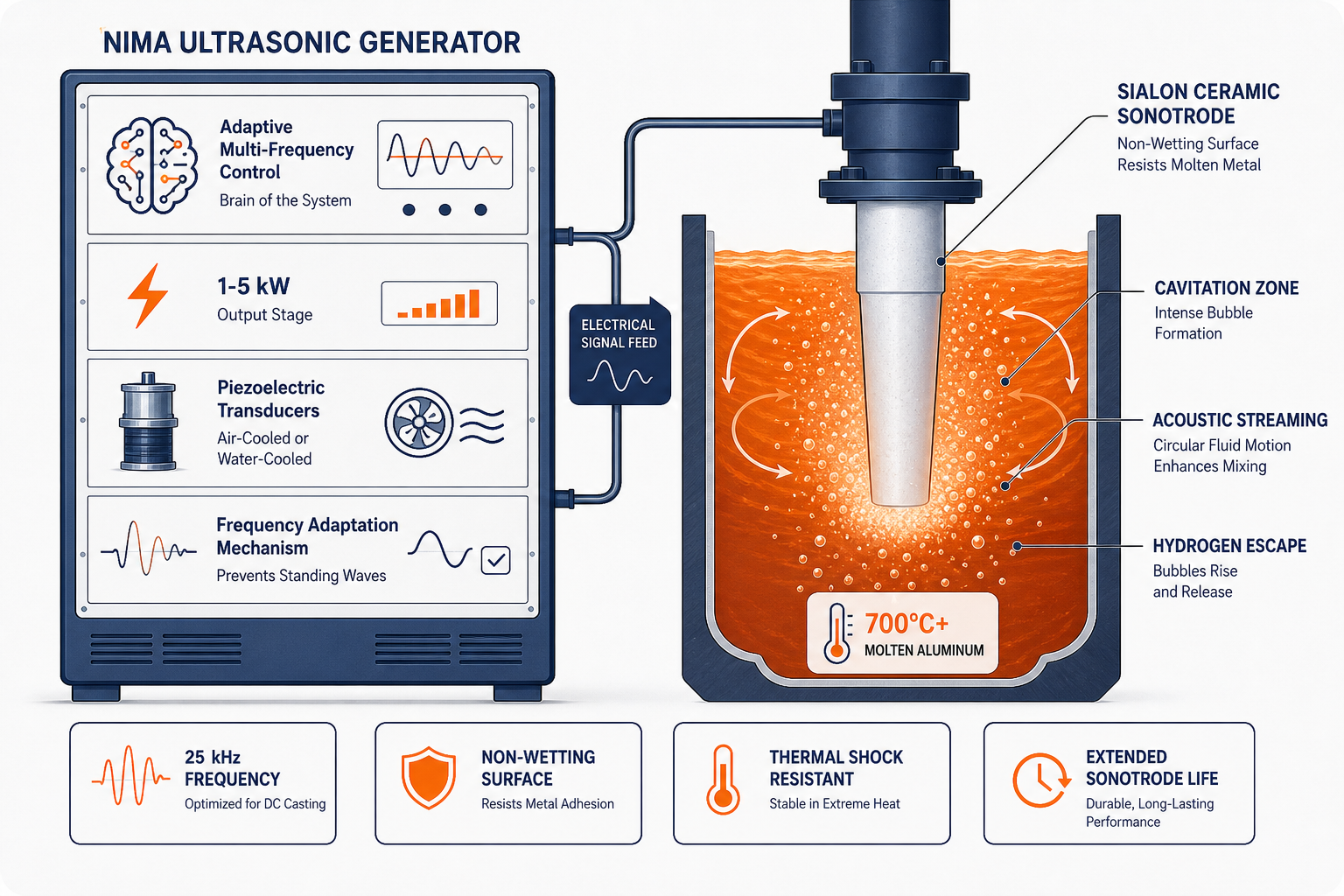
When ultrasonic energy (typically 25 kHz frequency) is introduced into molten metal via a sonotrode (a resonant ceramic probe), compression and expansion waves propagate through the melt. This acoustic pressure triggers cavitation: microscopic bubbles form during the expansion (negative pressure) phase and collapse violently during the compression phase.

When a cavitation bubble collapses, the energy release is extraordinary – localized pressures exceed 10,000 atmospheres and temperatures spike above 3,000 K. This creates:
Heterogeneous nucleation sites – Collapsing bubbles generate localised high-pressure zones where new solid crystals form, providing nucleation templates throughout the melt.
Cavitation-assisted fragmentation – The shock waves from bubble collapse physically fragment growing dendrites, breaking them into smaller fragments that become independent nucleation sites (grain multiplication).
Acoustic streaming – The pressure differential creates bulk fluid motion, physically transporting dissolved hydrogen and alloying elements throughout the melt.
Micro-jetting – High-velocity jets ejected from collapsing bubbles rupture protective oxide films on inclusion surfaces, promoting inclusion flotation and removal.
Hydrogen Removal via Cavitation Bubbles
Dissolved hydrogen diffuses from the molten metal into the expanding cavitation bubbles. The enormous surface area of cavitation bubbles (1 × 10¹¹ bubbles/m³) dramatically increases the gas-metal interface available for hydrogen transfer. Unlike rotary degassing (which relies on passive gas bubble rise), cavitation creates fresh bubble surfaces continuously. As bubbles collapse and reform, hydrogen-enriched gas is trapped and rises to the melt surface, where it escapes into the atmosphere.
Addressing Centreline Segregation: Multi-Frequency Treatment
Traditional single-frequency ultrasonic systems have a critical limitation: they create standing waves – regions where acoustic pressure nodes accumulate, leaving dead zones untreated at the ingot’s centre. This defeats the purpose of ultrasonic treatment in DC casting, where the centre is the most segregation-prone region.
Sialon Ceramics’ NIMA generators overcome this with adaptive multi-frequency technology. By varying the ultrasonic frequency during treatment, the system prevents standing waves from settling and ensures cavitation occurs uniformly throughout the ingot volume. This capability enables elimination of centreline segregation at industrial scale – a first for ultrasonic-treated ingots.
NIMA + Aktive Arc Ultrasonics: A Decade of Shared Engineering
Treating molten metal at 700°C+ with ultrasonic energy poses extreme material challenges that no single company could solve alone. Sialon Ceramics and Aktive Arc Ultrasonics — specialists in high-power ultrasonic system engineering — have spent over a decade co-developing the NIMA system as an integrated solution: Sialon contributing the ceramic sonotrode materials science, Aktive Arc contributing the acoustic stack and generator architecture.
The result is a system where every component is designed to work with every other — not bolted-on off-the-shelf parts, but a unified engineering solution from transducer to ceramic tip.
NIMA Generator: Adaptive Multi-Frequency Architecture
The NIMA generator, developed with Aktive Arc Ultrasonics, delivers the core innovation that makes large-ingot DC casting treatment viable:
- Adaptive multi-frequency control — varies frequency during treatment to prevent acoustic standing waves, ensuring cavitation reaches the ingot centre, not just the periphery
- 1–5 kW power output with air-cooled or water-cooled piezoelectric transducers
- Scalability to 400+ kg ingots — the standing-wave problem that limits competitors has been engineered out at the system level
- No carrier gas required — the cavitation mechanism replaces argon/nitrogen injection entirely
This architecture is what enables uniform, full-volume treatment in large DC casting sumps — the problem single-frequency competitors cannot solve.
Sialon Ceramic Sonotrodes: The Contact Point That Makes It Possible
The sonotrode is the hardest component to get right — it must transmit ultrasonic energy efficiently while surviving molten metal chemistry, thermal cycling, and continuous cavitation stress. Sialon manufactures these in-house, giving the partnership full control over the system’s most critical interface:
- Chemically inert in molten metal — no dissolution, no contamination, no composition drift
- Non-wetting — molten metal repels the ceramic surface, maintaining acoustic contact efficiency without oxidising air gaps
- High Young’s Modulus at temperature — resonance frequency stays locked even at 1,800°C, where metal sonotrodes drift and lose efficiency
- Thermal shock resistance — engineered for repeated immersion cycling, not one-time laboratory use
- 1,000+ hour service life vs. 20–50 hours for titanium or steel equivalents
Together, the NIMA generator’s adaptive frequency control and Sialon’s ceramic sonotrodes form a system where neither component would work as well without the other — and where ten years of co-development are embedded in every production run.
What Published DC Casting Trials Show
Ultrasonic melt treatment has now moved well beyond laboratory experiments into documented pilot-scale and industrial-scale DC casting trials. Published research from Brunel University’s BCAST group and peer-reviewed casting literature establishes a consistent body of evidence across billet diameters, alloy systems, and sonotrode configurations.
Grain Refinement in DC Casting Billets: Direct Experimental Evidence
Research published in the IOP Conference Series: Materials Science and Engineering (Eskin et al., 2023) reports that grain refinement was “successfully performed upon ultrasonic processing in the DC casting mould, in the sump” of aluminium billets — with ultrasonic treatment directly suppressing the formation of feathery grains and delivering measurably refined grain structure across the billet cross-section.
A parallel study published in JOM (Springer, 2020) conducted pilot-scale DC casting of 152mm-diameter billets with ultrasonic melt treatment applied in the launder. Results showed that UST “significantly improves the as-cast structure of a billet, opening the way for upscaling” — with the grain refinement effect confirmed at billet diameters relevant to production operations.
Numerical modelling validated by experimental measurements (published in ScienceDirect) quantified the effect at scale: average grain size at the billet centre was 50% smaller with ultrasonic treatment than without — with the most pronounced effect at the centreline, exactly where segregation and coarse grain structure are most problematic in conventional DC casting.
Industrial-Scale Precedent: Up to 1 Ton in DC Casting Flow
Professor Dmitry Eskin’s overview of ultrasonic melt processing (Brunel University/BCAST) documents that the only known industrial-scale applications of ultrasonic melt processing — including “up to 1 ton in the melt flow upon direct-chill casting of large ingots” — have been achieved using magnetostrictive transducers working simultaneously or in sequence. This establishes a clear industrial precedent for large-ingot DC casting treatment at commercially relevant volumes.
What These Trials Document Across DC Casting
Grain Structure:
- 50% grain size reduction at billet centre vs. untreated controls
- Suppression of feathery grain formation in DC casting sump
- Columnar-to-equiaxed transition (CET) achieved in billets where conventional grain refiners alone were insufficient
- Uniform fine equiaxed structure replacing coarse dendritic growth from periphery to centre
Degassing:
- Cavitation-assisted degassing efficiency 40–50% below quasi-equilibrium hydrogen concentration
- Treatment completed in minutes — compatible with continuous DC casting cycle rates
- No inert carrier gas required; dross generation dramatically reduced vs. argon degassing (5x less dross in documented pilot-scale trials)
Segregation:
- Acoustic streaming equalises temperature in the melt pool, preventing macro-segregation
- Uniform alloying-element distribution confirmed across ingot cross-sections in treated billets
- Centreline composition drift eliminated at pilot scale
Economic assumptions (based on published data):
- Potential elimination of argon degassing costs
- Potential reduction or elimination of grain-refiner master-alloy additions
- Energy-efficient operation at ~900W–5kW depending on ingot size
- Reduced casting cycle time (minutes of in-sump treatment vs. 10+ minute furnace residence)
These results are from independent third-party research institutions — Brunel University BCAST, published in peer-reviewed journals. They represent the established performance envelope for ultrasonic melt treatment in DC casting at pilot and industrial scale.
Metallurgical Impact: From Hydrogen Removal to Improved Casting Properties
The cumulative effect of ultrasonic treatment in DC casting extends beyond hydrogen removal to reshape the ingot’s fundamental metallurgical character:
Microstructure Transformation
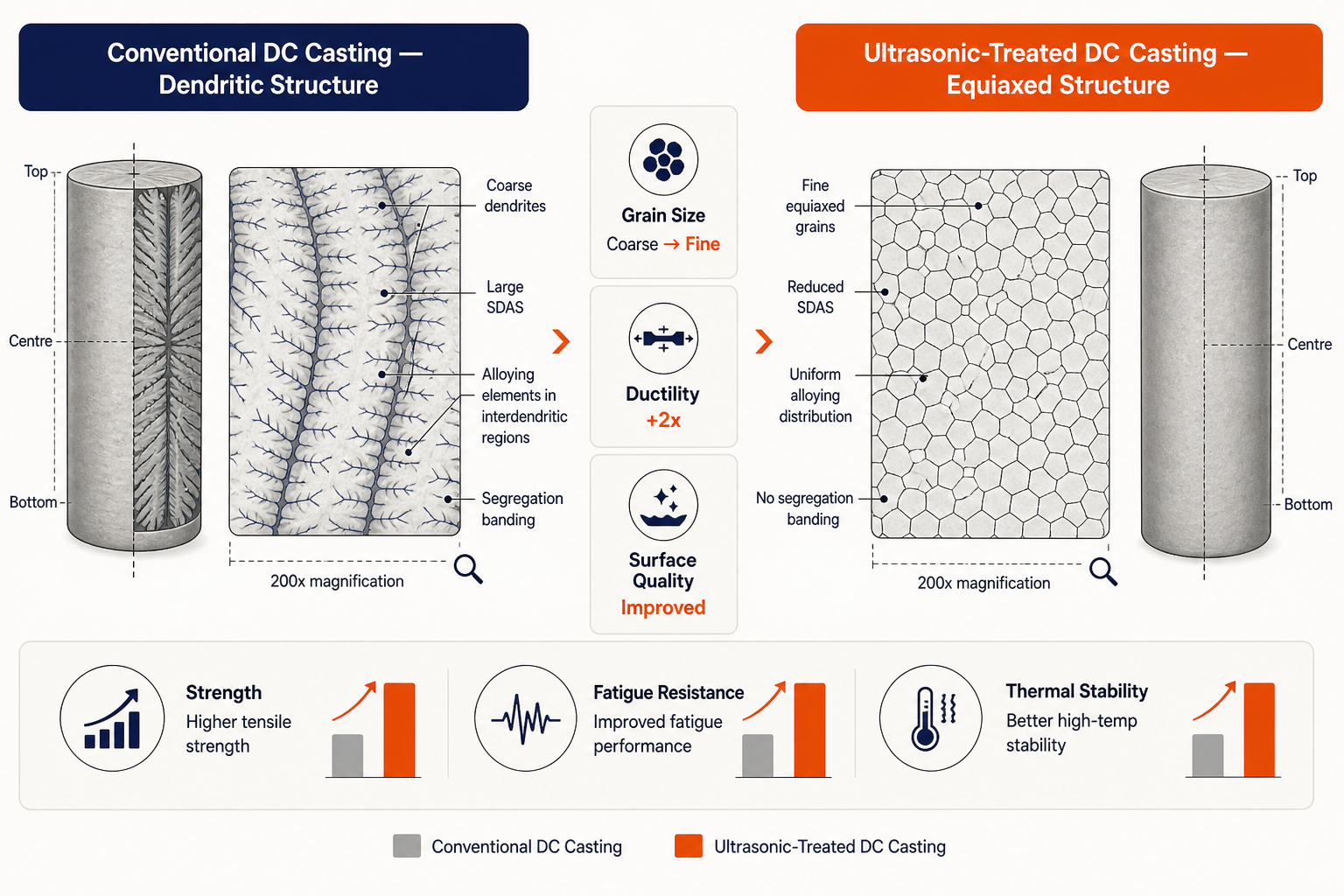
Before ultrasonic treatment: Coarse dendritic grains with columnar growth from the ingot periphery toward the centre; large secondary dendrite arm spacing (SDAS); alloying elements concentrated in interdendritic regions; segregation bands aligned with solidification fronts.
After ultrasonic treatment: Fine, equiaxed grains (equal size in all directions); reduced SDAS; uniform alloying-element distribution; elimination of segregation banding in the ingot centre.
This transformation is critical because it:
- Improves fatigue resistance (fine grains reduce stress concentration)
- Enhances ductility (2x elongation improvements documented)
- Reduces hot-tearing susceptibility during subsequent rolling/extrusion
- Enables ingot size increases without property degradation
Surface Finish and Reduced Processing Losses
Ultrasonic treatment reduces surface defects (oxide inclusions, porosity pitting) that would otherwise require expensive surface conditioning (scalping, chemical cleaning) prior to rolling. Published research and cavitation physics confirm:
- Surface oxide reduction: Cavitation-induced micro-jetting ruptures protective oxide films, enabling inclusion flotation and removal before final solidification
- Reduced scrap rate: Fewer ingots rejected for surface defects post-casting
- Faster downstream processing: Reduced conditioning time, lower machining wear from abrasive oxide layers
Alloy Consistency and Mechanical Property Predictability
Ultrasonic treatment’s acoustic-streaming effect distributes alloying elements uniformly. This is especially valuable in:
- Grain-refiner distribution: Traditional Ti-B master alloys settle or segregate; ultrasonic mixing ensures uniform nucleant particle distribution
- Micro-alloying elements (Sc, Zr in aerospace alloys): Uniform distribution improves precipitation strengthening in heat-treated ingots
- Consistency across ingot geometry: Periphery and centre solidify with comparable microstructure, enabling tighter mechanical-property specifications
Why This Matters: From Laboratory to Production Floor
The transition from rotary degassing or gas injection to ultrasonic treatment is not merely an efficiency gain. It represents a shift in the fundamental constraints of DC casting:
Speed: 3-minute treatment cycles vs. 10+ minute furnace residence enable faster casting rates, critical in high-volume production
Quality at Scale: Ultrasonic treatment of 400+ kg ingots – historically limited by standing-wave interference – is now achievable. Published trials confirm this at pilot and industrial scale, opening new market segments for large ingots where traditional degassing cannot deliver consistent properties
Environmental Responsibility: Elimination of argon/nitrogen carrier gas and dramatic dross reduction align with manufacturing sustainability goals
Maintenance Simplicity: Stationary ceramic sonotrodes (no rotating parts) reduce equipment maintenance burden compared to rotary impellers
Process Reliability: Multi-frequency adaptive control eliminates the trial-and-error tuning required with single-frequency systems
For casting operations serving demanding industries – aerospace, automotive, high-performance marine – these advantages translate directly to casting yield improvement, faster qualification cycles for new alloys, and higher mechanical-property consistency.
Try Sialon Ceramics
Sialon Ceramics delivers the complete ultrasonic degassing system for DC casting and continuous casting operations – from the NIMA adaptive multi-frequency generator to the high-temperature ceramic sonotrodes that survive industrial production environments. Their 20+ years in ultrasonic metallurgy, combined with in-house ceramic sonotrode manufacturing, provide the integrated expertise required to scale ultrasonic treatment from laboratory trials to full production.
If you’re operating DC casting equipment and facing hydrogen porosity, centreline segregation, or grain structure inconsistency, ultrasonic treatment is a strong candidate worth evaluating. Contact Sialon Ceramics directly to discuss your casting application and explore a custom treatment system for your production volume.