
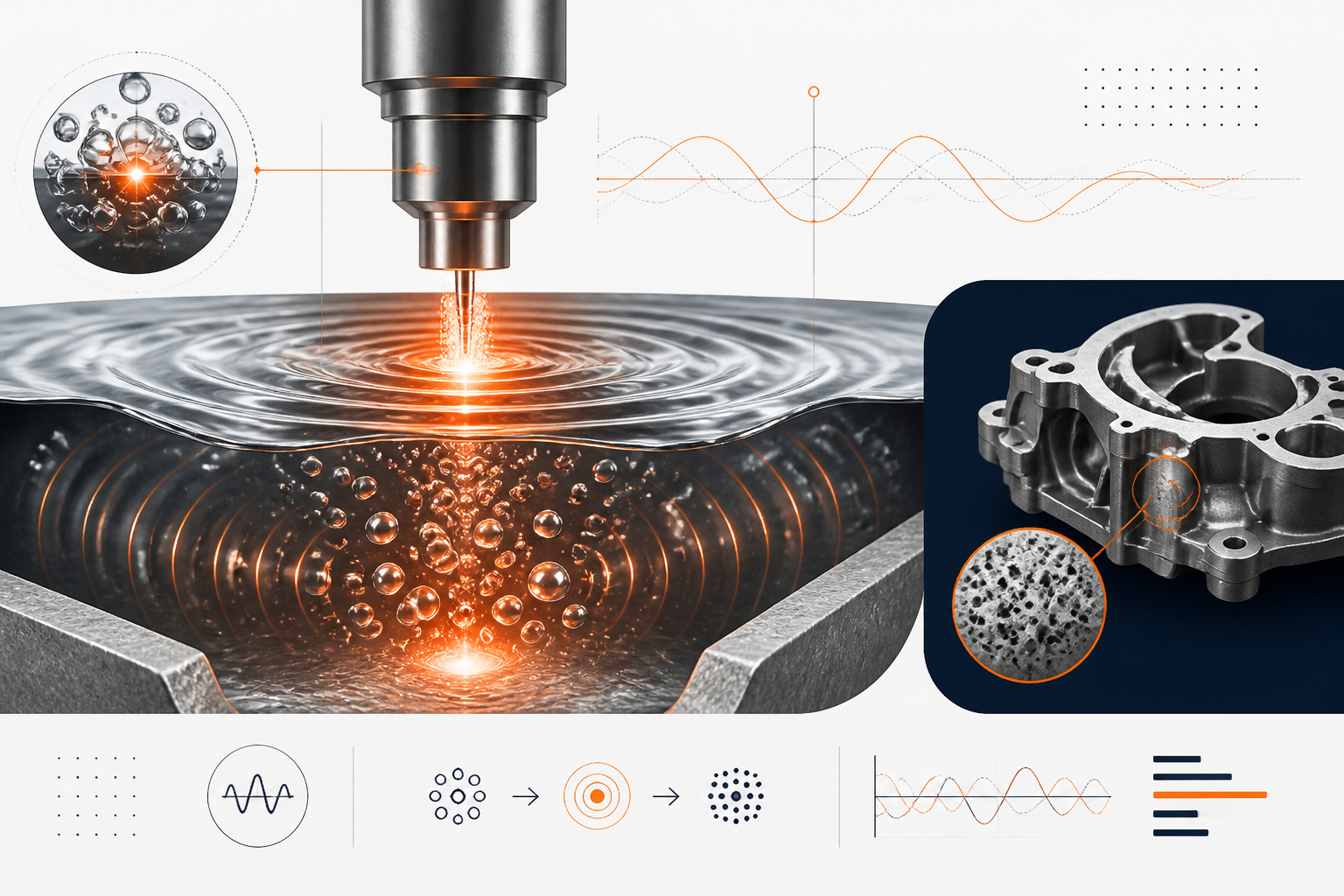
Hydrogen porosity weakens aluminum castings and drives quality failures. Ultrasonic cavitation creates 1 trillion microbubbles per cubic meter to extract dissolved hydrogen 20% faster than conventional methods, with 6-fold inclusion reduction and measurable strength gains.
August 8, 2026 · 9 min read
TL;DR
Hydrogen porosity remains one of the most critical defects in aluminum casting, compromising mechanical properties and creating costly scrap.While traditional methods like argon injection and vacuum treatment provide partial solutions, they require long treatment cycles. They also consume inert gases and generate significant waste.
Ultrasonic cavitation technology, developed in partnership with Aktive Arc Ultrasonics, offers a fundamentally different approach. The technology uses acoustic waves to create high-density microbubbles at approximately 1 × 10¹¹ m⁻³. These microbubbles provide extensive surface area for hydrogen diffusion. Acoustic streaming and jet flows also accelerate bubble rise and escape.
Industrial-scale studies show that ultrasonic degassing achieves 20% higher degassing efficiency in one-third the time compared with conventional methods. The process also delivers a 6-fold reduction in oxide inclusions and 81% less dross formation.
The result is higher-quality castings with 17% greater yield strength and 2–3× better elongation. Foundries also benefit from refined grain structures and improved production-scale porosity control.
What is hydrogen porosity and why it forms in aluminium casting
Hydrogen porosity-the formation of gas-filled voids within solidified aluminum-is a legacy defect with modern consequences. The physics is straightforward but relentless: molten aluminum is a hydrogen absorber. Water vapor in furnace atmospheres and atmospheric moisture reacts with the molten metal to produce dissolved hydrogen gas. At the melting point (~660°C for pure aluminum, 700°C typical for commercial alloys), hydrogen is highly soluble; the metal “wants” to hold onto it. But the moment solidification begins, hydrogen solubility drops sharply. The dissolved gas precipitates out of solution faster than it can escape, forming voids scattered throughout the casting matrix. These voids aren’t benign cosmetic defects-they’re fracture initiation sites. A casting riddled with hydrogen porosity exhibits:
- Reduced ultimate tensile strength (often 15–25% lower than intended)
- Catastrophic loss of elongation (ductility can drop to <1%)
- Fatigue crack initiation at void surfaces under cyclic loading
- Leak paths in pressure-containing or high-reliability components
- High scrap rates and downstream machining/inspection costs
In automotive high-pressure die-casting (HPDC), where shock towers, engine blocks, and ladder frames must meet ISO-grade property standards, hydrogen porosity is the primary cause of casting rejection at final quality gates. A single porosity cluster can invalidate an entire component, making prevention not a nice-to-have but an operational necessity.
Traditional prevention methods and their limitations
For decades, foundries have pursued three primary strategies to combat hydrogen porosity. Each offers partial protection, but all carry inherent trade-offs that modern ultrasonic technology addresses directly.
Argon sparging (rotary degassing)
Argon injection is the industry standard, deployed in foundries worldwide. A rotating graphite impeller disperses argon bubbles through the molten metal. Hydrogen atoms diffuse into these argon bubbles, which then rise and escape. In theory, elegant; in practice, compromised:
- Cycle time: 10–15 minutes per treatment to achieve acceptable density index (a measure of hydrogen content)
- Inert gas consumption: Significant volume of argon or nitrogen required, with disposal costs
- Graphite degradation: The rotor degrades over time, becoming brittle and requiring frequent replacement ($500–$2,000 per rotor, plus downtime)
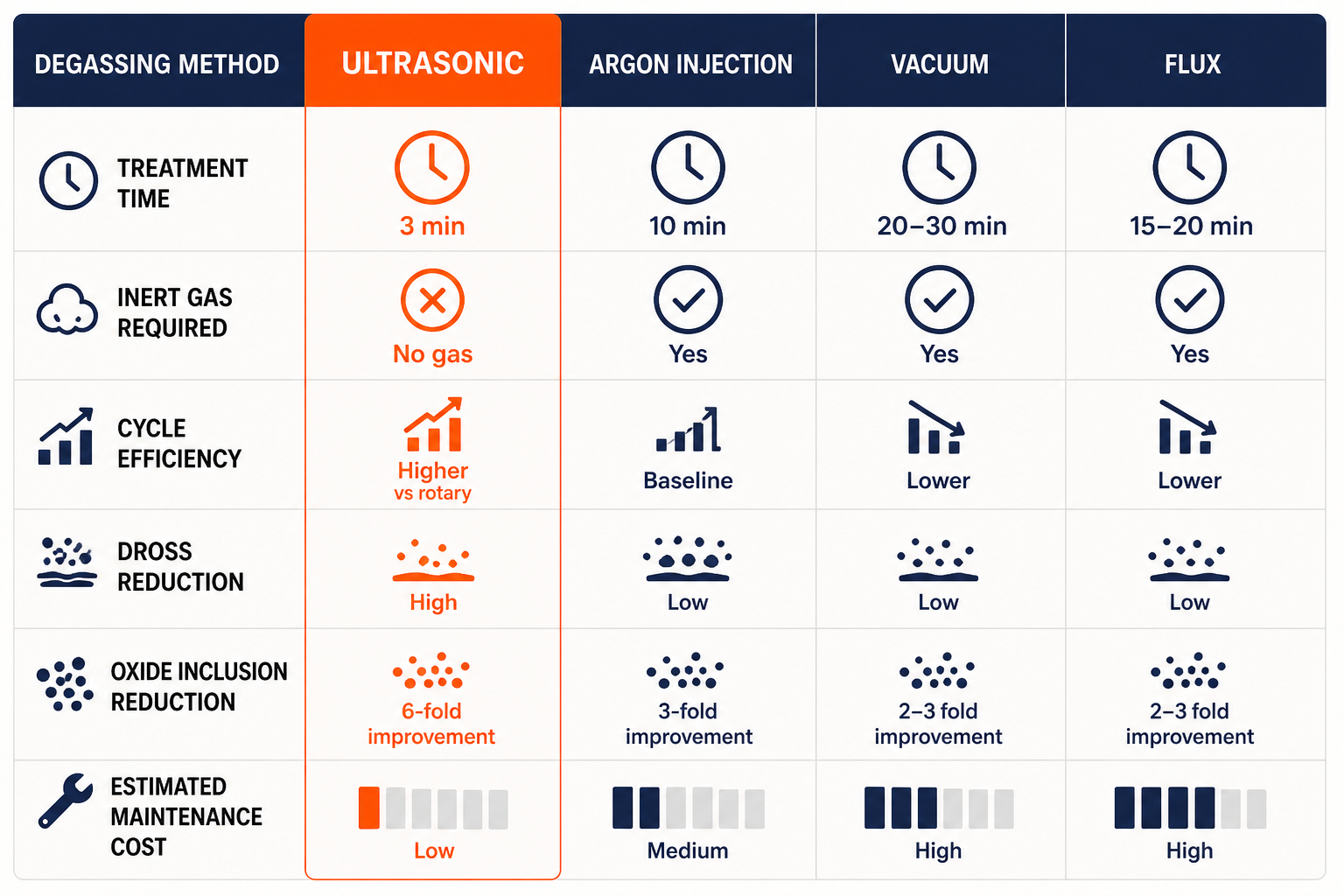
- Inclusion challenge: While hydrogen removal is reasonable, oxide inclusions remain-rotary methods achieve only 3-fold reduction in oxides vs. untreated melt
- Dross accumulation: Generates 1,300+ grams of dross per cycle; dross acts as a hydrogen reservoir through molecular adsorption above 600°C, risking re-contamination
Vacuum treatment
Reduced-pressure degassing attempts to sidestep hydrogen chemically by lowering the partial pressure of hydrogen in the furnace atmosphere. Vacuum chambers or vacuum-assisted casting molds are used to pull dissolved gases out of the melt:
- Equipment cost: Vacuum systems are capital-intensive
- Limited scalability: Vacuum degassing works well at lab scale or small furnace volumes; industrial 400+ kg melts present thermal and chamber-size constraints
- Incomplete removal: Hydrogen doesn’t escape cleanly under vacuum alone-solidification under reduced pressure helps, but doesn’t eliminate dissolved hydrogen in the melt itself
- Process fragility: Small leaks in vacuum seals degrade effectiveness; maintenance and monitoring are rigorous
Fluxing
Chemical flux additives (typically chlorine- or fluorine-based compounds) are introduced to the molten metal to release gases that strip hydrogen from the aluminum:
- Chemistry-dependent: Effectiveness varies with alloy composition, melt temperature, and flux selection
- Inclusion trade-off: While some fluxes reduce hydrogen content, they can introduce new inclusions (salt residues) that require additional removal steps
- Limited portability: Fluxing alone doesn’t address porosity formation during solidification-it’s most effective as a pre-treatment paired with vacuum or rotary degassing
- Environmental concern: Chlorine and fluorine release during heating raises air-quality and workplace-safety flags
The common thread: All three methods treat symptoms. They attempt to get hydrogen out of the melt or reduce its solubility, but they’re slow, consume resources, generate waste, and fall short on inclusion control. None fundamentally alter the thermodynamics of hydrogen precipitation during solidification.
The ultrasonic cavitation mechanism: engineering hydrogen out
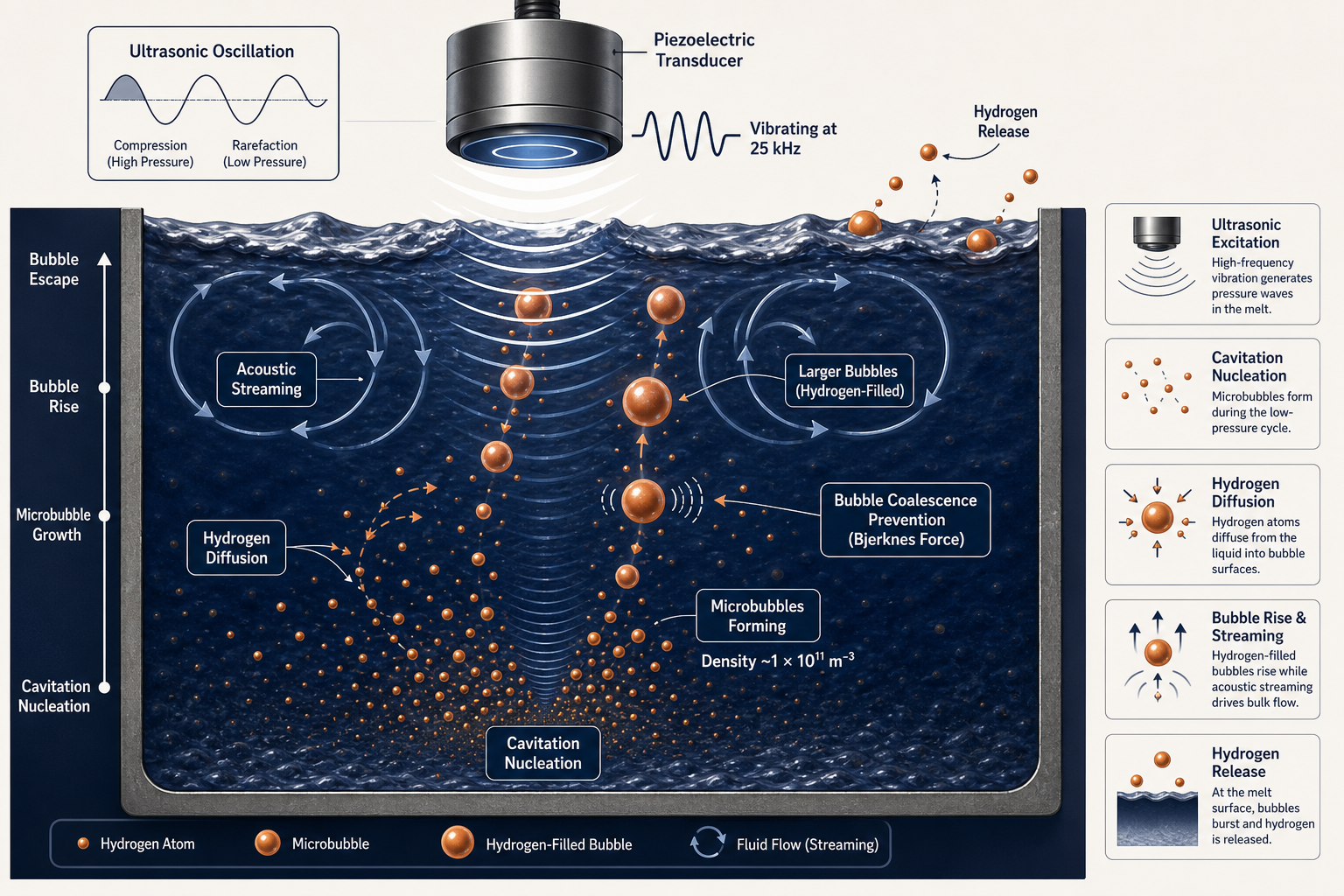
Ultrasonic degassing takes a radically different path. Instead of wrestling with hydrogen chemistry, it harnesses the physics of cavitation-the formation and collapse of microscopic bubbles under acoustic pressure waves. When a piezoelectric transducer vibrates at 25 kHz (a frequency optimized for cavitation in molten metals), it generates acoustic pressure cycles. During the low-pressure half-cycle, the pressure in the liquid drops below the saturated vapor pressure, and voids appear-cavitation bubbles. These bubbles then collapse violently under the high-pressure half-cycle, releasing enormous energy and creating the conditions for hydrogen removal on an entirely different scale.
Microbubble nucleation and population density
Here’s the critical insight: ultrasonic cavitation creates bubble populations of extraordinary density-approximately 1 × 10¹¹ bubbles per cubic meter. This is not approximate; it’s been measured via synchrotron X-ray imaging of cavitation collapse dynamics in molten aluminum. Each bubble is microscopic (typically 50–500 micrometers), and each one represents a “diffusion site” where hydrogen atoms can migrate. Compare this to rotary degassing: an impeller creates bubbles of millimeter to centimeter scale, far fewer in number, with orders of magnitude less total surface area. The ultrasonic advantage is quantified: the cavitation bubble population provides ~1,000× more surface area for hydrogen diffusion than conventional bubble clouds.
Hydrogen atoms, dissolved in the molten aluminum surrounding each microbubble, are thermodynamically “pushed” toward these bubble surfaces through concentration gradients. Once at the bubble surface, they recombine into molecular hydrogen (H₂) and cross the gas-liquid interface, entering the bubble interior. The bubble now carries hydrogen that it didn’t have before-and crucially, this hydrogen will rise with the bubble rather than remain dissolved in the metal.
Acoustic streaming: bulk fluid motion and distribution
Cavitation doesn’t happen in isolation. The violent energy release from bubble collapse generates what’s known as acoustic streaming-a persistent, directed flow of the liquid metal induced by the acoustic waves. This isn’t turbulence; it’s a steady circulation pattern that sweeps through the entire melt volume.
Acoustic streaming serves two critical functions:
- Uniform treatment: Without it, cavitation would be localized near the sonotrode (the vibrating horn in contact with the melt). Streaming ensures that hydrogen-rich metal from throughout the furnace volume is continuously refreshed into the high-cavitation zone, then transported away. Every region of the melt experiences degassing action, not just areas immediately adjacent to the sonotrode.
- Bubble transport: Streaming doesn’t just transport dissolved hydrogen-it accelerates the rise velocity of hydrogen-filled bubbles, cutting the time they spend in the melt and reducing the risk that hydrogen re-dissolves during bubble ascent.
Hydrogen diffusion into bubbles: a cascade process
The microbubble population and acoustic streaming create a cascade of hydrogen removal:
- Phase 1 (0–1 minute): High-concentration gradient between dissolved hydrogen and bubble interior drives rapid diffusion into the first generation of cavitation bubbles. Density index (a direct measure of hydrogen porosity risk) drops steeply.
- Phase 2 (1–2 minutes): As initial bubbles rise and escape, new cavitation bubbles form continuously (the 25 kHz transducer is vibrating at 25,000 cycles per second). Each new bubble population continues diffusing hydrogen from the surrounding metal. Acoustic streaming refreshes hydrogen-rich metal back into the cavitation zone.
- Phase 3 (2–3 minutes): Dissolved hydrogen concentration reaches a plateau-further removal becomes slower as the driving concentration gradient flattens. This is the natural endpoint of a 3-minute treatment cycle.
Industrial studies show a 75% reduction in density index (hydrogen content) in just 3 minutes, compared to a 56% reduction from rotary degassing in 10 minutes-a 20% efficiency gain accomplished in one-third the time.
Bubble rise and escape: jet streams and oxide removal
Here’s an unexpected bonus: when cavitation bubbles collapse, they generate intense jet streams-localized flows with velocities reaching hundreds of meters per second. These jets are powerful enough to rupture the protective oxide films that coat aluminum oxide inclusions (Al₂O₃) on inclusion surfaces.
Oxide inclusions are sticky-they’re held together by weak intermolecular forces and surrounded by protective oxide films that resist attachment to rising gas bubbles. In rotary degassing, inclusions remain largely suspended in the melt or sink. In ultrasonic degassing, cavitation jets rupture these films, allowing inclusions to attach directly to rising hydrogen bubbles and float to the surface as part of the dross. PoDFA analysis (Porous Disc Filtration Apparatus, a quantitative inclusion measurement) shows a 6-fold reduction in aluminum oxide content-compared to 3-fold for rotary degassing.
The result is a melt not just depleted of hydrogen, but also stripped of oxide inclusions that would otherwise remain and become porosity nucleation sites during solidification.
Practical outcomes: quality gains from ultrasonic treatment
The physics translates directly to measurable improvements in cast component quality and mechanical performance. Here’s what foundries observe when they transition from rotary degassing to ultrasonic treatment:
Reduced porosity and improved density
An industrial-scale study on 400 kg Al-Si-Cu alloy melts (the benchmark aluminum-silicon-copper composition used in automotive HPDC) compared ultrasonic treatment to conventional impeller+nitrogen degassing:
Density Index Results (direct measure of hydrogen content):
- Ultrasonic: 10.3% → 2.6% in 3 minutes (75% reduction)
- Rotary (impeller+N₂): 10.5% → 4.6% in 10 minutes (56% reduction)
This 20% efficiency gain is the direct consequence of the 1,000× greater bubble surface area and acoustic streaming-driven diffusion. The 3-minute cycle time means a foundry can treat 8 melts per hour instead of 6-immediate throughput advantage-while producing denser, more reliable castings.
Additionally, dross formation dropped 81% (from 1,300 g to 245 g per cycle). Because dross acts as a hydrogen sink, lower dross formation prevents hydrogen re-contamination during the cooling phase-a subtle but critical win for melt stability.
Increased strength and ductility
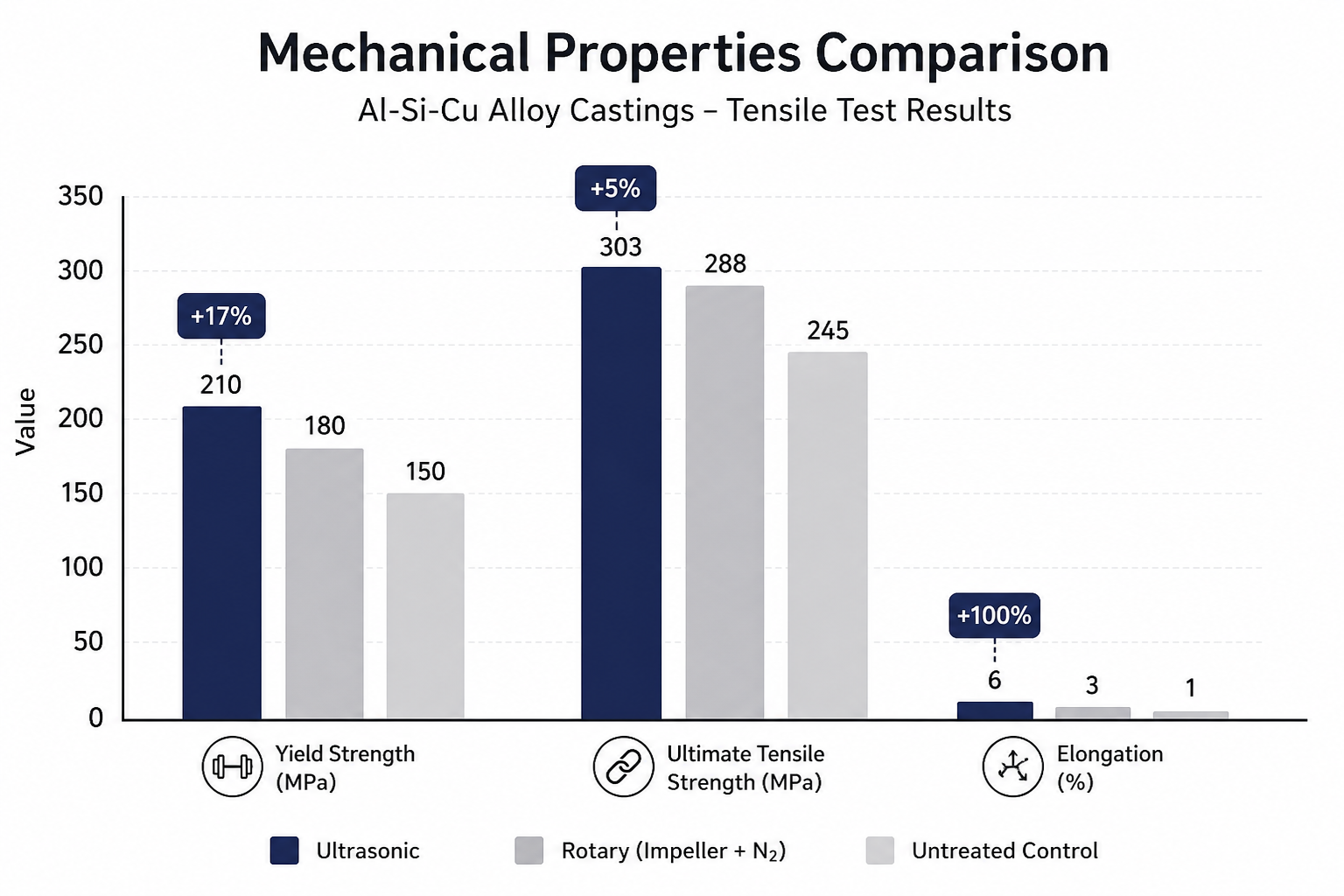
Reduced porosity isn’t merely a density metric; it manifests as real mechanical strength. Tensile testing of cast components produced from ultrasonic-treated melts versus rotary-treated melts revealed:
| Property | Ultrasonic-Treated | Rotary-Treated | Improvement |
|---|---|---|---|
| Yield Strength (YS) | 210 MPa | 180 MPa | +17% |
| Ultimate Tensile Strength (UTS) | 303 MPa | 288 MPa | +5% |
| Elongation | 6% | 3% | +100% |
The 17% yield strength gain is substantial for structural applications. Elongation-the measure of ductility-jumped from 3% to 6%, doubling the metal’s ability to absorb deformation before fracture. This is the practical benefit of fewer porosity initiation sites: the material no longer fails prematurely at void surfaces under load.
Microstructure refinement and surface finish
Beyond hydrogen control, cavitation-driven acoustic streaming has a secondary benefit: it induces heterogeneous nucleation during solidification, resulting in finer, more uniformly oriented grain structures. Microstructural analysis from industrial casts showed:
- Decreased intermetallic particle size (intermetallics are brittle phases; smaller size = higher toughness)
- Refined grain boundaries (equiaxed, rather than columnar, grain growth)
- Reduced centerline segregation (more uniform alloy distribution through the casting volume)
This grain refinement effect is a free bonus alongside hydrogen removal-rotary degassing doesn’t deliver it. For thin-walled or complex-geometry castings, the refined microstructure allows engineers to reduce wall thickness or add detail that would otherwise be at risk of failure.
Surface finish also improves. With fewer subsurface voids and inclusions, castings require less finishing work, and the finished surfaces are more consistent. For cosmetic or tight-tolerance components, this reduces secondary machining costs.
Why ultrasonic treatment is the cleanest and most efficient industrial solution
When weighing degassing approaches against real production constraints, ultrasonic cavitation emerges as the clear efficiency leader across multiple dimensions:
Speed and throughput
3 minutes versus 10+ minutes is a 65% cycle-time reduction. For a high-volume HPDC foundry processing 50+ melts per shift, this translates directly to increased casting output. At scale, a single ultrasonic system can often replace two rotary systems, reducing capital footprint and maintenance burden.
Environmental impact
No inert gas required. Rotary degassing consumes argon or nitrogen-gases that, while inert, still carry extraction, liquefaction, storage, and disposal costs. Ultrasonic treatment requires only electricity and water cooling for the transducer. A foundry switching from rotary to ultrasonic eliminates annual inert-gas procurement, storage risk, and atmospheric release. For operations in regions with environmental compliance mandates around gas emissions, this advantage is material.
Additionally, 81% lower dross formation means far less waste to dispose of. Dross is classified as hazardous (it can contain aluminum-metal particles that react exothermically with moisture) and requires controlled disposal. Less dross = lower environmental liability.
Maintenance and durability
Ultrasonic systems employ proprietary ceramic sonotrodes rather than graphite rotors. Ceramics are non-wetting (molten aluminum doesn’t adhere to them), hard, and thermally stable. Graphite rotors, by contrast, wear, degrade in the melt, and can fracture under thermal shock. Ultrasonic sonotrodes operate in a stationary or slowly-moving position (2 rpm rotation in the latest systems), eliminating the rapid wear from high-speed rotation (750 rpm in rotary systems). Field data shows ceramic sonotrodes last 3–5× longer than graphite rotors, reducing replacement frequency and operational downtime.
Inclusion control
The 6-fold reduction in oxide inclusions versus 3-fold for rotary degassing directly translates to fewer casting defects downstream. Fewer internal voids and inclusions mean fewer rejected components at final quality gates, lower scrap rates, and more consistent mechanical properties across batches. For automotive suppliers working under strict ISO standards, this consistency is a competitive advantage.
Scalability
At 400 kg per treatment, ultrasonic systems have proven they can handle industrial-scale melts-twice the previous record for ultrasonic treatment and comparable to the largest rotary systems. The “no standing waves” generator architecture (proprietary to leading ultrasonic equipment makers) ensures uniform treatment even at this scale, eliminating dead zones and inconsistent results that plagued earlier ultrasonic equipment. This scalability removes the old objection that ultrasonic degassing was a “lab-scale” technology.
Total cost of ownership
When capital cost, operating cost, maintenance, scrap reduction, and throughput are tallied, ultrasonic treatment typically achieves lower cost per treated melt than rotary degassing within 12–24 months of operation. The speed and quality improvements compound the advantage.
The modern approach to industrial porosity control
Hydrogen porosity hasn’t disappeared because it’s a thermodynamic fact, not a limitation of current technology-but ultrasonic cavitation comes closer to engineering it away than any competing method. The combination of unprecedented bubble density, acoustic streaming, and oxide-removal jet streams addresses porosity control from multiple angles simultaneously: fast hydrogen removal, minimal dross, refined grain structure, and measurable mechanical property gains.
For foundries facing rising quality standards, tight cycle times, and pressure on costs, ultrasonic degassing represents the state of the art in production-scale metal treatment. It’s the cleanest (no inert gas, minimal waste), fastest (3 minutes), and most effective (20% efficiency gain, 6-fold inclusion reduction, +17% strength) solution available today.
Try Ultrasonic Degassing & Grain Refinement
Ultrasonic Degassing & Grain Refinement is the Denmark-based specialist in high-temperature ultrasonic metal treatment, operating at temperatures up to 1,800°C. Their proprietary NIMA generators — developed alongside system integration partner Aktive Arc Ultrasonics — use 25 kHz “no standing waves” architecture to ensure uniform cavitation across melt volumes up to 400 kg-eliminating dead zones and delivering the consistent, measurable porosity reduction detailed throughout this article. Paired with durable ceramic sonotrodes (engineered to outlast graphite alternatives by 3–5×), Ultrasonic Degassing’s system handles degassing, grain refinement, and micro-alloying in a single treatment pass. For foundries ready to transition from conventional argon injection to production-ready ultrasonic technology, they offer free technical webinars and direct consultation to evaluate your specific alloy, melt volume, and quality targets.
Frequently Asked Questions
What is hydrogen porosity and why does it matter in aluminum casting?
Hydrogen porosity refers to gas-filled voids that form when dissolved hydrogen precipitates out of solution during aluminum solidification. These voids are fracture initiation sites that reduce mechanical properties by 15–25%, causing casting rejection at quality gates. In automotive HPDC applications (shock towers, engine blocks), hydrogen porosity is the primary cause of component failure. Prevention is essential for structural integrity.
How does ultrasonic degassing work compared to traditional argon injection?
Traditional rotary degassing uses an impeller to disperse argon bubbles (10–15 minute cycle, significant gas consumption). Ultrasonic treatment uses acoustic waves at 25 kHz to create 1 trillion microbubbles per cubic meter in just 3 minutes. The 1,000× greater bubble surface area enables 20% faster hydrogen removal, while acoustic streaming and cavitation jet streams also remove oxide inclusions-a benefit rotary degassing doesn’t provide. Industrial studies confirm 20% superior efficiency in one-third the time.
What are the measurable mechanical property improvements from ultrasonic treatment?
On 400 kg Al-Si-Cu alloy castings, ultrasonic-treated components showed yield strength +17% (210 MPa vs. 180 MPa for rotary), ultimate tensile strength +5% (303 MPa vs. 288 MPa), and elongation doubled (6% vs. 3%). These gains stem from fewer porosity sites and refined microstructure. For automotive suppliers working under strict ISO standards, this consistency directly improves defect rates and production throughput.
How does dross formation affect hydrogen re-contamination?
Dross-the byproduct of metal treatment-acts as a hydrogen accumulator through molecular adsorption, particularly above 600°C. Rotary degassing generates 1,300+ grams of dross per cycle, providing a hydrogen reservoir that can re-contaminate the melt. Ultrasonic treatment produces 81% less dross (245 g vs. 1,300 g), eliminating this re-contamination risk and maintaining clean melt conditions longer. This is a critical advantage for high-reliability castings where hydrogen levels must stay low through casting and solidification.
What about environmental and cost benefits of ultrasonic versus rotary degassing?
Ultrasonic systems require no inert gas (eliminating argon/nitrogen procurement and waste), generate 81% less dross (lower disposal liability), and achieve 65% faster cycle times (3 min vs. 10 min), boosting foundry throughput. Ceramic sonotrodes last 3–5× longer than graphite rotors, reducing maintenance costs. Total cost of ownership typically favors ultrasonic treatment within 12–24 months of operation. For foundries facing environmental compliance mandates, the elimination of inert gas consumption is a material regulatory and operational advantage.